Solaris Doubles The EPS Consensus And Raises Guidance Again, But A Services-Heavy Mix Thins Margins And The Stock Has Gone Nowhere
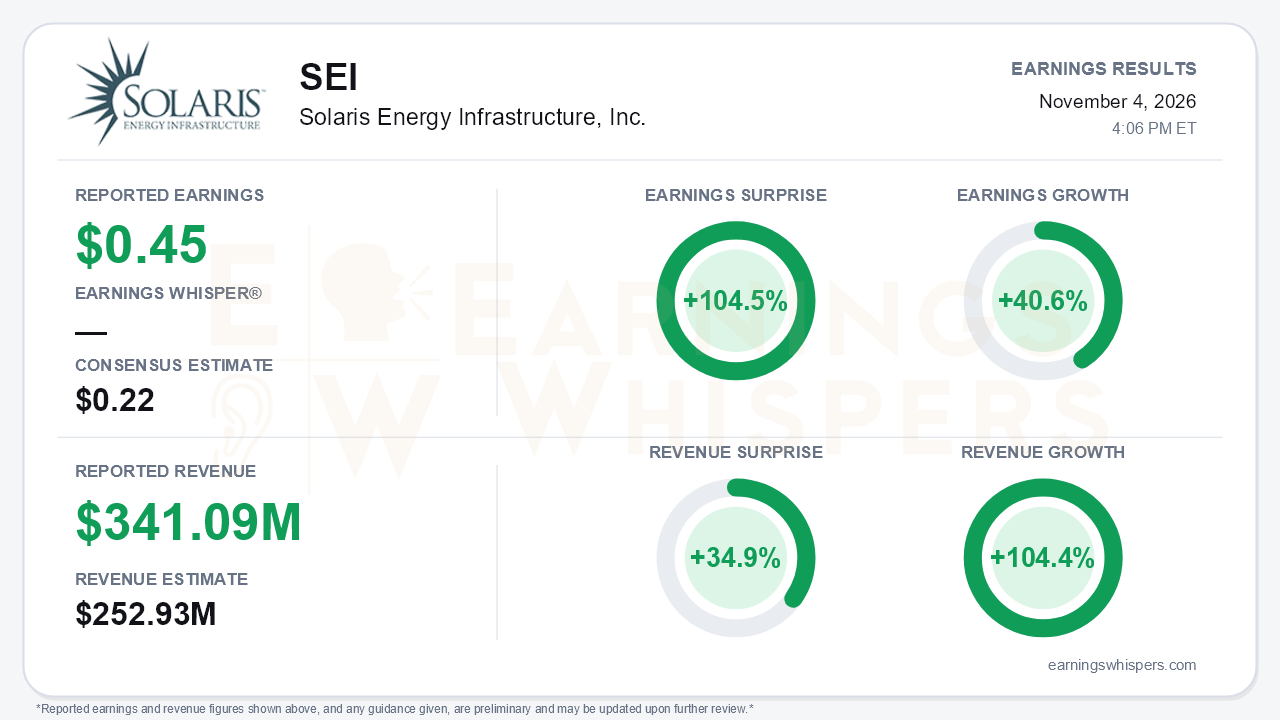
Solaris Energy Infrastructure delivered a decisive beat. Adjusted pro forma earnings of $0.45 per share more than doubled the $0.22 consensus, a 104.5% surprise. Revenue of $341.09 million topped the $252.93 million estimate by 34.9%. Revenue grew 104.4% year over year, and earnings rose 40.6%. Management raised fourth-quarter 2026 Adjusted EBITDA guidance to $165-185 million from $145-180 million and first-quarter 2027 guidance to $220-260 million from $200-240 million. It also signed its largest and longest power contract yet. Yet the gap between revenue growth and earnings growth is the central tension. The top line is accelerating faster than profitability, and the quality of that acceleration deserves scrutiny.
The composition of revenue changed sharply. Service revenue nearly doubled sequentially to $199 million from $112 million. Product sales jumped to $51 million from just $2 million. Leasing revenue, the long-duration core of the power-rental thesis, fell to $90.6 million from $105.7 million. Sequential revenue growth of 55% marked a sharp acceleration from the roughly 12% pace between the first and second quarters. Adjusted EBITDA growth of 26% was essentially in line with the prior quarter's pace rather than faster. Power Solutions segment EBITDA rose 32% on 79% revenue growth, so segment margin compressed meaningfully as lower-margin services and equipment sales took a larger share. Below EBITDA, interest expense climbed to $22.9 million from $16.9 million, and depreciation and amortization rose to $51.5 million. The pro forma diluted share count grew to 96.4 million from 81.3 million a year ago. On a GAAP basis, diluted EPS was $0.42 versus $0.31 a year earlier, a solid gain but far less dramatic than the revenue line.
The call supplied the long-duration counterweight. Contracted capacity under long-term agreements now stands at 3.2 GW. That compares with more than 2 GW in the first quarter and about 1.4 GW at the end of 2025. Backlog exceeds $16 billion, with an average term of roughly 11 years. The new 900 MW agreement carries a 15-year term with a 15-year extension option and comes from an existing investment-grade customer. Deployments are expected to begin in the first half of 2027. Management lifted its run-rate Adjusted EBITDA potential to about $1.6 billion, up from more than $1 billion two quarters ago. It also reiterated that 2027 Adjusted EBITDA should more than double 2026. The Omega and GESA acquisitions are performing better than expected, and the services arm now operates about 3 GW of third-party-owned power. That makes services a capital-light growth leg rather than mere filler. Management's tone was notably expansive; it described the company as never having been in a better position.
Bears still have legitimate ammunition. Average megawatts earning revenue fell 14% sequentially to 820 MW as temporary third-party units rolled off ahead of owned capacity under long-term contracts. That transition is planned, but it leaves a near-term volume gap. Management acknowledged that services revenue is lumpy, with limited visibility beyond first-quarter 2027 guidance. Logistics revenue slipped 7% on lower last-mile activity. Funding needs are also climbing:
- Quarterly capex reached $547 million.
- Capex expected through 2029 rose by about $600 million.
- Debt attributable to Solaris climbed to $2.4 billion from $973 million at year-end.
Management says the company is fully funded after the $1.25 billion notes deal, and its $850 million revolver is undrawn. Two further disclosures add risk. Contracts include termination-for-convenience clauses, under which customers would pay 50% of undiscounted future revenue and Solaris would keep the equipment. Customer concentration can reach about 35% of expected EBITDA per customer. Post-election political backlash against data centers also pressured the stock. Management countered that its contracts are not site-specific and that little capacity sits in Texas.
The market has not rewarded the operating momentum. At $57.64, shares were essentially flat, down 0.6%, from the $58.00 open following the August report. They sat 9.3% below the 200-day moving average of $63.56. Investor sentiment remained slightly negative and edged lower, from -0.060 to -0.071, which is a modest shift rather than a capitulation. Shorter-term price, sequential-growth and AVWAP trend readings are positive. That suggests some stabilization even as the stock lags its longer-term average.
The bottom line is that Solaris produced a beat and raise that turnaround-style skeptics would struggle to dismiss. Contracted capacity, backlog and run-rate EBITDA potential all stepped up again. The headline, however, masks a mix shift toward lumpier, lower-margin services and product revenue, along with a temporary dip in revenue-earning megawatts and a rising debt and capex load. Until owned long-term capacity ramps in 2027 and margins recover alongside revenue, investors appear willing to wait for execution rather than pay up for the guidance.
Read our earnings preview for Solaris Energy Infrastructure, Inc.: https://www.earningswhispers.com/article/SEI/21934
This earnings review was originally published on Earnings Whispers.
This article is for informational purposes only and is not investment advice. Earnings Whispers and its staff may hold positions in the securities mentioned. It is AI-assisted, based on proprietary Earnings Whispers data and company reports, and edited by Earnings Whispers staff.
Mentioned In This Article
Latest News
| 11 hours | |
| Nov-04 | |
| Nov-04 | |
| Nov-04 | |
| Oct-27 | |
| Oct-26 | |
| Oct-12 | |
| Oct-08 | |
| Sep-28 | |
| Sep-22 | |
| Sep-22 | |
| Sep-21 | |
| Sep-09 | |
| Sep-08 | |
| Sep-08 |
