MGIC Beats On A Shrinking Share Count, But Rising Delinquencies And A New Regulatory Overhang Cloud The Picture
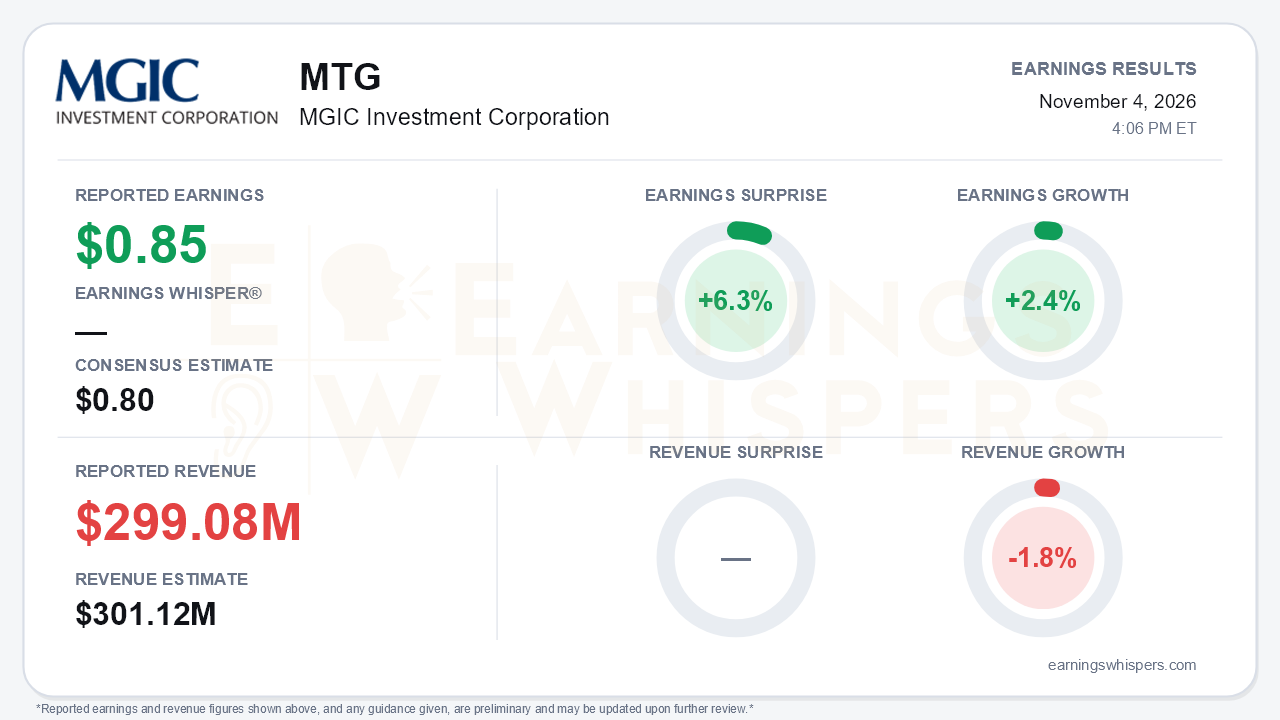
MGIC Investment Corporation delivered a third-quarter beat that owes more to the share count than to the income statement. The mortgage insurer earned $0.85 per diluted share, topping the $0.80 consensus by 6.3% and rising 2.4% from a year ago. GAAP and adjusted net operating income were essentially identical. Revenue of $299.08 million missed the $301.12 million estimate by 0.7% and fell 1.8% year over year. Net income fell to $175.0 million from $191.1 million a year earlier and $182.1 million in the second quarter. Per-share growth came only because diluted shares dropped to 205.4 million from 231.4 million. That is the central tension: capital return is producing EPS growth while the underlying earnings base is slowly eroding.
The quality of the beat deserves scrutiny on the credit side. Losses incurred more than doubled to $23.9 million from $10.9 million a year ago, lifting the loss ratio to 10.0% from 4.5%. Current-period losses, at $58 million, were unchanged from a year earlier. The real change was smaller favorable reserve development: $34 million versus $47 million a year ago and $43 million last quarter. New delinquency notices rose to 14,412 from 13,582 a year earlier, the primary delinquency inventory climbed to 27,814, and the delinquency rate reached 2.52%, up 15 basis points sequentially and 20 basis points year over year. Paid claims are also rising, with net paid claims of $21 million versus $14 million a year ago. Expense discipline carried much of the load. Underwriting and other expenses fell to $44.9 million from $49.6 million, and the expense ratio improved to 19.1% from 21.1%.
The top line shows a franchise that is growing volume but not revenue. New insurance written rose to $17.1 billion from $16.5 billion, and insurance in force reached $307.3 billion. However, the call noted that in-force growth slowed to 2.2% year over year from 2.6% in the second quarter and 3% in the first. Annual persistency slipped to 82.5% from 85.0% a year ago. Net premiums earned declined because the net premium yield compressed to 31.2 basis points from 32.3, driven by higher ceded premiums. The in-force yield, at 37.9 basis points, continues to grind lower. Net investment income also edged down to $60.9 million. Annualized ROE remains healthy at 14.2% but slipped from 14.5% in the prior quarter.
Management's strongest forward-looking moves came in reinsurance and costs. MGIC agreed to terms for a 40% quota share on 2028 NIW and a 20% quota share on 2029 NIW. Management described this as the furthest forward coverage in the program's history, at an estimated cost of roughly 3% after tax. It also amended its 2023 quota share, which management said cuts that treaty's ongoing cost by about 35% beginning in 2027. Full-year operating expenses are now expected slightly below the low end of the $190-$200 million range, a further tightening from the prior quarter. On credit, the message was more cautious. Management indicated that fully developed claim rates are drifting toward 3-4% and that any change to the 7.5% initial claim-rate assumption is more likely to be upward. That points to less reserve-release support ahead.
The new risk is regulatory. A presidential executive order directs FHFA to explore a pilot on mortgage insurance cancellation, which could shorten policy lives and pressure persistency and returns. Management called it too early to assess and noted that roughly 40,000-50,000 borrower-requested cancellations a year are already modeled. Capital return is also moderating. Buybacks fell to $152.5 million from $177 million in the second quarter and $193 million in the first. Holding company liquidity declined to $783 million, although a $350 million subsidiary dividend in November replenishes it. Book value per share slipped to $24.06 on larger unrealized investment losses, while book value excluding AOCI rose to $25.68.
Investors have grown noticeably more skeptical. Earnings Whispers sentiment moved from roughly neutral at -0.0045 to a clearly negative -0.2713. Shares, at $29.13, are down 8.7% since opening at $31.89 after the July report. The stock still sits 4.9% above its 200-day moving average of $27.78, so the selling has dented the trend rather than broken it. The AVWAP trend reading is negative, while other trend signals are largely neutral.
The bottom line is that MGIC remains a highly profitable, well-reinsured, shareholder-friendly insurer, and the quarter offered no evidence of a credit break. Still, the beat was manufactured largely through buybacks and cost cuts while net income, revenue, and reserve releases declined and delinquencies rose at an accelerating pace. With buybacks slowing and the cancellation executive order unresolved, bears have legitimate ammunition. Upcoming quarters will need to show that credit normalization stays gradual for the per-share story to hold.
Read our earnings preview for MGIC Investment Corporation: https://www.earningswhispers.com/article/MTG/21880
This earnings review was originally published on Earnings Whispers.
This article is for informational purposes only and is not investment advice. Earnings Whispers and its staff may hold positions in the securities mentioned. It is AI-assisted, based on proprietary Earnings Whispers data and company reports, and edited by Earnings Whispers staff.
Mentioned In This Article
Latest News
| 4 hours | |
| Nov-04 | |
| Nov-04 | |
| Oct-29 | |
| Oct-27 | |
| Oct-23 | |
| Oct-08 | |
| Sep-21 | |
| Jul-29 | |
| Jul-29 | |
| Jul-23 | |
| Jul-02 | |
| Apr-29 | |
| Apr-29 | |
| Apr-23 |
