Strategic Education Misses, Writes Down Torrens And Resets The Path To Growth Until 2028
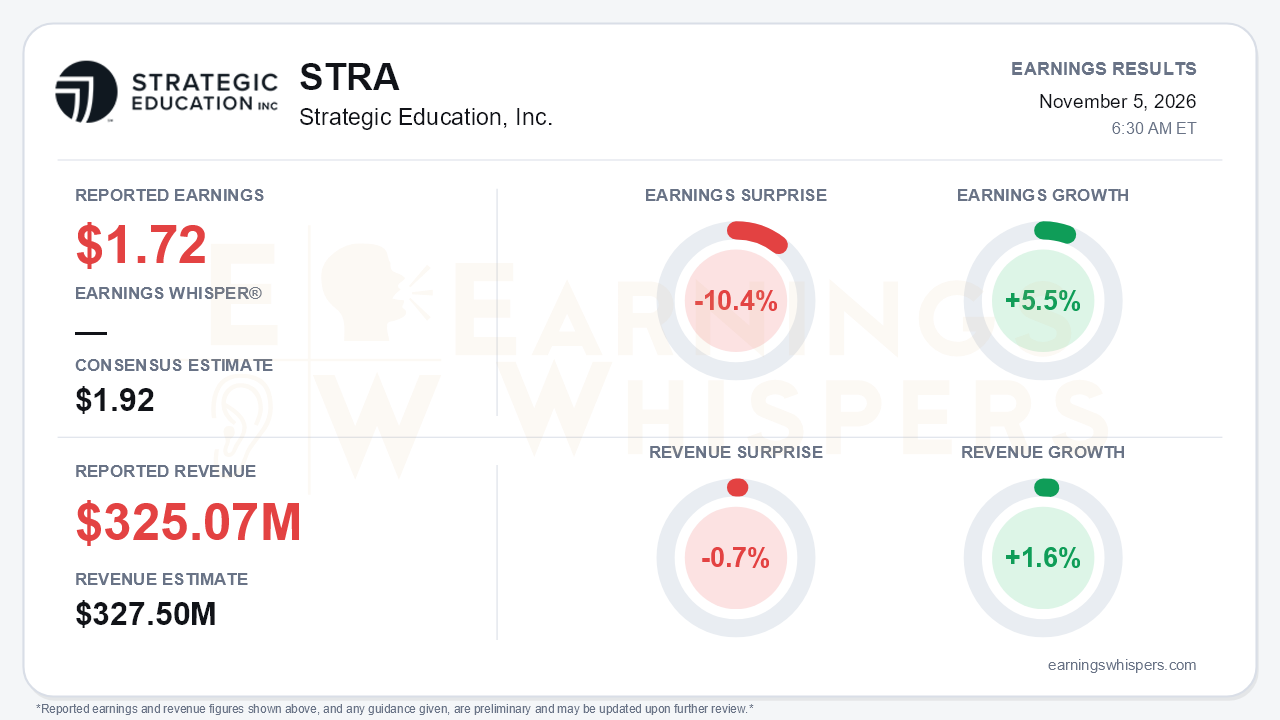
Strategic Education (NASDAQ: STRA) delivered a quarter in which the miss mattered less than the reset that came with it. Adjusted earnings of $1.72 per share missed the $1.92 consensus by 10.4%, and revenue of $325.07 million came in 0.7% below the $327.5 million estimate. Earnings still grew 5.5% year over year and revenue rose 1.6%. The headline numbers, however, understate how much changed. Management took a $134.1 million non-cash impairment on Torrens University, said its 2026 notional outlook is now unlikely to be met, and guided 2027 revenue to roughly flat with lower margins. The growth framework investors had been underwriting has effectively moved out a year.
The quality of the quarter deserves scrutiny. On a GAAP basis, the impairment produced an operating loss of $87.6 million and a diluted loss of $4.68 per share, compared with a profit of $1.15 a year earlier. Excluding the charge and restructuring costs, adjusted operating income was essentially flat at $51.0 million versus $51.3 million. Adjusted net income slipped to about $37.0 million from $37.7 million. The modest EPS growth therefore came from the share count rather than the business. Adjusted diluted shares fell to 21.46 million from 23.21 million after $101.3 million of buybacks so far this year. Currency also flattered the results. Constant-currency revenue rose just 0.1% to $320.1 million, which is why the call described revenue as flat. Constant-currency adjusted margin eased to 15.7% from 16.0%.
The segment trends explain the deterioration. Australia/New Zealand is the clearest problem. Enrollment fell 9.1%, worsening from declines of 3% in Q1 and 5% in Q2. Constant-currency revenue fell 7.2%, and the segment margin compressed to 15.8% from 18.2%. Management cited visa approvals down as much as 80% in some months and a new visa requirement for onshore transfers that effectively closes that market. The expected return to enrollment growth has now slipped three times: from end-2026, to early 2027, to early 2028. Education Technology Services remains the profit engine, with revenue up 11.9% and margin up to 42.5%, but it is clearly decelerating:
- Segment revenue growth slowed from 21% in Q1 and 15% in Q2 to 12%.
- Sophia subscriber growth fell from 40% to 32% to 22%.
- Workforce Edge-driven enrollment growth at Strayer and Capella dropped to 4%, from 70% in Q1 and 21% in Q2.
U.S. Higher Education offers the most credible part of the story. Total enrollment dipped 1.1% to 84,725 and operating income fell 4%. Underneath that, the mix is improving:
- Healthcare enrollment grew 9% and now represents 54% of the segment, up from 49% a year ago.
- Retention reached a record 89.2%.
- Declines in unaffiliated enrollment moderated to about 4%.
- New pre-licensure programs, including Capella's BSN and Strayer's Radiologic Technology degree, are tracking ahead of plan.
Management expects net positive U.S. new-student growth in 2027 and unaffiliated declines to reach breakeven by the end of that year. Those are expectations, not results. The cash picture is solid: year-to-date free cash flow rose to $136.7 million, and the company carries no revolver debt.
The forward setup is where bears have legitimate ammunition. For 2027, management plans about $50 million of growth investment across ETS, U.S. healthcare and Australian domestic expansion, including a Perth campus in late 2027. About half of that spending is offset by productivity savings, so opex rises only around 2%. Against flat revenue, though, ETS margins are expected to compress 300 to 400 basis points, with smaller declines in the other segments. The tone shift is notable. Last quarter, management was 'very confident' in its margin target. Additional risks include regulatory uncertainty from Democratic control of Congress and a pending Fair Work Ombudsman matter in Australia.
Investors appeared to sense trouble before the report. Earnings Whispers sentiment fell from -0.258 to -0.450, a meaningful move deeper into negative territory. Shares had dropped 5.1% since the open after the July report, to $74.32. That leaves them 7.4% below the 200-day moving average and 17.2% below the $89.73 52-week high set on July 30. The stock gave back that entire post-report spike and entered earnings just 3.3% above its inter-earnings low of $71.97. Price and AVWAP trend readings remain negative.
The bottom line is that STRA's miss was modest, but the guidance reset is substantial. The U.S. healthcare pivot and record retention keep a credible long-term thesis alive, and cash generation continues to fund buybacks and the dividend. Even so, flat 2027 revenue, margin-dilutive reinvestment, a decelerating ETS segment and a repeatedly delayed Australian recovery mean investors are now being asked to wait until 2028 for the growth story they expected in 2026.
Read our earnings preview for Strategic Education, Inc.: https://www.earningswhispers.com/article/STRA/22188
This earnings review was originally published on Earnings Whispers.
This article is for informational purposes only and is not investment advice. Earnings Whispers and its staff may hold positions in the securities mentioned. It is AI-assisted, based on proprietary Earnings Whispers data and company reports, and edited by Earnings Whispers staff.
Mentioned In This Article
Latest News
| Nov-05 | |
| Nov-05 | |
| Nov-05 | |
| Oct-28 | |
| Sep-30 | |
| Sep-16 | |
| Aug-12 | |
| Aug-06 | |
| Jul-30 | |
| Jul-29 | |
| Jul-29 | |
| Jun-24 | |
| Jun-05 | |
| May-08 | |
| Apr-27 |
