Granite Point Misses Badly As Credit Deterioration Accelerates And Regrowth Plan Gives Way To Strategic Review
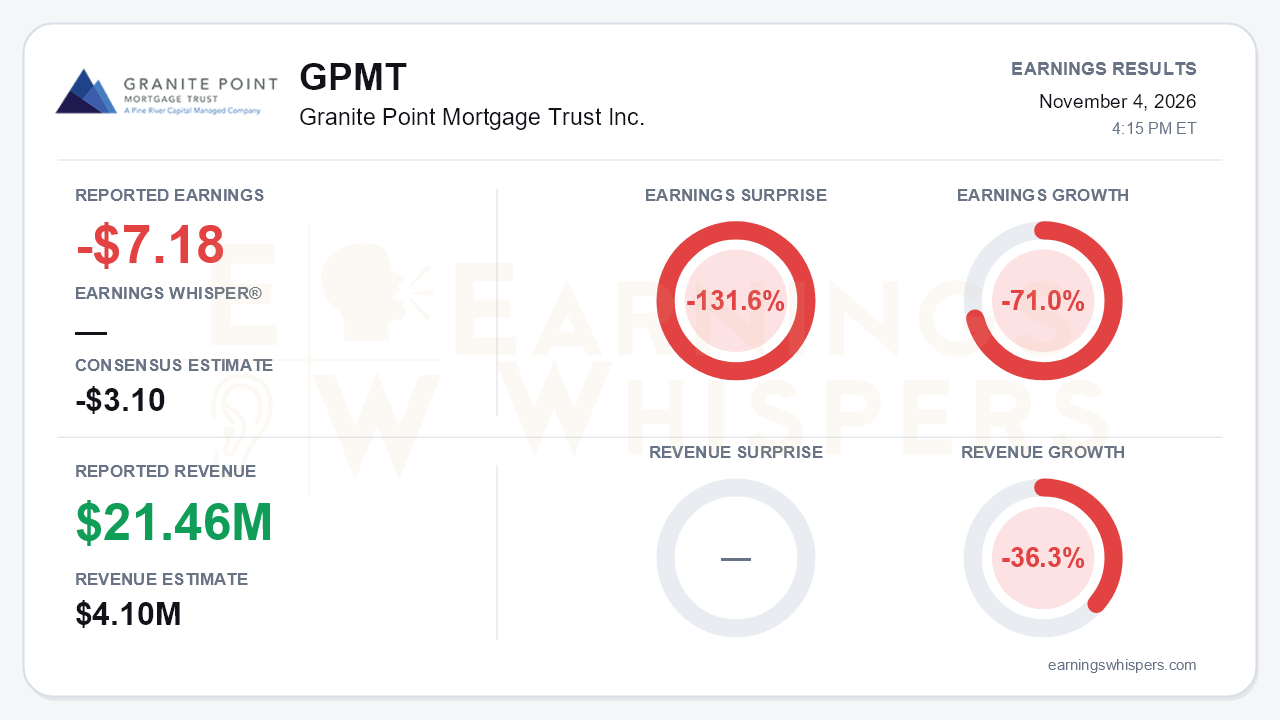
Granite Point Mortgage Trust's third quarter was the moment its recovery story broke down. On an Earnings Whispers basis, the commercial mortgage REIT lost $7.18 per share against a consensus loss of $3.10, a 131.6% miss. Earnings fell 71.0% from a year ago. The company's own figures were harsher. The GAAP net loss attributable to common stockholders was $60.3 million, or $(12.50) per split-adjusted share. Distributable loss was $33.7 million, or $(6.99), and distributable loss before realized gains and losses was $(1.74). The miss matters less than what accompanied it. The board launched a strategic alternatives review, the planned restart of originations was suspended, longer-term guidance was withdrawn, and nearly every credit metric moved the wrong way.
The headline revenue beat deserves scrutiny. Revenue of $21.46 million topped the $4.1 million consensus by 423.5%. That gap is so wide that it more likely reflects a difference in how revenue was defined than genuine outperformance. The actual earnings engine has stalled. Net interest income collapsed to $416,000 from $10.3 million a year earlier, as interest income on loans fell to $18.1 million from $33.0 million. Revenue fell 36.3% year over year. Realized loan yield has slid every quarter, from 6.7% at the end of 2025 to 6.0% in the second quarter and 5.3% now. The real damage came from credit. The company booked a $45.4 million provision for credit losses and $25.3 million in write-offs, which pushed the CECL reserve to $185.9 million, or 13.7% of commitments. It was $166 million in the second quarter and $148 million at year-end.
The call showed how quickly the loan book has soured. Seven loans moved to non-accrual during the quarter, lifting other non-accrual unpaid principal balance to $343 million from $68 million in the second quarter. Two Atlanta office loans totaling $74 million were downgraded to a risk rating of 5. The weighted average risk rating rose to 3.3 from 2.9 at year-end. Specific reserves now make up 95% of the allowance, up from 70% at year-end. That shift suggests losses are increasingly tied to identified problem loans rather than general caution. Book value per share fell to $44.54, equivalent to about $4.45 before the 1-for-10 reverse split. That compares with $5.70 in the second quarter and $7.29 at year-end, a roughly 22% sequential decline. Management's tone has moved from "improving market, regrow the book" earlier in the year to plainly defensive. It cited rising rates slowing property sales and refinancings.
There is real progress on the other side of the ledger, and it should not be dismissed. Two problem loans were resolved: a $52.4 million Georgia multifamily loan and a $14.7 million Connecticut hotel loan, with the roughly $25 million write-off already reserved. Two office loans totaling about $20 million paid off in full. Funding costs keep falling. The JPMorgan facility was upsized and extended to July 2028, the legacy CLOs were refinanced, and the Morgan Stanley and Citi assets were moved over. Together these cut weighted repo cost to SOFR+213 from SOFR+242, saving about $0.5 million per quarter. Near-term catalysts include:
- the Miami Beach REO, under contract with a hard deposit for a year-end close;
- a possible Tempe resolution by year-end;
- some non-accrual loans that management expects to return to accrual in the fourth quarter or early 2027.
The Minneapolis office loan is also expected to become REO before year-end, which adds to the resolution pipeline rather than removing a problem.
Bears have legitimate ammunition on liquidity. Unrestricted cash fell to $44.7 million at quarter-end and roughly $38.8 million by November 2. That is not a large cushion against a $20 million minimum cash covenant. The Series A preferred dividend switches to a floating rate in January 2027, which raises the quarterly cost from about $3.6 million to roughly $5.1 million. That increase lands on a business whose net interest income is now close to zero. The common dividend has already been cut to $0.10 from $0.50 a year ago.
The market had anticipated much of this. Shares are down 66.1% since the opening after the August report and sit about 65.7% below their 200-day moving average of $13.43. The Earnings Whispers trend signals are uniformly negative across price, sequential growth, momentum and AVWAP. Investor sentiment has moved further into negative territory, falling to -0.20 from -0.07, a meaningful but not extreme shift.
The bottom line is that Granite Point has moved from a plan to work out legacy loans and then regrow to a board-led review of its options. The quarter showed why. Resolutions and cheaper financing are real, but they are being outpaced by new non-accruals, rising reserves and a sharply lower book value. With guidance withdrawn and liquidity thin, the outcome of the strategic review and the pace of REO sales now matter far more than any quarterly earnings comparison.
Read our earnings preview for Granite Point Mortgage Trust Inc.: https://www.earningswhispers.com/article/GPMT/21842
This earnings review was originally published on Earnings Whispers.
This article is for informational purposes only and is not investment advice. Earnings Whispers and its staff may hold positions in the securities mentioned. It is AI-assisted, based on proprietary Earnings Whispers data and company reports, and edited by Earnings Whispers staff.
Mentioned In This Article
Latest News
| Nov-05 | |
| Nov-04 | |
| Nov-04 | |
| Oct-27 | |
| Oct-21 | |
| Oct-06 | |
| Sep-23 | |
| Sep-15 | |
| Aug-05 | |
| Aug-05 | |
| Aug-03 | |
| Jul-22 | |
| Jun-16 | |
| May-05 | |
| May-05 |
