Comstock Misses On A Thin $0.02 Profit As The $1.65 Billion SOCAR Sale Overshadows Rising Western Haynesville Costs
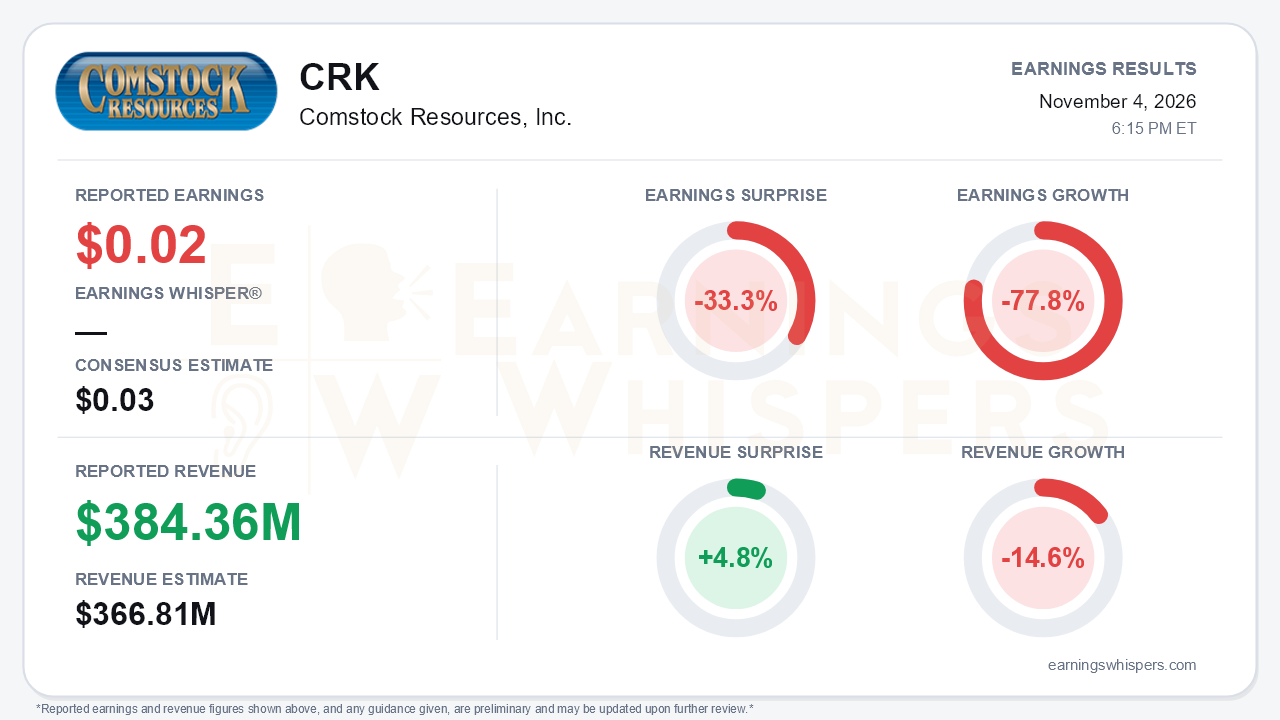
Comstock Resources (NYSE: CRK) delivered a quarter in which the income statement mattered less than the balance sheet. Adjusted earnings of $0.02 per share missed the $0.03 consensus by 33.3% and fell 77.8% from a year earlier. Revenue of $384.36 million beat expectations by 4.8% but declined 14.6% year over year. The same day, the company signed a $1.65 billion sale of minority Haynesville interests to Azerbaijan's state oil company, SOCAR. Investors are now weighing that deal, together with a roughly $450 million drilling venture with the Jones family, against a core operation still earning almost nothing at sub-$3 gas. That is the central tension.
The headline numbers need some unpacking. The revenue decline came almost entirely from gas services, which fell to $64.5 million from $141.3 million. That business runs at razor-thin margins, so the drop says little about the upstream operation. Natural gas and oil sales actually rose to $319.9 million from $308.6 million, because production grew 9% year over year and 8% sequentially to 122.4 Bcfe. That volume growth offset a lower realized price of $2.61 per Mcfe, down from $2.76.
The profit picture is weaker. Depreciation, depletion and amortization climbed to $185.7 million from $157.4 million. Exploration expense and cash G&A also rose. Unit production costs increased to $0.80 per Mcfe from $0.77, led by gathering and transportation, and the unhedged operating margin slipped to 69% from 72%. GAAP earnings of $0.08 per share look better than the adjusted figure only because of a $35.1 million unrealized hedging gain. Year to date, adjusted EPS of $0.18 is roughly half of last year's $0.35, so the earnings trend is still decelerating even as volumes recover.
The call confirmed that the operating recovery is real but incomplete. Production of about 1.3 Bcfe/d compares with 1.2 in the second quarter and 1.1 in the first. EBITDAX rose to $266 million from $245 million in Q2, and operating cash flow improved to $208 million from $189 million.
Capital intensity remains the problem. Third-quarter exploration and development spending of $382.9 million far exceeded cash generation, and long-term debt rose to $3.36 billion from $2.81 billion at year-end. The Western Haynesville is where bears have legitimate ammunition:
- Completion costs jumped 22% sequentially to $1,959 per foot.
- Drilling costs rose to $1,934 per foot.
- Drivers included 8-10% service inflation, shorter laterals and heavier proppant loads.
- Management conceded full-cycle economics there are roughly breakeven at current costs.
- 2026 Western Haynesville wells drilled were trimmed to 19 from 22, and Legacy turn-in-lines fell to 45 from 48.
On the positive side, Western Haynesville initial rates averaged a strong 33 MMcf/d. Legacy drilling costs fell 11%, and early data show roughly 10%-plus EUR uplift from larger fracs.
The balance-sheet transformation changes the investment setup. Management pegs pro forma net debt at about $1.7 billion, down from $3.4 billion, with leverage near 2.0x versus 3.2x. The bank facility now runs to 2028 and extends to 2031 once the SOCAR deal closes. The Jones venture funds most of the cost of 27 wells, which management says should produce free cash flow in the fourth quarter. That is a marked shift from earlier in the year, when cash burn was the debate.
SOCAR also brings potential LNG marketing optionality and follows prior third-party investments in Pinnacle and the Anderson County power hub, where first gas sales are expected in early 2028. The trade-offs are real, however:
- Comstock is surrendering 15-20% of its upstream interests and part of its future drilling economics.
- The SOCAR deal still needs to close.
- The dividend stays off until leverage falls below 1.5x.
Investors appear to be leaning toward the deleveraging narrative. Earnings Whispers sentiment moved from mildly negative (-0.19) to slightly positive (0.06), a meaningful swing but hardly euphoric. The snapshot is dated the day of the release, so it may not fully capture the reaction to the call. Shares at $13.38 are up 9.2% since the open after the July report, yet remain 16.8% below the 200-day moving average of $16.08. The market has warmed to the stock without fully re-rating it. The AVWAP trend reading is positive, while price and momentum readings are neutral.
The bottom line is that Comstock's third quarter was a modest miss on thin earnings, rescued strategically by a deal that roughly halves debt. The production recovery is genuine and free cash flow is finally in sight. However, the company bought that flexibility by selling part of its asset base. Its flagship Western Haynesville growth play is also currently breakeven on a full-cycle basis because of rising costs. Until gas prices improve or the cost curve bends, the improved balance sheet is a stronger argument than the underlying earnings power.
Read our earnings preview for Comstock Resources, Inc.: https://www.earningswhispers.com/article/CRK/21812
This earnings review was originally published on Earnings Whispers.
This article is for informational purposes only and is not investment advice. Earnings Whispers and its staff may hold positions in the securities mentioned. It is AI-assisted, based on proprietary Earnings Whispers data and company reports, and edited by Earnings Whispers staff.
Mentioned In This Article
Latest News
| Nov-05 | |
| Nov-05 | |
| Nov-04 | |
| Nov-04 | |
| Oct-27 | |
| Oct-05 | |
| Sep-29 | |
| Sep-28 | |
| Sep-10 | |
| Sep-09 | |
| Sep-08 | |
| Sep-03 | |
| Sep-02 | |
| Sep-01 | |
| Sep-01 |
