Blue Owl Technology Finance Misses As NAV Rebounds, But Stalled Deployment And Rising Non-Accruals Leave The Dividend Gap Unresolved
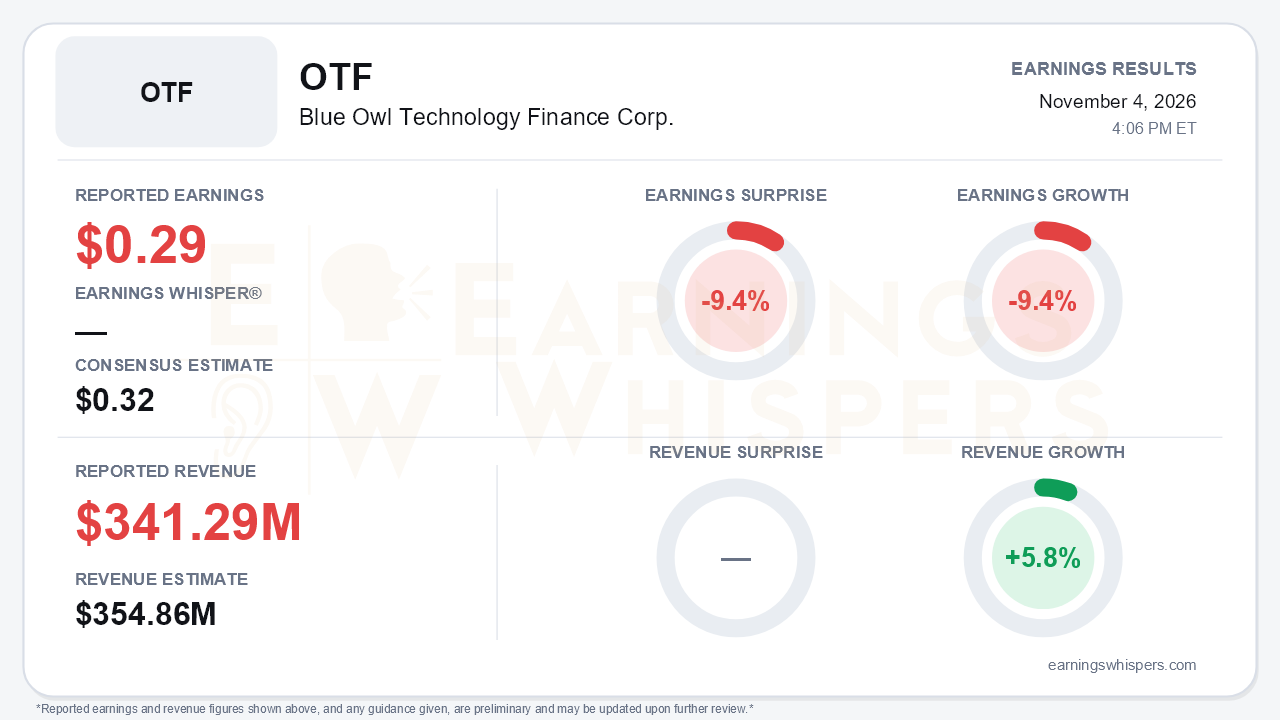
Blue Owl Technology Finance Corp. (NYSE: OTF) delivered a quarter in which the balance sheet looked better while the earnings engine looked worse. Net investment income of $0.29 per share missed the $0.32 consensus by 9.4% and fell 9.4% from a year ago. Total investment income of $341.29 million rose 5.8% year over year but came in 3.8% below expectations. The central tension is that NAV per share rose to $16.62 from $16.48 and spreads on new loans widened, yet NII slipped from $0.30 in the second quarter and remains well short of the $0.35 base dividend. Credit also showed its first notable deterioration of the year.
The quality of the quarter deserves scrutiny. Investment income rose only about $3 million sequentially. Operating expenses climbed $10 million, driven by interest expense, which rose to $117 million from $109 million as average borrowings increased. That compression is the core reason NII went backward. The GAAP bottom line looked healthier, with net increase in net assets of $0.48 per share versus $0.33 in the second quarter and an 11.7% net income ROE that CEO Craig Packer highlighted. However, $0.19 of that came from realized and unrealized gains, including $69 million of net realized gains. Those gains helped NAV, but they are not recurring income. The $0.05 special dividends tied to last year's listing are now fully paid. Going forward, shareholders receive only the $0.35 base dividend, which the current $0.29 run-rate does not cover. Spillover income of roughly $0.35 per share provides a cushion, not a solution.
The call made clear that deployment is the binding constraint. New commitments fell to $441 million from $852 million in the second quarter, about $1.7 billion in the first quarter and $2.3 billion in the fourth quarter of last year. Fundings, including net revolver and delayed-draw activity, were roughly $395 million against $334 million of repayments. As a result, net leverage barely moved to 0.94x from 0.93x, still at the low end of the target range. Management conceded that earnings did not grow as much as it would have liked. Average deal size dropped sharply, software M&A remains muted, and borrower growth moderated to mid-to-high single digits. That compares with high single digits in the second quarter and low-to-mid teens a year ago.
Credit is the other soft spot. Non-accruals jumped to 1.1% of the portfolio at fair value and 1.8% at cost, up from 0.1% and 0.6% in June, across three names, one of them new. Names in the weaker internal rating buckets rose to about 9% from 7.6%. Revolver utilization ticked up to just under 12%. None of this is alarming in isolation, but the direction is unfavorable for a software-heavy lender just as borrower growth is cooling.
There are credible offsets. Effective spreads on new originations reached 5.8%, well above the 4.6% of a year ago, with new software deals pricing at SOFR plus 550 to 650 basis points. The portfolio yield at cost improved to 9.6% from 9.3%. The largest new deal was a $180 million share of a $2.4 billion Iren GPU financing, which management described as senior secured, short-tenor, fully amortizing and targeting low-teens returns. Digital infrastructure is now about 2% of the portfolio, with a stated goal of mid-to-high single digits. That deal also introduces fixed-rate exposure; 45.3% of new debt commitments were fixed-rate this quarter. Management also acknowledged post-quarter stress in neocloud and tech credit, along with wider unsecured funding spreads.
Management laid out an explicit path to dividend coverage: about $1.2 billion of net deployment and leverage moving toward 1.15x. It reaffirmed a mid-2027 coverage target rather than pulling it forward, and estimated that every 100 basis points of higher base rates adds about $0.02 of quarterly NII. Capacity to execute exists. OTF raised $900 million of new debt and now has roughly $2.9 billion of liquidity. It also repurchased $55 million of stock, adding about $0.06 to NAV.
Investor sentiment improved meaningfully, moving from -0.40 to a modestly positive 0.09, consistent with management's more confident tone on software valuations. The stock tells a less forgiving story. At $9.79, shares are down 6.9% since the open following the August report, sit 11.7% below the 200-day moving average of $11.09, and trade roughly 40% below NAV. The AVWAP trend remains negative and momentum is neutral.
The bottom line is that OTF's report improved the backdrop more than it improved the earnings. NAV, spreads and liquidity moved the right way. Meanwhile, NII missed, deployment hit its slowest pace of the year, non-accruals rose and the dividend gap persists. Until net deployment actually accelerates toward the stated $1.2 billion goal, the coverage plan remains a target rather than a trend, and bears have legitimate ammunition.
Read our earnings preview for Blue Owl Technology Finance Corp.: https://www.earningswhispers.com/article/OTF/21902
This earnings review was originally published on Earnings Whispers.
This article is for informational purposes only and is not investment advice. Earnings Whispers and its staff may hold positions in the securities mentioned. It is AI-assisted, based on proprietary Earnings Whispers data and company reports, and edited by Earnings Whispers staff.
Mentioned In This Article
Latest News
| Nov-05 | |
| Nov-05 | |
| Nov-04 | |
| Nov-04 | |
| Oct-27 | |
| Oct-02 | |
| Oct-01 | |
| Sep-21 | |
| Sep-04 |
Blue Owls Tech Fund Is Raising Debt While its Shares Sink 21% Year-To-Date
OTF
Benzinga Private Markets
|
| Sep-04 | |
| Aug-17 |
Blackstone, Blue Owl Funds Upsize Bond Sales After Third-Quarter Lull in Private Credit Issuance
OTF
Benzinga Private Markets
|
| Aug-13 | |
| Aug-06 | |
| Aug-05 | |
| Aug-05 |
