U-Haul Misses Badly On Consensus As Fleet Cost Relief, Not Margin Expansion, Drives A 34.7% Earnings Rebound
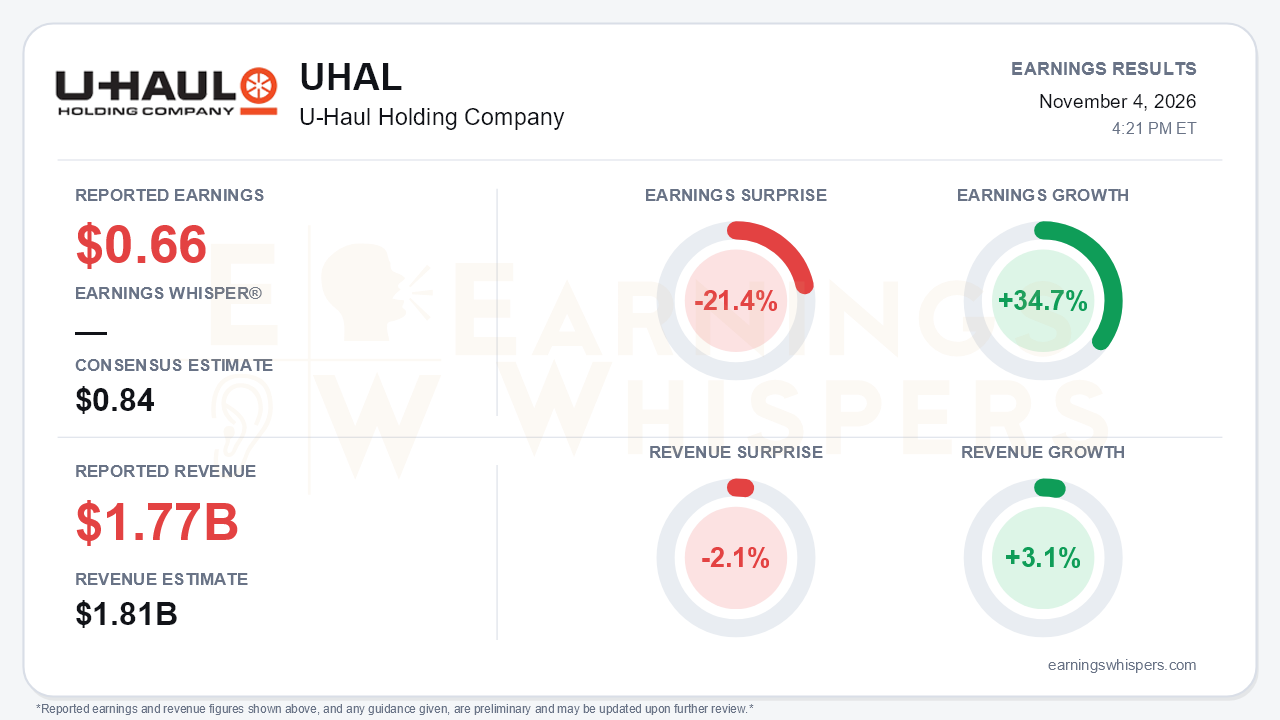
U-Haul Holding Company reported fiscal second-quarter earnings of $0.66 per share on revenue of $1.773 billion. That was well short of the $0.84 consensus estimate, a 21.4% miss, and revenue came in 2.1% below the $1.81 billion consensus. Year over year, earnings grew 34.7% and revenue rose 3.1%. The press release leads with $0.71 per share for the Non-Voting (UHAL.B) shares. The gap reflects the company's two-class method: $0.66 is undistributed earnings per share, and the $0.71 adds back the $0.05 dividend. Either way, the quarter marks a real turn. Earnings followed losses in the fiscal third and fourth quarters of 2026 and a year-over-year decline in the fiscal first quarter. The central tension is that the recovery is real but narrow. It came largely from the fleet cost line, while operating profitability barely moved and expectations had run well ahead of it.
The quality of the improvement deserves scrutiny. Moving and Storage earnings from operations rose $44.5 million to $241.9 million. Of that, $34.1 million came from smaller losses on retired rental equipment, which fell to $4.2 million, and another $4.5 million came from lower fleet depreciation. Segment adjusted EBITDA rose only $5.0 million to $547.6 million. The call put the adjusted EBITDA margin about 90 basis points lower year over year, and trailing-twelve-month adjusted EBITDA is down $39.5 million to $1.64 billion. Freight and shipping costs rose $24.4 million, personnel $10.2 million, self-insured liability $6.2 million and property taxes $4.7 million, absorbing most of the top-line gain. Interest expense also climbed to $99.0 million from $90.3 million. Net debt to adjusted EBITDA has crept up to 4.5x from 4.1x a year ago.
The operating story beneath the headline did improve. Self-moving equipment rental revenue rose $37.4 million, or 3.4%, which compares with gains of just $8 million and $12 million in the fiscal third and fourth quarters. Revenue per transaction was higher in both In-Town and One-Way, and In-Town transactions grew. Management added several encouraging signals:
- The trailing-twelve-month transaction count turned positive in October for the first time in a long stretch.
- One-way miles per transaction have risen for three straight quarters.
- October revenue is running above second-quarter levels.
- U-Box returned to growth, lifting Moving and Storage other revenue 4.3%.
In self-storage, revenue grew 6.4%, and the same-store occupancy decline narrowed sharply to 110 basis points, leaving occupancy at 89.5%. That compares with declines of 456 basis points in the first quarter and 540 basis points in the fourth.
Bears still have legitimate ammunition. Storage revenue-per-foot growth on the call slowed to roughly 3% from above 6% as the delinquency-cleanup comparison laps. New move-in rate growth eased to about 2%, and net move-ins remain behind goal. Dealer additions disappointed at a net 500 year over year, versus 1,400 cited at fiscal fourth quarter, and the fleet-size decision has been pushed out. Most notably, the CFO dropped the first-quarter expectation that freight pressure would ease in the back half and now sees no near-term relief. Management also said no structural demand catalyst is visible.
The forward-looking emphasis is capital discipline. Chairman Joe Shoen called the quarter "a modest win" and said reinvestment continues "at an appropriately slower pace." Specifically:
- Second-quarter fleet capex fell $275 million.
- The net fleet capex reduction of a little over $500 million for the fiscal year was reaffirmed.
- The storage development pipeline is shrinking.
- U-Box warehouse plans are roughly half their earlier level.
Management also expects a sizable positive variance in fleet liability costs in the second half. Buybacks stepped up to about $78 million from about $48 million in the first quarter. Liquidity, however, slipped to $1.335 billion from $1.479 billion at fiscal year-end, and management cited market volatility in weighing repurchases against liquidity.
Investor sentiment has turned noticeably cooler. It fell from a moderately positive 0.30 at the prior report to roughly neutral at -0.01. The stock has dropped 18.8% since opening at $74.91 after the August report and now trades at $60.80. That leaves it only about 4% above its 200-day moving average of $58.45, a thin cushion. The Earnings Whispers price and AVWAP trend readings are both negative, consistent with a stock the market has been de-rating ahead of this print.
The bottom line is that U-Haul delivered genuine year-over-year earnings growth and better moving-demand indicators, but fell far short of consensus. Most of the profit improvement came from depreciation and disposal relief rather than operating margin. Improving rental trends and capex restraint support the recovery case. Persistent freight inflation, fading storage pricing gains, rising leverage and a soured investor mood mean the burden of proof has shifted to the coming quarters.
Read our earnings preview for U-Haul Holding Company: https://www.earningswhispers.com/article/UHAL/22030
This earnings review was originally published on Earnings Whispers.
This article is for informational purposes only and is not investment advice. Earnings Whispers and its staff may hold positions in the securities mentioned. It is AI-assisted, based on proprietary Earnings Whispers data and company reports, and edited by Earnings Whispers staff.
Mentioned In This Article
Latest News
| 8 hours | |
| Nov-04 | |
| Nov-04 | |
| Oct-28 | |
| Oct-21 | |
| Oct-14 | |
| Oct-13 | |
| Oct-08 | |
| Aug-27 | |
| Aug-20 | |
| Aug-19 | |
| Aug-06 | |
| Aug-05 | |
| Aug-05 | |
| Jul-22 |
