Corvus Misses By A Penny As The Soquelitinib Pipeline Widens But Key Milestones Slip Further Into 2027
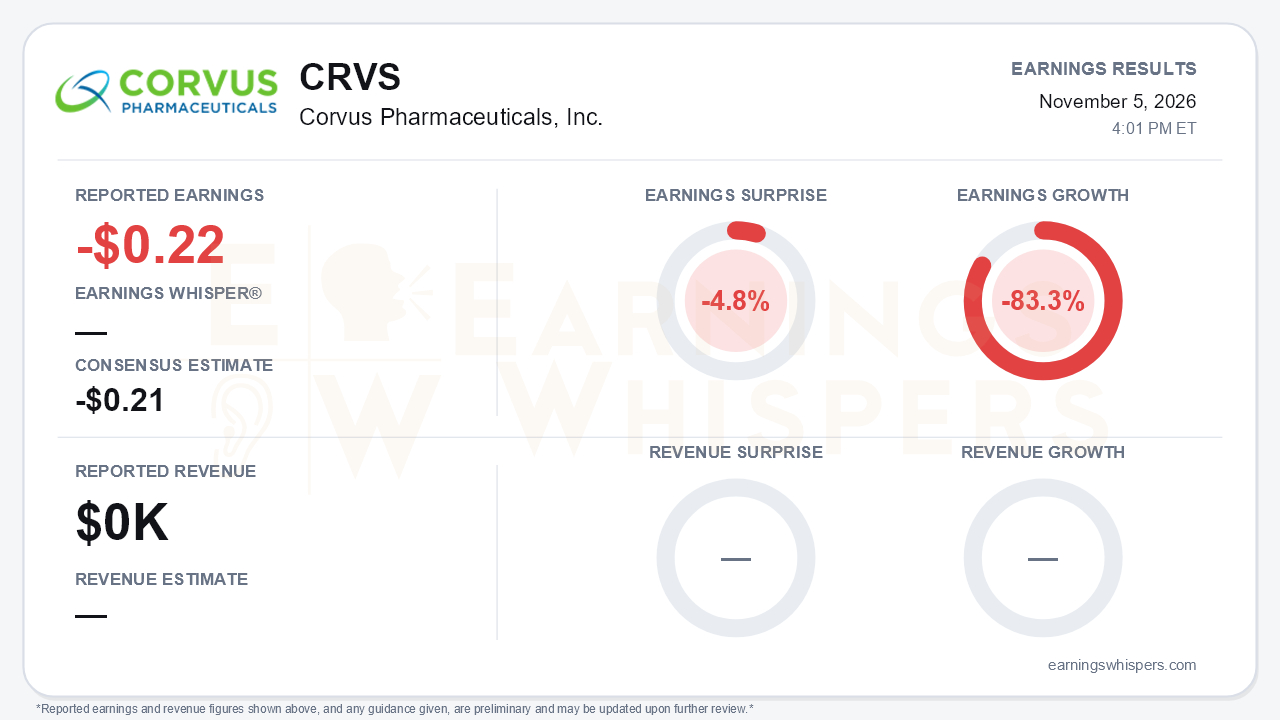
Corvus Pharmaceuticals reported a third-quarter loss of $0.22 per share, a penny worse than the $0.21 consensus, a 4.8% miss. The loss was 83.3% larger than a year ago, when the company lost $0.12 per share. For a clinical-stage company with no revenue, the miss matters less than what drove it and what came with it. Spending rose as soquelitinib moved into more trials at once, and the pipeline got broader. At the same time, several near-term milestones moved later. That trade-off is the central tension of the quarter: the story got wider but slower.
The income statement reflects a company running multiple mid- and late-stage programs in parallel. Research and development expense more than doubled to $17.8 million from $8.5 million a year earlier and rose from $16.0 million in the second quarter. Management attributed the increase to soquelitinib clinical trial costs and personnel. General and administrative expense climbed to $3.6 million from $2.1 million. The net loss widened to $20.3 million from $18.0 million sequentially and $10.2 million a year ago. Interest income of $1.9 million on the January financing provided only a modest cushion. The balance sheet remains the company's strongest asset. Cash and marketable securities stood at $202.9 million, down $12.3 million from $215.2 million at the end of June. Runway guidance into the second quarter of 2028 was reaffirmed.
The call added real substance to the breadth argument:
- **ALPS:** The NIAID-run trial produced the first disclosed clinical data, accepted as an ASH poster. All three patients completed a year at 200 mg twice daily with no grade 3 or 4 adverse events. All three discontinued background medications, including steroids. Corvus will take over the IND and plans to ask the FDA to add treatment sites and pediatric patients.
- **Hidradenitis suppurativa:** The Phase 1b trial is enrolling ahead of plan. Management set benchmarks of roughly 50-60% HiSCR50 and about 30% HiSCR75 for the data expected in the first half of 2027.
- **Asthma:** The FDA cleared the asthma IND. The trial will enroll both T2 and non-T2 patients.
- **Mechanism:** A Memorial Sloan Kettering ASH abstract linking response in cutaneous T-cell lymphoma to Th2 blockade added mechanistic support.
Management now frames 2027 as a dense catalyst year with roughly seven readouts. Core execution held: SIERRA1 atopic dermatitis enrollment remains on track for topline in the third quarter of 2027.
The weaker side of the ledger is timing, and the pattern deserves scrutiny:
- Angel Pharma's China atopic dermatitis cohort 1 data moved from before year-end 2026 to March 2027. Management attributed this to waiting for 12 weeks of dosing plus 30 days of follow-up.
- Cohort 2 data moved from the second quarter of 2027 to the second half.
- A potential atopic dermatitis Phase 3 start moved from as early as late 2027 into 2028.
- The U.S. asthma start slipped from "later this year" to the first quarter of 2027. Management called that delay immaterial and holiday-driven.
- The PTCL Phase 3 interim futility analysis is still guided for the first quarter of 2027, unchanged from the prior call. However, it was guided for late 2026 as recently as the fourth-quarter 2025 call.
Each individual delay is explainable. Cumulatively, they push the decisive data later while quarterly spending keeps rising.
That creates a financing question bears can legitimately raise. With runway ending in the second quarter of 2028 and an atopic dermatitis Phase 3 now pointed at 2028, the most capital-intensive step would begin close to the end of the current funding. Additional capital would likely be needed before or around that point. The PTCL futility read in early 2027 is binary and event-driven, and it will heavily shape the company's negotiating position.
Investor expectations improved heading into the report. Earnings Whispers sentiment moved from -0.11 to +0.06, a shift from mildly negative to mildly positive rather than a surge of enthusiasm. The tape tells a harsher story. Shares closed at $10.57 the day before the release, down 18.1% from the $12.90 open after the August report and 26.8% below the 200-day moving average of $14.45. The stock peaked at $15.72 on August 19 and has fallen 32.8% from there. It sits 14.8% above its October 14 low of $9.21. Price and AVWAP trend readings remain negative, consistent with a stock that has been sold steadily despite the broadening pipeline.
The bottom line is that Corvus delivered a slight miss in a quarter where earnings were never the point. The real news was a pipeline that grew more interesting and a timeline that grew longer. The ALPS data, fast HS enrollment and asthma IND strengthen the case that ITK inhibition has reach beyond lymphoma. Repeated slippage in the China atopic dermatitis readouts and the PTCL interim, however, has pushed validation into 2027 as spending climbs. Until the PTCL futility analysis and the first atopic dermatitis data arrive, the stock is likely to trade on milestone credibility and cash runway rather than quarterly losses.
Read our earnings preview for Corvus Pharmaceuticals, Inc.: https://www.earningswhispers.com/article/CRVS/22458
This earnings review was originally published on Earnings Whispers.
This article is for informational purposes only and is not investment advice. Earnings Whispers and its staff may hold positions in the securities mentioned. It is AI-assisted, based on proprietary Earnings Whispers data and company reports, and edited by Earnings Whispers staff.
Mentioned In This Article
Latest News
| Nov-05 | |
| Nov-05 | |
| Nov-05 | |
| Nov-04 | |
| Oct-29 | |
| Oct-29 | |
| Sep-30 | |
| Sep-03 | |
| Aug-27 | |
| Aug-07 | |
| Aug-06 | |
| Aug-06 | |
| Jul-30 | |
| Jun-09 | |
| May-20 |
