CytomX Matches On EPS, But Varseta-M Data Slips To 2027 Shift The Burden To January
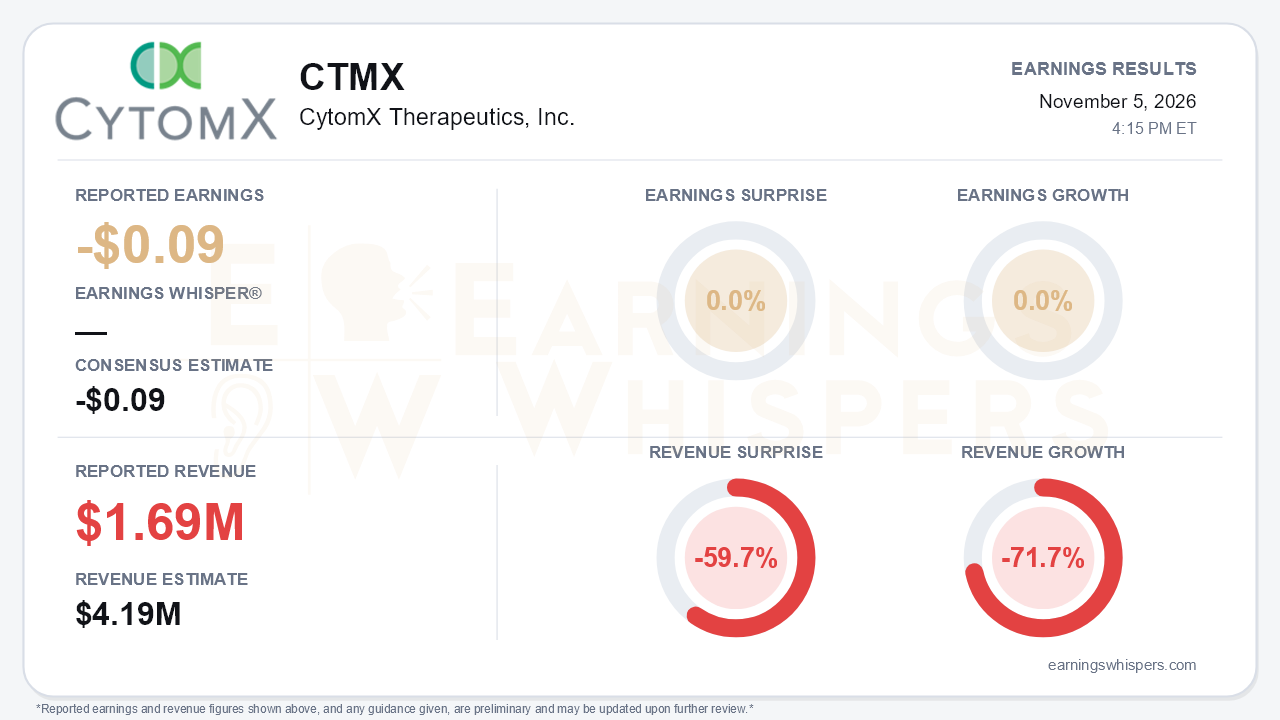
CytomX Therapeutics delivered a third-quarter loss of $0.09 per share, exactly in line with consensus and unchanged from a year ago (0.0% growth). Revenue was weak: $1.69 million missed the $4.19 million consensus by 59.7% and fell 71.7% year over year. For a clinical-stage oncology company, though, the financial line items are not the story. The central development is timing. The two readouts investors were positioned for in late 2026, the integrated Varseta-M monotherapy update and initial CX-801 data, have both moved into 2027. A stronger balance sheet and a broadening development program partly offset that delay, but they do not replace the data.
The flat EPS figure flatters the quarter. Net loss widened to $20.0 million from $14.2 million a year earlier. Per-share losses held steady only because the weighted share count rose to roughly 219 million from 165 million after this year's equity raises. Operating expenses climbed to $25.2 million from $21.7 million. G&A rose $2.3 million to $8.7 million on personnel, consulting and rent tied to the new Emeryville headquarters. R&D rose more modestly to $16.5 million, and that increase was helped by lower Varseta-M manufacturing spend due to timing, so the cost base is likely to grow further. The revenue decline is structural rather than a stumble: the Astellas collaboration obligation concluded in the second quarter. Higher interest income of $3.3 million cushioned the operating loss.
The constructive offset is cash. CytomX ended September with $348.0 million in cash and investments, up from $330.3 million in June, which is unusual for a company running $25 million in quarterly expenses. On the call, management attributed the increase to an expanded Regeneron collaboration, under which two additional targets were selected and $37 million was received. The sharp rise in long-term deferred revenue on the balance sheet is consistent with that payment being recognized over time rather than flowing through the income statement. Runway into the second half of 2028 was reaffirmed, so financing risk is not the near-term concern. Execution and competition are.
Operationally, management delivered much of what it promised. The company announced FDA Fast Track designation for relapsed/refractory mCRC in August. It opened non-CRC expansion cohorts of about 20 patients each in gastric/GEJ, EpCAM-selected pancreatic and EpCAM-selected biliary tract cancers. The 2L Phase 1/2 study pairing Varseta-M with bevacizumab and 5-FU/leucovorin remains on track to start by year-end. Bevacizumab-combination data and a potential first registrational start are both still slated for 1H27. Management confirmed overall survival as the primary endpoint for a randomized registrational trial. It said dose optimization between 8.6 and 10 mg/kg is nearing conclusion, and it reiterated a 10% grade 3 diarrhea rate against a target of 20% or below.
The tone, however, was more measured than on earlier calls. The January 2027 update, which will include the first OS look, dose selection and registrational strategy, slipped from "by end of 2026." Management attributed the delay to follow-up time and regulatory feedback. It declined to give dose or trial-design detail, and the choice between a third-line and fourth-line path is still open. Bevacizumab plus Lonsurf, with roughly nine-month OS, looms as a benchmark comparator. The competitive field is also getting crowded: AbbVie's Temab-A and Merck KGaA's precemtabart tocentecan are in Phase 3, and CDH17-directed ADCs surfaced at ESMO. Management also framed the U.S. 3L+ CRC opportunity at about 35,000 patients, a more conservative presentation than the 45,000-by-2040 figure cited earlier in the year. Bears have legitimate ammunition here.
The market had already priced in much of that frustration. Shares fell 29.2% from the $3.32 open after the August report to $2.35, sit about 38.5% below the $3.82 200-day moving average, and are well off the $3.89 inter-earnings high set in early September. The stock touched a 52-week low of $2.14 on November 2 and entered the report less than 10% above it. Price and AVWAP trends remain negative. Investor sentiment nevertheless improved ahead of the release, rising from roughly neutral at 0.04 to a mildly positive 0.16. That suggests some investors see the selloff as having moved ahead of the fundamentals.
The bottom line is that CytomX's in-line quarter was financially unremarkable and operationally steady, but the slips in both key readouts turn January 2027 into a high-stakes event. The Regeneron cash and a runway into 2H28 buy time, and the Varseta-M program is broader than it was a quarter ago. Still, with competitors advancing and the registrational design undecided, the investment case now rests almost entirely on whether the OS and dose-selection data justify a differentiated path in a crowded colorectal ADC field.
Read our earnings preview for CytomX Therapeutics, Inc.: https://www.earningswhispers.com/article/CTMX/22459
This earnings review was originally published on Earnings Whispers.
This article is for informational purposes only and is not investment advice. Earnings Whispers and its staff may hold positions in the securities mentioned. It is AI-assisted, based on proprietary Earnings Whispers data and company reports, and edited by Earnings Whispers staff.
Mentioned In This Article
Latest News
| Nov-05 | |
| Nov-05 | |
| Nov-05 | |
| Nov-02 | |
| Oct-29 | |
| Oct-29 | |
| Sep-01 | |
| Aug-27 | |
| Aug-07 | |
| Aug-06 | |
| Aug-06 | |
| Aug-03 | |
| Jul-30 | |
| Jul-27 | |
| Jul-06 |
