Lionsgate Beats On A TV Inflection And Rapid Deleveraging, But Sequential OIBDA And Cash Flow Soften Ahead Of A Hunger Games-Driven Second Half
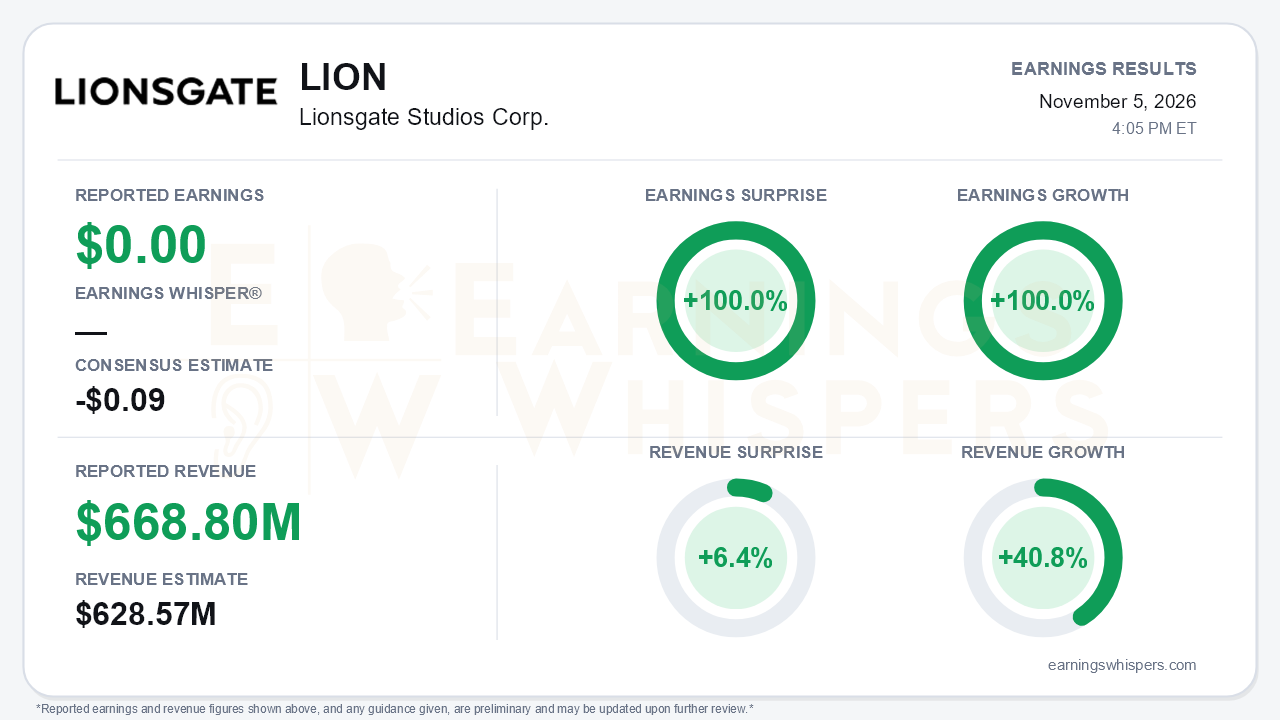
Lionsgate Studios (NASDAQ: LION) delivered a clean beat on both lines for its fiscal second quarter. On Earnings Whispers' normalized basis, it posted breakeven results against a consensus loss of $0.09 per share, a 100.0% surprise and 100.0% year-over-year earnings growth. Revenue of $668.8 million topped the $628.57 million consensus by 6.4% and grew 40.8%. The company's own figures sit on either side of that normalized number: a GAAP diluted loss of $0.05 from continuing operations and adjusted diluted income of $0.07. Both mark a sharp swing from a $0.39 GAAP loss and a $0.20 adjusted loss a year ago. The central takeaway is that the recovery has broadened beyond a single hit film. Television, which had declined for three straight quarters, inflected sharply. The sequential numbers, however, show a business heading into a back-half-weighted year rather than one that is still accelerating.
The quality of the improvement is real at the operating level. GAAP operating income swung to $29.1 million from a $46.0 million loss. Studio segment profit more than doubled to $110.3 million from $43.0 million. Motion Picture revenue rose 30% to $359.3 million, and segment profit nearly tripled to $88.7 million on the continued run of Michael and library strength. Television Production was the bigger change. Revenue jumped 56% to $309.5 million and segment profit rose 73% to $21.6 million on 22 scripted episodic deliveries versus 7 a year ago, led by Power: Origins and the second seasons of The Studio and The Hunting Wives. Below the operating line, interest expense fell to $57.8 million from $67.3 million. That helped narrow the net loss from continuing operations to $15.5 million from $111.9 million. Still, stock-based compensation of $22 million and $48.2 million in equity-award tax withholding are reminders that the adjusted figures flatter the cash picture.
That is where the headline masks softer near-term trends. Adjusted OIBDA of $72.0 million was up roughly fivefold year over year but slipped from $79 million in the June quarter, and it remained well below $165 million in fiscal Q4. Adjusted free cash flow was a use of $8.2 million after a $129 million inflow in Q1. Cash fell to $358.5 million from $426 million. Filmed entertainment backlog was essentially flat sequentially at about $1.5 billion, though television's share rose to 58% from 52%. Management attributed the cash dip to content spend that is roughly 60% weighted to the second half. It guided fiscal Q3 as the peak quarter and pre-flagged a difficult Q4, which faces a hard comparison, P&A for Day Drinker and Karoshi, and pre-release spending on Resurrection.
The balance-sheet story is the strongest evidence of change. Leverage fell to 3.7x from 4.3x in Q1, 6.1x in fiscal Q4, and 7.4x two quarters before that. Management introduced a new target of significantly below 3x by fiscal 2029. An SP Media investment in a JV holding the 3 Arts interest will fund the January 2027 3 Arts put, which management had previously flagged as roughly a half-turn leverage hit. Trailing 12-month library revenue recovered to $1.04 billion, up 4%, at roughly 60% cash margins.
The call added a long list of catalysts:
- a Meta partnership spanning VR glasses and a 3D conversion of Hunger Games: Sunrise on the Reaping;
- Sony as international partner and co-financier on Naruto;
- a channels business that has tripled to more than $100 million;
- a first live-entertainment target of about $50 million in revenue and more than $30 million in contribution by the end of fiscal 2028;
- an early Netflix season-three order for The Hunting Wives.
Management's tone moved from "highly confident" to "ever more confident." It reaffirmed significant fiscal 2027 adjusted OIBDA growth and extended explicit growth visibility into fiscal 2028 and 2029, but offered no new quantified guidance.
Bears still have legitimate ammunition. After a roughly 65% rise in fiscal 2027 episodic deliveries, television faces a tough fiscal 2028 comparison. Hunger Games now carries elevated expectations, with tracking signals running "meaningfully higher" than the prior installment. Capital-structure activity also remains busy, including possible ABS refinancing of IP credit facilities and press reports of a Legendary offer on which management declined to comment.
The market setup is more complicated than the surprise implies. Shares closed at $12.72 before the report, down 4.6% from the $13.34 open after the August release. The stock peaked at $13.40 that day and then slid to a $10.46 low on September 25. Since that low it has rebounded 21.6% to sit 8.9% above its 200-day moving average and about 5% below the quarter's high. Investor sentiment remained slightly negative but improved modestly, to -0.03 from -0.04, which hardly amounts to enthusiasm. The Earnings Whispers trend readings are mixed: momentum and AVWAP are positive even as the price trend remains negative.
The bottom line is that Lionsgate's quarter strengthened the structural case. Television has turned, the library is back above $1 billion, and leverage has been nearly halved in three quarters. The sequential dip in OIBDA, negative quarterly free cash flow, and flat backlog mean the next leg depends heavily on second-half execution, particularly Hunger Games. Lukewarm sentiment and a stock still below its post-August level suggest investors want to see that delivery before paying for fiscal 2028 and 2029 visibility.
Read our earnings preview for Lionsgate Studios Corp.: https://www.earningswhispers.com/article/LION/22328
This earnings review was originally published on Earnings Whispers.
This article is for informational purposes only and is not investment advice. Earnings Whispers and its staff may hold positions in the securities mentioned. It is AI-assisted, based on proprietary Earnings Whispers data and company reports, and edited by Earnings Whispers staff.
Mentioned In This Article
Latest News
| Nov-05 | |
| Nov-05 | |
| Nov-05 | |
| Nov-02 | |
| Oct-28 | |
| Oct-28 | |
| Oct-26 | |
| Oct-21 | |
| Oct-20 | |
| Oct-20 | |
| Oct-14 | |
| Oct-08 | |
| Oct-01 | |
| Sep-23 | |
| Sep-14 |
