Kura Sushi Misses As Traffic Collapses 11.5%; Labor Gains Hold Margins While Value Pivot And Slower Growth Reset The Story
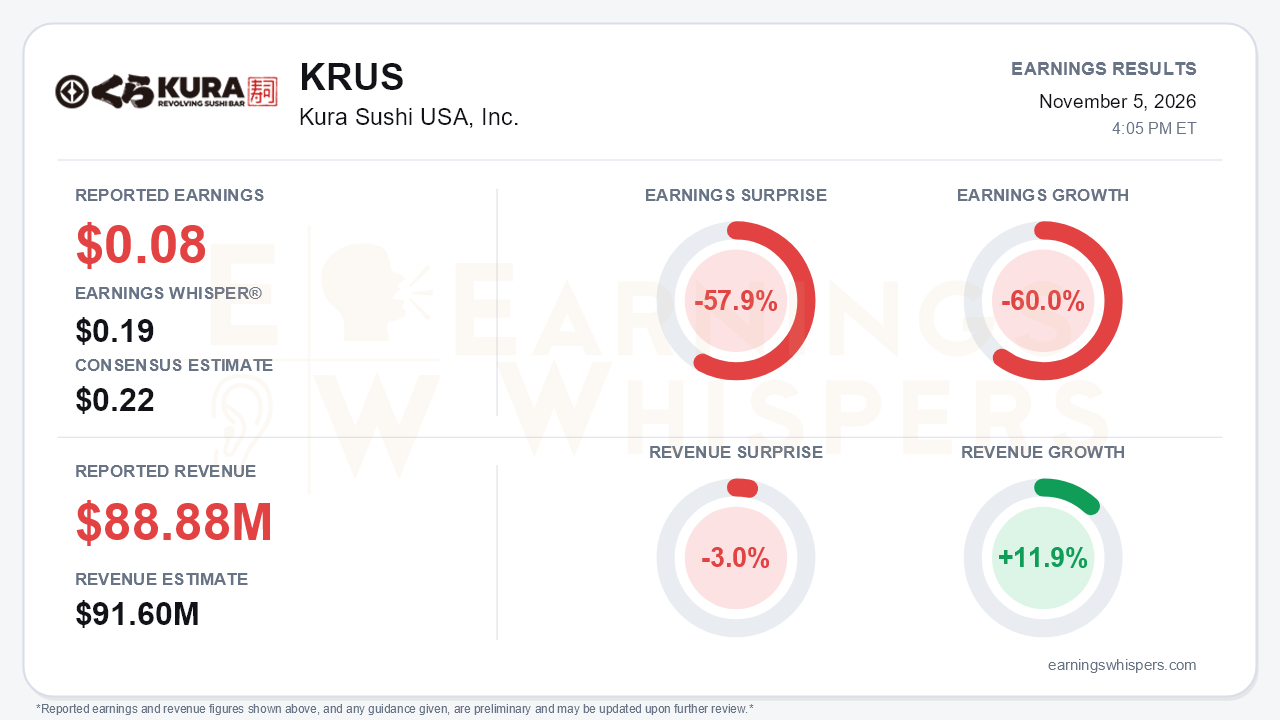
Kura Sushi USA's fiscal fourth quarter was a clear miss, and the quarter's damage came from the top line rather than cost control. Adjusted EPS of $0.08 fell well short of the $0.22 consensus and the $0.19 Earnings Whisper number, a 57.9% shortfall, and adjusted earnings fell 60.0% from a year ago. On a GAAP basis the company swung to a net loss of $(0.02) per share from a $0.18 profit. Revenue of $88.88 million rose 11.9% year over year on new units, but it missed the $91.6 million consensus by 3.0% and landed below management's own Q3 guidance. The central development is a traffic breakdown. Comparable sales fell 5.7%, with traffic down 11.5%, and the FY2027 outlook now builds in slower unit growth, zero pricing, and an explicit turn toward value.
The quality of the quarter deserves scrutiny. A record price/mix contribution of +5.8% hid how badly guest counts deteriorated. The sequential trajectory is stark. Comps went from +8.6% in Q2 to -0.4% in Q3 and -5.7% in Q4, while traffic moved from +4.3% to -5.1% to -11.5%. Restaurant-level margin slipped to 19.1% from 19.8% as tariff-driven food costs rose to 29.7% of sales from 28.4%. Even that margin was flattered by a one-time tariff refund of roughly $0.5 million in other costs. A $1.2 million impairment, mostly tied to one underperforming restaurant, pushed operating results to a $0.6 million loss. Below the line, interest income roughly halved as cash fell to $28.4 million from $47.5 million, which removes a cushion that had propped up the bottom line.
Labor was the real bright spot. Labor costs fell to 30.4% of sales from 31.1%. Full-year labor leverage reached 190 basis points against an original 100-basis-point goal, enough to offset roughly 180 basis points of tariff pressure. Adjusted EBITDA still edged up to $7.7 million. Management is targeting another 100 basis points of labor improvement in FY2027, supported by robot dishwasher retrofits (33 done, about 20 remaining). It guided restaurant-level margin to about 19% and G&A to about 11.5% of sales. The cost structure is improving. Demand is the problem.
The call marked a strategic reversal. Management had framed Kura as a quality-first beneficiary of consumer trade-down and had repeatedly reiterated a positive full-year comp goal. It missed that goal, and it is now leaning on overt value. The plan includes $9.99 and $11.99 combos, which reached 5% of mix in a brief pilot with no check degradation, a systemwide launch targeted for fiscal Q2 with paid social support, and no new pricing even as 3.5% of prior pricing rolls off in November. Traffic losses were broad-based and concentrated in weekday lunch. Management also said the World Cup drag did not reverse after the tournament, and some Q4 IP collaborations underperformed, which weakens confidence in IP-driven comps just as the FY2027 slate expands to eight IPs and 12 food LTOs. Quarter-to-date fiscal Q1 comps of -3.1% are less bad than Q4 but still negative. The tone shifted from Q2's confidence to defensive explanation, and dropping regional comp disclosure will not help credibility.
Guidance reinforces the reset. FY2027 sales of $376 million to $381 million came in below estimates, and the low end assumes negative comps. Unit growth was trimmed to 17 openings, about 18%, from prior talk of more than 20%, and the openings are heavily back-half weighted. The offset is a new goal of positive free cash flow and self-funding by FY2031 with no further capital raise. That matters for a company whose cash balance shrank by about $19 million this year. Bears still have legitimate ammunition: value combos, paid advertising, and zero pricing could compress margins further if traffic does not respond.
The market had already priced in much of the slide. Shares hit their inter-earnings high of $54.39 the day after the July report and then gave all of it back. They reached a 52-week low of $29.69 on October 26 before rebounding about 27% to $37.79 heading into the release. That price is still 19.7% below the post-July open and 28.4% under the 200-day moving average. Price and AVWAP trend readings remain negative. Investor sentiment, already negative, deteriorated further from -0.22 to -0.34. That is a meaningful but not extreme shift, and it suggests the pre-report bounce was not built on renewed conviction.
The bottom line is that Kura delivered a demand problem wrapped in a cost-control success. Labor efficiency and G&A leverage give the margin guide credibility, but an 11.5% traffic decline, a guide below expectations, and a retreat from pricing and unit growth show the concept's momentum has broken. The investment case now rests on whether value combos can restore traffic without eroding the margins management worked hard to protect.
Read our earnings preview for Kura Sushi USA, Inc.: https://www.earningswhispers.com/article/KRUS/22325
This earnings review was originally published on Earnings Whispers.
This article is for informational purposes only and is not investment advice. Earnings Whispers and its staff may hold positions in the securities mentioned. It is AI-assisted, based on proprietary Earnings Whispers data and company reports, and edited by Earnings Whispers staff.
Mentioned In This Article
Latest News
| Nov-05 | |
| Nov-05 | |
| Nov-05 | |
| Oct-28 | |
| Oct-15 | |
| Aug-27 | |
| Jul-08 | |
| Jul-07 | |
| Jul-07 | |
| Jul-06 | |
| Jul-01 | |
| Jul-01 | |
| Jun-16 | |
| May-29 | |
| May-21 |
