Organogenesis Shows Sequential Repair, But A Third Guidance Cut, An FDA Setback, And A $26.9 Million Cash Balance Dominate The Quarter
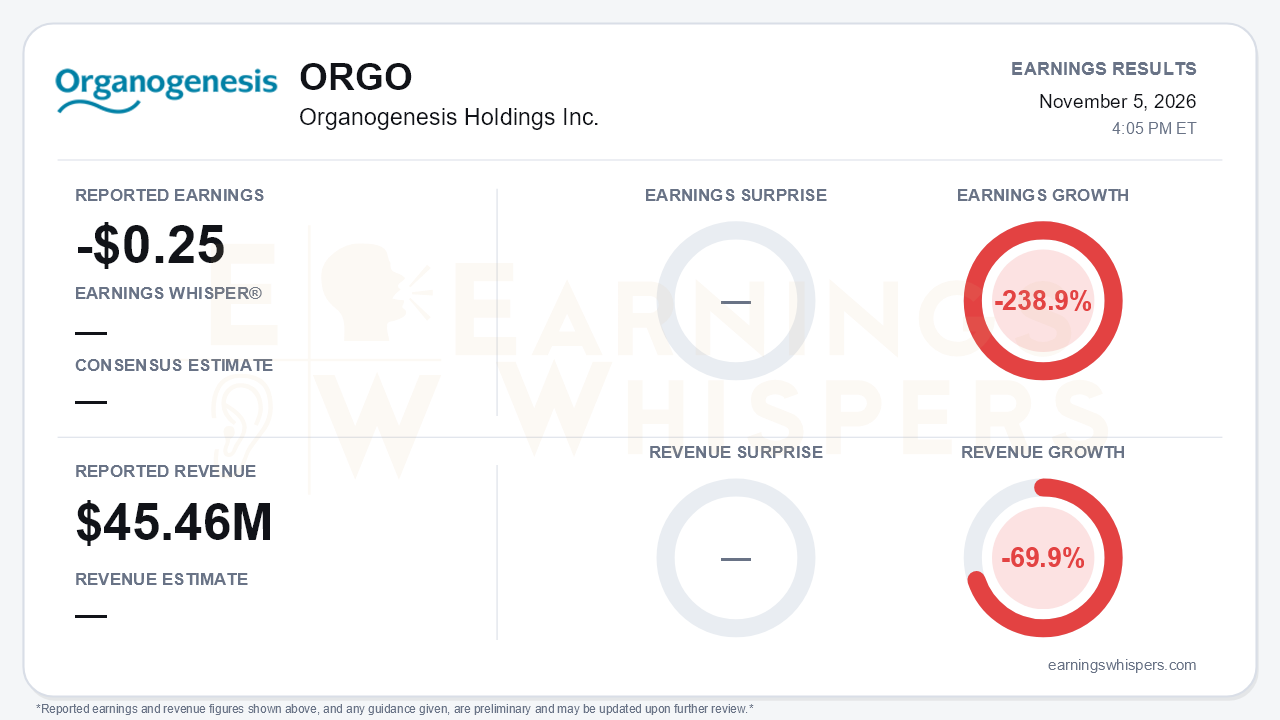
Organogenesis Holdings (NASDAQ: ORGO) reported a third-quarter loss of $0.25 per share on revenue of $45.46 million. That compares with GAAP earnings of $0.11 per share a year ago. Earnings fell 238.9% year over year, and revenue fell 69.9% as the advanced wound care market continued to reset after CMS's 2026 reimbursement and coverage changes. No consensus estimate was available for comparison. The result is best judged against the company's own trajectory, and that is where the central tension sits. The operating business is clearly healing quarter by quarter, but the pace of recovery is slowing just as the balance sheet leaves less room for delay.
The sequential improvements are real. Net product revenue rose 6% from the second quarter. Advanced Wound Care grew 6% to $38.2 million, and Surgical & Sports Medicine rose 10% to $7.3 million. Gross margin recovered to 52%, up from 45% on a GAAP basis in the second quarter and 29% in the first. Restructuring is also working its way through the cost base. Non-GAAP operating expenses fell to about $53 million from $63 million in the second quarter and $80.3 million in the first. Adjusted EBITDA loss narrowed to $22.4 million from $34.4 million and $48.2 million over the same quarters. The headline, however, masks a decelerating recovery. Sequential growth slowed to 6% from 18% in the second quarter. Revenue is still 70% below last year's $150.5 million, and Advanced Wound Care remains down 73%. Unlike earlier quarters, this one carried essentially no restructuring or write-down adjustments. Adjusted net loss of $29.3 million was nearly identical to the GAAP loss, so the remaining loss reflects the core business rather than one-time charges.
Management struck a confident tone on demand. It called a definitive market bottom and said claims data show Organogenesis's share up more than 30% since the first quarter, growing at more than twice the rate of major competitors. It expects double-digit market expansion once roughly 20% of dumped low-cost inventory clears by year-end. Management also pointed to the October publication of the PREPARE randomized controlled trial for PurePly AM. It described a possible reinstatement of the LCD as a strong possibility that could consolidate the market around four or five evidence-backed suppliers. Annualized cost savings were raised to about $45 million from the roughly $32 million previously tied to restructuring alone.
Guidance tells a more cautious story. The full-year revenue range is now $179.4 million to $200.0 million, after the high end was trimmed from $215 million. That is the third consecutive reduction for a year that began with a forecast for a 25% to 38% decline. The Advanced Wound Care outlook was cut at the top to $151-171 million, and Surgical & Sports Medicine to $26-27 million. The implied fourth quarter still requires a meaningful step-up from the third, roughly $53 million to $74 million against $45.5 million. Management now says positive fourth-quarter adjusted EBITDA is achievable only at the high end of the range, a retreat from the high-teens margin target discussed at the start of the year.
The pipeline also slipped. An FDA pre-license inspection of the Norwood facility produced 18 observations. Remediation is not expected to be complete until September 30, 2027, at a total cost of about $8 million, roughly $4 million of it incremental. As a result, the April 24, 2027 PDUFA date for MNUVIX (referenced as Amnuvx in the release's risk factors) will be extended. The FDA has also issued information requests on the clinical data. A key long-term catalyst has therefore moved further out while near-term costs rise.
The balance sheet gives bears legitimate ammunition. Cash fell to $26.9 million from $46.8 million at the end of the second quarter and $94.3 million at year-end. Nine-month operating cash burn of $29.1 million was flattered by a $123.6 million drawdown in accounts receivable, a tailwind that diminishes as the receivables book normalizes. Spending on landlord assets for the Smithfield build-out consumed another $24 million. The company has no debt and an at-the-market facility of up to $75 million, but it has raised only $1.4 million through it so far. It says it is evaluating alternative financing, which makes dilution risk a live issue. The stock opened at $1.75 after the August report, well beneath its current 200-day moving average of $2.32. The market was already treating the recovery narrative with skepticism before this quarter's setbacks.
The bottom line is that Organogenesis delivered the sequential revenue, margin, and cost progress a bottoming story requires. Yet slower growth, another guidance cut, a delayed MNUVIX timeline, and a thin cash cushion mean the recovery must now outrun the company's financing needs. Fourth-quarter execution toward the upper half of guidance, and the terms of any capital raise, will matter more than management's market-bottom call.
This earnings review was originally published on Earnings Whispers.
This article is for informational purposes only and is not investment advice. Earnings Whispers and its staff may hold positions in the securities mentioned. It is AI-assisted, based on proprietary Earnings Whispers data and company reports, and edited by Earnings Whispers staff.
Mentioned In This Article
Latest News
| Nov-05 | |
| Nov-05 | |
| Nov-05 | |
| Oct-12 | |
| Oct-12 | |
| Sep-21 | |
| Aug-06 | |
| Aug-06 | |
| Jul-27 | |
| Jul-09 | |
| Jul-06 | |
| Jun-02 | |
| May-07 | |
| May-07 | |
| Apr-28 |
