NMI Holdings Misses As Credit Normalization Hits, Overshadowing Record Insurance-In-Force
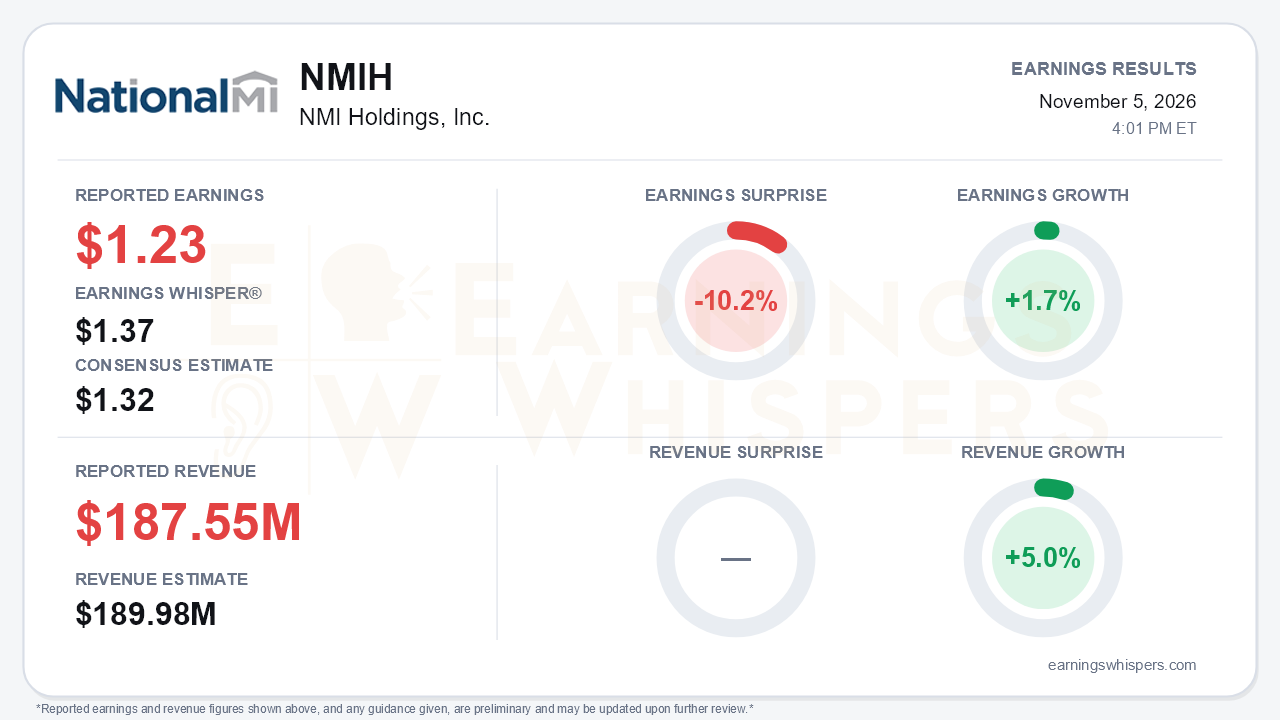
NMI Holdings delivered a clear miss in the third quarter. The problem was not the size of the book. It was the cost of insuring it. Adjusted EPS of $1.23 fell 10.2% short of the $1.32 consensus and further below the $1.37 Earnings Whisper. Revenue of $187.55 million missed by 1.3%. Earnings still grew 1.7% year over year and revenue rose 5.0%, but the sequential view is starker: EPS fell from a record $1.38 in the second quarter, and adjusted return on equity dropped to 13.9% from 15.9%. That is the central tension. Insurance-in-force reached another record, yet the earnings power of each dollar of that portfolio weakened on several fronts at once.
The quality of the miss deserves scrutiny, and it points squarely at credit. Insurance claims and claim expenses more than doubled to $29.1 million from $13.1 million in the second quarter, lifting the loss ratio to 18.7% from 8.3% and the combined ratio to 38.5% from 27.7%. The reserve rollforward shows the mechanics:
- Current-year incurred losses rose to $31.5 million from $27.2 million a year earlier.
- Favorable prior-year development shrank to just $2.4 million from $8.7 million.
- The default inventory climbed to 8,571 loans, a 1.23% default rate, versus 1.05% a year ago.
- The cure rate slipped to 26% from 29%.
- Claims paid jumped to 216 from 93 a year earlier, with severity rising to 87% from 73% and the average claim reaching about $71,000.
GAAP and adjusted results were virtually identical, so this was not an accounting story. The underlying loss environment is normalizing, and the reserve-release cushion that flattered recent quarters is thinning.
Beneath the credit story, the premium engine also lost some momentum. Net premiums earned fell to $155.5 million from $157.5 million. Net yield slipped to 27.2 basis points and core yield to 33.4 basis points after holding steady for three quarters, which undercuts the stable-yield narrative. Annual persistency kept eroding, from 83.4% at year-end to 80.8%. Management tied part of the decline to the 2020 vintage, where borrowers are cancelling coverage under HOPA and through appraisals obtained for HELOC and second-lien loans. New insurance written fell 15% sequentially to $13.6 billion as higher rates choked off refinance volume, which dropped to $634 million from $1.76 billion. Without net investment income, up 20% year over year to $32.2 million, the earnings comparison would have looked considerably worse. Management's tone shifted accordingly, from describing record or terrific quarters earlier in the year to calling this one strong or solid.
The call did preserve a credible longer-term story. Book value per share excluding unrealized gains and losses rose to $38.13, up 3% sequentially and 14% year over year. PMIERs available assets of $3.8 billion leave roughly $1.6 billion of excess. In October the company signed new quota share and excess-of-loss reinsurance treaties that extend forward-flow coverage on new business through 2030 at roughly a 4% pre-tax cost of capital, and management called them among its best ever. Management also said the persistency decline has stabilized in recent data, that the recent rise in rates could help persistency, and that post-COVID vintage loss ratios near 17% are in line with or better than pricing. Bears have legitimate ammunition, however. The October 22 executive order on lowering housing costs introduces policy uncertainty around mortgage insurance pricing and cancellations, even as management positions private MI as an existing affordability solution. Buybacks also slowed to $27.1 million from $31.4 million, with $140 million of authorization remaining.
Investor expectations had already cooled before the release. Earnings Whispers sentiment fell from 0.29 to 0.01, still technically positive but now essentially neutral, a meaningful retreat over the quarter. The price action is more complicated. Shares opened at $45.25 after the prior report, set a 52-week high of $46.74 that day, then slid to a $36.21 low on September 30. They rebounded sharply to $43.96 heading into this report. That leaves the stock down 2.9% since the last earnings open but 21% off its quarterly low and about 9% above its $40.34 200-day moving average. The supporting trend readings lean modestly positive, with AVWAP positive and price trend neutral. In short, the stock entered the report with a recovery largely priced in and a whisper number well above consensus, a setup that leaves little room for a credit-driven miss.
The bottom line is that NMI's third quarter looks like a step down in earnings quality rather than a break in the franchise. The insured book, capital position and reinsurance protection are all stronger than a year ago. But rising defaults, higher severity, fading reserve releases, a lower premium yield and weaker persistency together explain why EPS fell well short of both consensus and the whisper. Investors now have to judge whether the second quarter's 8.3% loss ratio was the anomaly or this quarter's 18.7% is the new baseline. That answer matters more than the record insurance-in-force figure.
Read our earnings preview for NMI Holdings, Inc.: https://www.earningswhispers.com/article/NMIH/22346
This earnings review was originally published on Earnings Whispers.
This article is for informational purposes only and is not investment advice. Earnings Whispers and its staff may hold positions in the securities mentioned. It is AI-assisted, based on proprietary Earnings Whispers data and company reports, and edited by Earnings Whispers staff.
Mentioned In This Article
Latest News
| Nov-05 | |
| Nov-05 | |
| Nov-05 | |
| Oct-30 | |
| Oct-28 | |
| Oct-14 | |
| Jul-31 | |
| Jul-30 | |
| Jul-30 | |
| Jul-29 | |
| Jul-02 | |
| May-26 | |
| May-12 | |
| May-01 | |
| Apr-30 |
