Suzano Crushes Estimates As Pulp Strengthens And Arbex Arrives, But Costs, Paper, And Leverage Temper The Beat
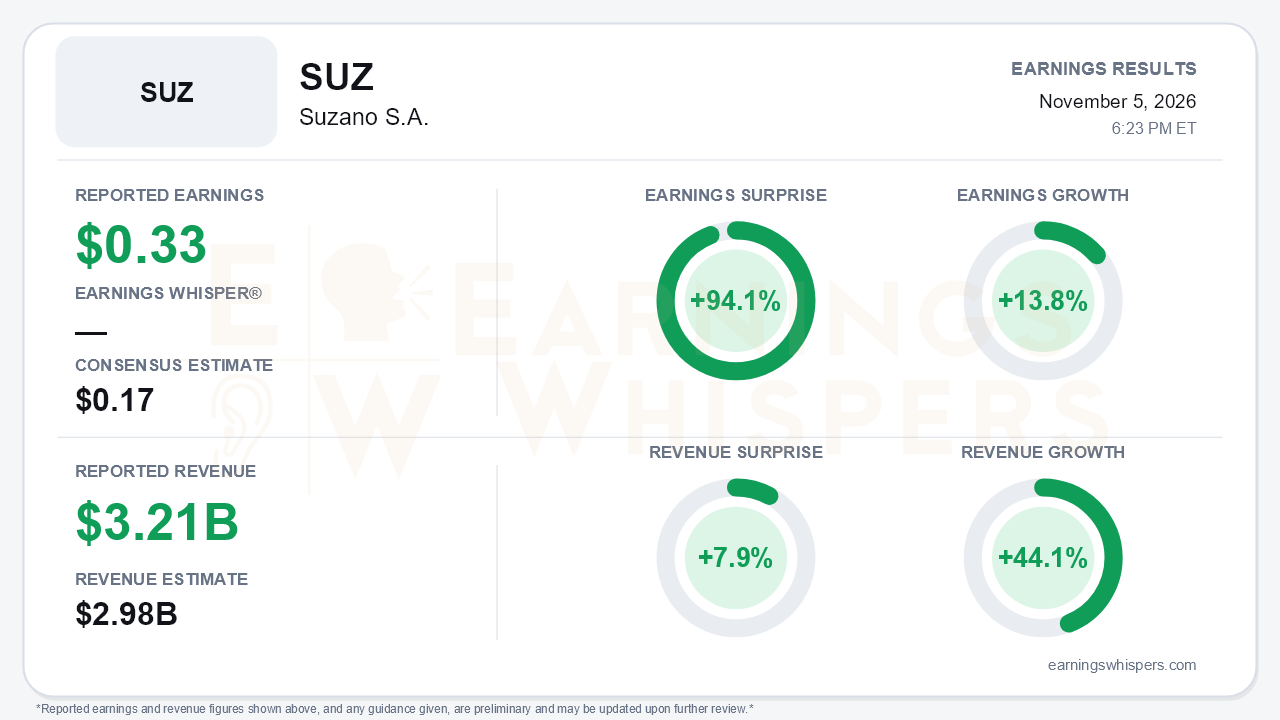
Suzano delivered a large third-quarter beat, but the surprise says more about pulp-market strength and a new consolidation than about a cleaner balance sheet or lower costs. The pulp producer reported earnings of $0.33 per share, beating the $0.17 consensus by 94.1%. Revenue of $3.214 billion topped the $2.98 billion estimate by 7.9%. Earnings grew 13.8% year over year, while revenue jumped 44.1%. The gap between those growth rates is the first clue to the quarter. This was the first period to include Arbex, the Kimberly-Clark joint venture in which Suzano holds 51%, and that consolidation, not organic acceleration, drove most of the top-line surge. Those results came alongside a worse cost outlook, a stumble in paper and packaging, and reported leverage that moved the wrong way. That is the central tension.
The quality of the beat deserves scrutiny. In local currency, net revenue reached a record R$16.5 billion, up 36%. The faster dollar growth rate reflects currency translation. Adjusted EBITDA rose only 9% to R$5.7 billion, and operating cash generation increased 12% to R$3.8 billion. Revenue growth far outpacing EBITDA growth is consistent with Arbex's mix. The new Consumer Goods unit generated R$5.0 billion in revenue, R$4.2 billion of it international, and R$803 million in adjusted EBITDA, a roughly 16% margin. By comparison, pulp margins ran near 50%. Arbex broadens Suzano's geographic and product base, but it dilutes consolidated margins. Kimberly-Clark's 49% stake will also flow through non-controlling interests, so headline revenue overstates the economics that accrue to Suzano shareholders.
The stronger story sits in the core pulp business, which carried the quarter:
- **Earnings and margin:** Pulp EBITDA rose to R$4.8 billion, up 12% sequentially, from R$4.2 billion in the second quarter and R$4.1 billion in the first. Margin expanded to 50% from 48%.
- **Volumes:** Sales reached 3.19 million tonnes, up from 2.9 million and 2.84 million tonnes in the prior two quarters.
- **Pricing:** The export price averaged $591 per tonne, up 13% year over year but slightly below the second quarter's $601.
- **Unit costs:** Quarterly cash cost fell 2% sequentially to R$825 per tonne.
Management's tone on the market was notably constructive. October price increases were fully implemented globally, China order intake reached historic levels, and invoicing backlogs stretched beyond two months. Supply is also tightening. The startup of the OKI2 mill slipped into 2027, with a mid-third-quarter base case. Indonesian wildfires and a fire at the OKI1 mill added disruption. Permanent closures exceed 1 million tonnes, and unexpected downtime has reached about 2.3 million tonnes year to date. Management also said the first cases of Western de-verticalization, the 'imminent' deals it flagged earlier in the year, are now materializing.
Bears still have legitimate ammunition. Full-year 2026 cash cost guidance excluding downtime moved to roughly R$825 per tonne from the R$800 reaffirmed in the first and second quarters. Management cited a higher Brent assumption ($94 versus $84) and a weaker real. A year ago, the company had framed a run-rate near R$778. The cost outlook may get worse, because Brent was about $98 at quarter end and Middle East-driven chemical inflation persists. Paper and packaging was weaker on several fronts:
- **Earnings:** Combined EBITDA fell 14% sequentially.
- **Pine Bluff:** Reliability problems at the plant undercut a second-quarter promise of a strong second half without major events.
- **SAP rollout:** A July system implementation disrupted Brazilian paper exports, which fell 27% year over year.
- **Home market:** Brazilian paperboard demand dropped 9% sequentially as imports surged.
The call analysis also flags 2027 cost targets as at risk ahead of a December update. Those targets include a R$787 cash cost premised on $70 Brent.
The balance sheet is the swing factor. Reported net debt climbed to $14.7 billion after the $1.3 billion Arbex purchase and consolidation of the joint venture's debt. Reported net leverage reached 3.7 times, or 3.4 times including Arbex's trailing EBITDA on a pro forma basis. That compares with 3.2 times at the end of 2025. Excluding Arbex, net debt of $12.5 billion remains well above the earlier $11 billion ambition. Management guided to net debt below $14 billion by year-end, with the fourth quarter expected to be the strongest of the year and no asset sales assumed. It also reaffirmed the $175 million synergy target for Arbex over three years. Reported leverage will not fully reflect Arbex's earnings until mid-2027.
Investors are not treating the beat as a clean win. Earnings Whispers sentiment, already slightly negative at -0.058 before the prior report, fell meaningfully to -0.257. Meanwhile, the stock has risen 17.1% since opening at $8.11 after the August report and now trades at $9.50, about 5% above its 200-day moving average. Much of the pulp upcycle already appears reflected in the share price, even as conviction has cooled.
The bottom line is that Suzano's core pulp franchise is in its strongest position of the year, with rising prices, volumes, and margins against a tightening supply backdrop. The Arbex consolidation flatters headline growth more than per-share economics. Higher cost guidance, a faltering paper unit, and elevated leverage leave the next leg dependent on pulp prices holding and Suzano meeting its year-end debt target.
Read our earnings preview for Suzano S.A.: https://www.earningswhispers.com/article/SUZ/22396
This earnings review was originally published on Earnings Whispers.
This article is for informational purposes only and is not investment advice. Earnings Whispers and its staff may hold positions in the securities mentioned. It is AI-assisted, based on proprietary Earnings Whispers data and company reports, and edited by Earnings Whispers staff.
Mentioned In This Article
Latest News
| Nov-06 | |
| Nov-05 | |
| Oct-28 | |
| Aug-04 | |
| Jul-01 | |
| Jun-01 | |
| May-06 | |
| May-06 | |
| Apr-29 | |
| Apr-28 | |
| Apr-01 | |
| Mar-03 | |
| Mar-02 | |
| Mar-02 | |
| Mar-02 |
