PSQ Holdings Shrinks Losses And Cash Burn, But Slowing Growth, A Steep Q4 Target And NYSE Listing Risk Define The Setup
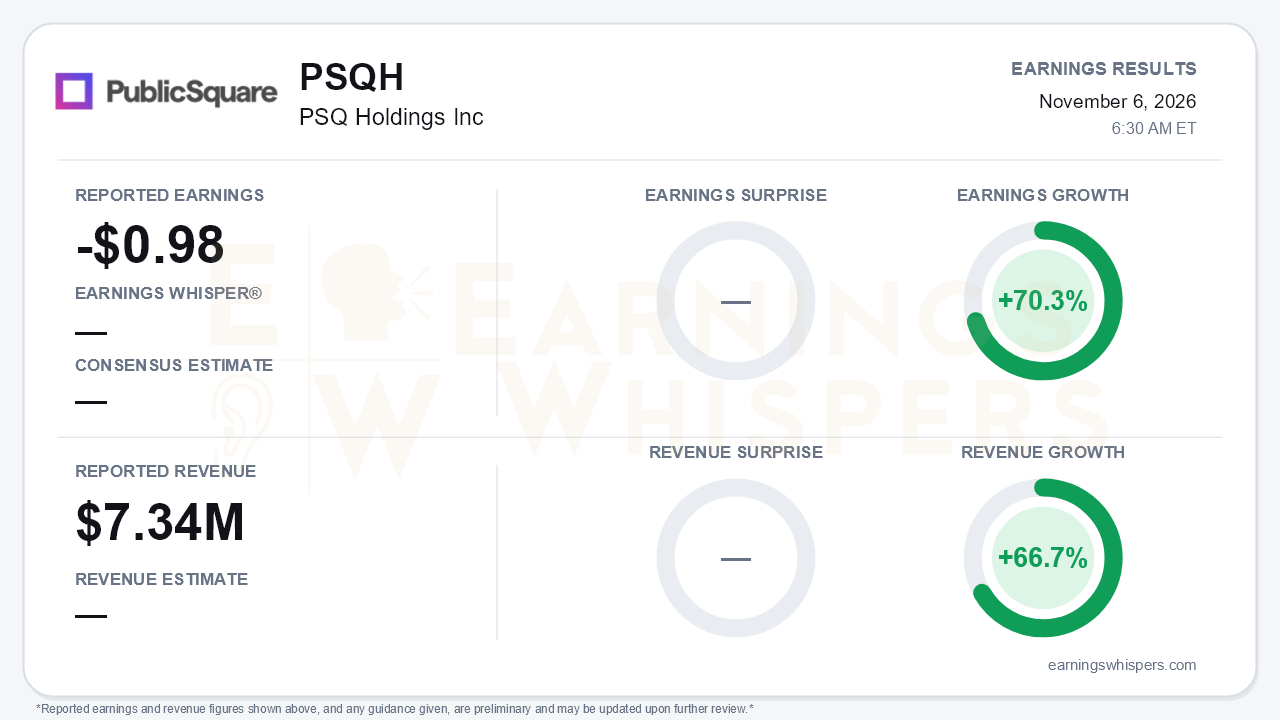
PSQ Holdings reported a third-quarter loss from continuing operations of $0.98 per share, a 70.3% improvement from a year ago. Revenue rose 66.7% to $7.34 million. No consensus estimate was available, so there is no beat or miss to measure. The more useful comparison is internal. The company is executing well on costs, but its top-line growth is slowing sharply and its balance sheet is getting thinner. That is the central tension. PSQ has nearly finished cutting its way to break-even, yet it has not shown that revenue can carry the business from here. The headline per-share figure also differs depending on the measure. Net loss including discontinued operations was $1.00 per share, versus $3.90 a year ago, and both figures reflect the 1-for-15 reverse split that took effect in July.
The cost story is real. Operating expenses fell 50% year over year. GAAP operating loss narrowed to $3.3 million from $9.7 million. Quarterly operating cash burn has fallen every quarter this year: $4.1 million in Q1, $2.3 million in Q2 and $1.7 million in Q3, a figure that included roughly $600,000 of one-time costs. Headcount is down to 35 from 47 in Q1. Annualized savings reached about $10 million against an $8 million commitment.
The quality of the second straight quarter of positive non-GAAP operating income deserves scrutiny. The $0.3 million figure excludes three items:
- share-based compensation;
- depreciation and amortization;
- $1.65 million of corporate costs not allocated to segments.
That last exclusion is more aggressive than typical adjustments. The $0.3 million also sits against roughly $1 million of quarterly interest expense on convertible notes and the revolver.
Beneath the revenue line, the trend is decelerating. Year-over-year growth went from 167% in Q1 to 108% in Q2 to 67% in Q3. Management had warned in Q2 that growth would slow to above 50%, so this was telegraphed, but the direction is unmistakable.
Mix is also eroding profitability. Revenue less cost of revenue fell to 52% from 67% a year ago as lower-margin payments volume became a larger share. Payments volume itself was strong at $197.3 million, up 121% and above Q2's $172.5 million.
Credit is softening. Origination growth slowed to 23% from 32% in each of the first two quarters. Applications from sub-640 credit scores are down about 7%. Management acknowledged that credit growth now depends on conversion rather than new demand, and that conversion has limits.
Management reaffirmed its 2026 outlook of $32 million in revenue and positive full-year non-GAAP operating income. With $22.6 million booked through nine months, that requires a record fourth quarter of roughly $9.4 million. That would exceed Q1's $8.2 million peak by a wide margin. The company points to three supports:
- seasonal hunting and holiday demand across its firearms and outdoor merchants;
- initial loan-repayment processing through LendSuite, Dealer Cash and Roja, which reach about 150 lenders and more than 100 Texas auto dealers;
- historical precedent, which management cited, that election-driven shifts toward Democratic control pull forward firearm demand.
These are credible catalysts, but the lender integrations were described as building into 2027. Their near-term contribution is unproven.
Bears have legitimate ammunition on the balance sheet:
- Unrestricted cash from continuing operations is just $3.8 million, down from $10.1 million at Q1.
- The revolver is $6.8 million drawn against a $10 million line.
- Stockholders' equity has dropped to $1.7 million from $13.4 million at year-end, against $28.4 million of convertible notes.
- The EveryLife sale, first framed as $5.5 million all-cash, closed for $1 million in cash plus a $4.5 million note paid over 12 months.
- Management disclosed risk to the NYSE listing tied to the $15 million average market-cap threshold and said it is talking with the exchange almost daily about exemptions and capital options.
On the positive side, the material weakness has been remediated. An August private placement drew every eligible director, was priced at a premium and carried no warrants.
The market setup has been punishing. Shares opened at $3.35 after the July report, less than half the $7.33 200-day moving average. Current price data and post-report sentiment were not available. Investor sentiment going into the prior report was solidly positive at 0.56, which suggests the investor base had been willing to back the restructuring narrative even as the stock lagged.
The bottom line is that PSQ delivered the discipline it promised: smaller losses, lower burn and a cleaner, payments-only company. Fundamentals still face three tests at once: decelerating growth, compressing margins and a fragile capital position. The fourth quarter is now a proving ground. Hitting the roughly $9.4 million implied target would validate the guidance and ease liquidity concerns. Falling short would likely sharpen questions about funding and the listing that the cost cuts alone cannot answer.
This earnings review was originally published on Earnings Whispers.
This article is for informational purposes only and is not investment advice. Earnings Whispers and its staff may hold positions in the securities mentioned. It is AI-assisted, based on proprietary Earnings Whispers data and company reports, and edited by Earnings Whispers staff.
Mentioned In This Article
Latest News
| 1 hour | |
| 9 hours | |
| Nov-05 | |
| Nov-05 | |
| Aug-21 | |
| Aug-18 | |
| Aug-14 | |
| Aug-13 | |
| Aug-06 | |
| Aug-03 | |
| Jul-31 | |
| Jul-29 | |
| Jul-29 | |
| Jul-29 | |
| Jul-28 |
