Hawaiian Electric's Core Earnings Slide 31.6% As Storm Costs And Rate Delays Overshadow Settlement Prepayments And A First 2027 Earnings Path
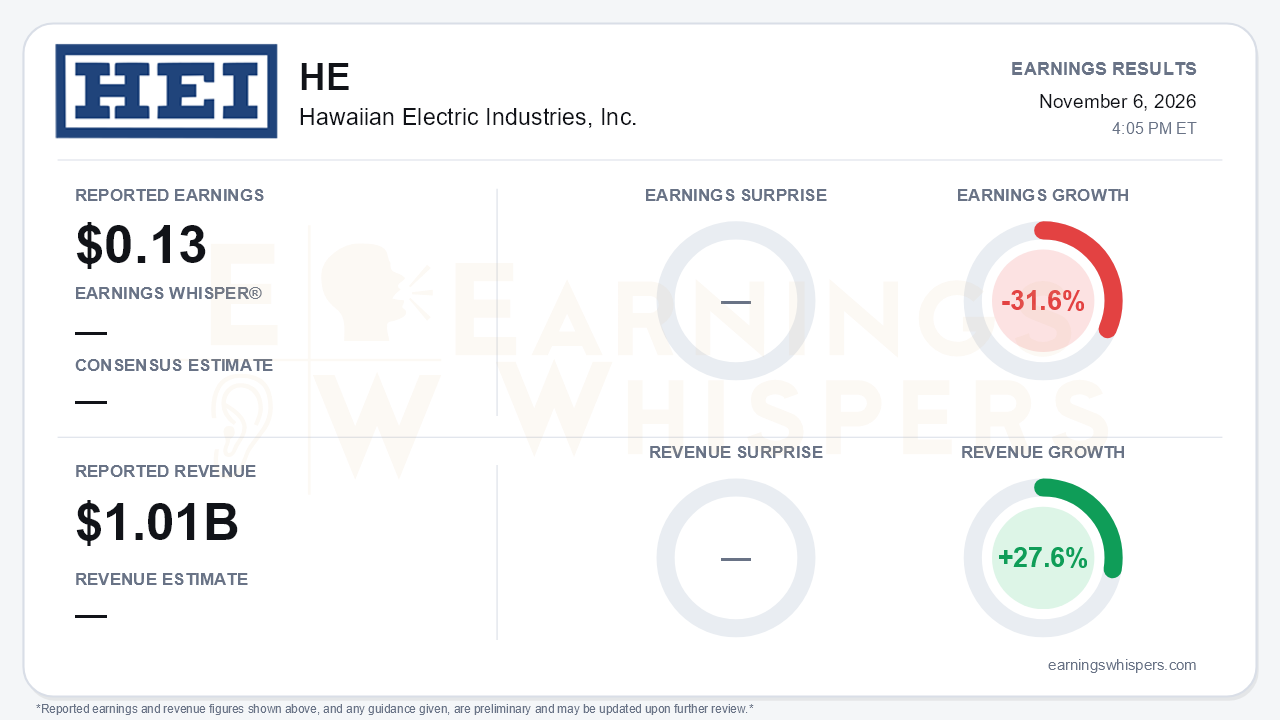
Hawaiian Electric Industries reported third-quarter core earnings of $0.13 per share, down 31.6% from a year ago, on revenue of $1.009 billion, up 27.6%. There was no consensus estimate to measure against, so the quarter has to be judged on its trajectory, and that trajectory remains negative. Management is clearly repairing the balance sheet and the wildfire-settlement overhang. The utility's earnings power is still eroding, and the arrival of new rates has slipped. That is the central tension: the holding company's financial position is improving faster than the utility's income statement.
The headline numbers need unpacking. GAAP net income rose to $35 million, or $0.20 per share, from $0.18. That increase came from $64 million of pre-tax realized and unrealized gains on HEI's remaining American Savings Bank stake after the September IPO. A $51 million impairment tied to the collapsed sale of Pacific Current's Mahipapa biomass plant partly offset those gains. Core net income, which strips out those items and wildfire-related charges, fell to $23 million from $33 million.
The revenue growth is similarly misleading. It largely reflects fuel pass-through. Average fuel oil cost jumped to $154.87 per barrel from $98.20, and fuel oil expense climbed by roughly $158 million. Revenue net of fuel and purchased power rose only about $8 million, mainly from the annual revenue adjustment mechanism. Kilowatt-hour sales were essentially flat at 2,257 million versus 2,234 million.
Beneath that, the utility's core earnings are on a steady downward slope. Utility core net income was $27.6 million, versus $39.6 million a year ago. It has also declined sequentially all year: $35.7 million in Q1, $32.6 million in Q2 and now $27.6 million. Operations and maintenance expense rose $20 million. That increase included $14 million of incremental storm costs from three hurricanes in August and September, which knocked out power to more than 40% of customers at peak. It also included about $6 million of holding-company costs shifted to the utility after integration that are not covered by customer rates.
On a GAAP basis, interest expense nearly doubled at the consolidated level, to $47.7 million from $26.2 million. About $18 million of that is non-cash accretion on the settlement liability, a quarterly drag the call indicated will persist. The storm costs may eventually be recovered through a deferral request and a Z-factor filing in 2027, but neither has been approved.
The call nonetheless preserved a credible repair story, and management's tone was its most confident of the year. HEI has prepaid $80 million of the $479 million April 2027 settlement installment. It plans to prepay at least another $100 million, which would take the remaining amount below $300 million. Liquidity held near $1.3 billion. The wildfire securitization request grew to up to $500 million from the $350 million referenced last quarter. Management also gave its first illustrative 2027 framework:
- $83 million of partial-year rebasing revenue, or a $125 million run-rate
- Core ROE of 7.3%-7.8% for the partial year, or 8.3%-8.8% on a full-year basis
The performance-based regulation (PBR) staff proposal largely tracks the company's positions. Under that proposal, performance incentive mechanisms (PIMs) carry up to roughly $33 million of upside against about $11 million of downside. Management also raised the possibility of revisiting the dividend.
Bears have legitimate ammunition, however. In Q2 the company was seeking interim rates by January 1, 2027. New rates are now illustrated as starting around early May 2027, extending the period in which costs run ahead of revenue. Draft rules on a liability cap are not expected until 2027. Management acknowledged that the at-the-market equity program is unusable at the current share price, which is a telling admission about the cost of capital. The remaining prepayments are expected to be financed with debt or convertibles.
The market has treated the stock harshly. Shares sat at $8.44 heading into the report, down 30.5% from the $12.15 open after the August release and about 35% below the 200-day moving average of $13.03. The stock set a 52-week low of $8.15 on October 26 and entered earnings just 3.6% above it, near the bottom of an inter-earnings range that peaked at $12.22 on the first day after the prior report. Investor sentiment edged up from slightly negative (-0.04) to roughly neutral (+0.02). That is a modest shift that signals ambivalence rather than conviction in either direction.
The bottom line is that HEI is executing on the balance-sheet side faster than its utility earnings can stabilize. The settlement liability is shrinking, liquidity is solid and 2027 now has a defined ROE target. But core earnings fell again, storm recovery is unapproved, and rate relief has been pushed back four months. With shares pinned near their lows, the stock likely needs evidence that utility core income has stopped declining, along with regulatory wins on rates and storm deferral, before the improving balance sheet translates into a better equity story.
Read our earnings preview for Hawaiian Electric Industries, Inc.: https://www.earningswhispers.com/article/HE/22509
This earnings review was originally published on Earnings Whispers.
This article is for informational purposes only and is not investment advice. Earnings Whispers and its staff may hold positions in the securities mentioned. It is AI-assisted, based on proprietary Earnings Whispers data and company reports, and edited by Earnings Whispers staff.
Mentioned In This Article
Latest News
| Nov-06 | |
| Nov-06 | |
| Oct-29 | |
| Aug-08 | |
| Aug-08 | |
| Aug-07 | |
| Jun-24 | |
| May-08 | |
| May-08 | |
| Apr-06 | |
| Mar-06 | |
| Mar-04 | |
| Mar-02 | |
| Feb-28 | |
| Feb-28 |
