Baytex Beats And Lifts Its Growth Plan, But Shares Have Already Given Back An October Rally
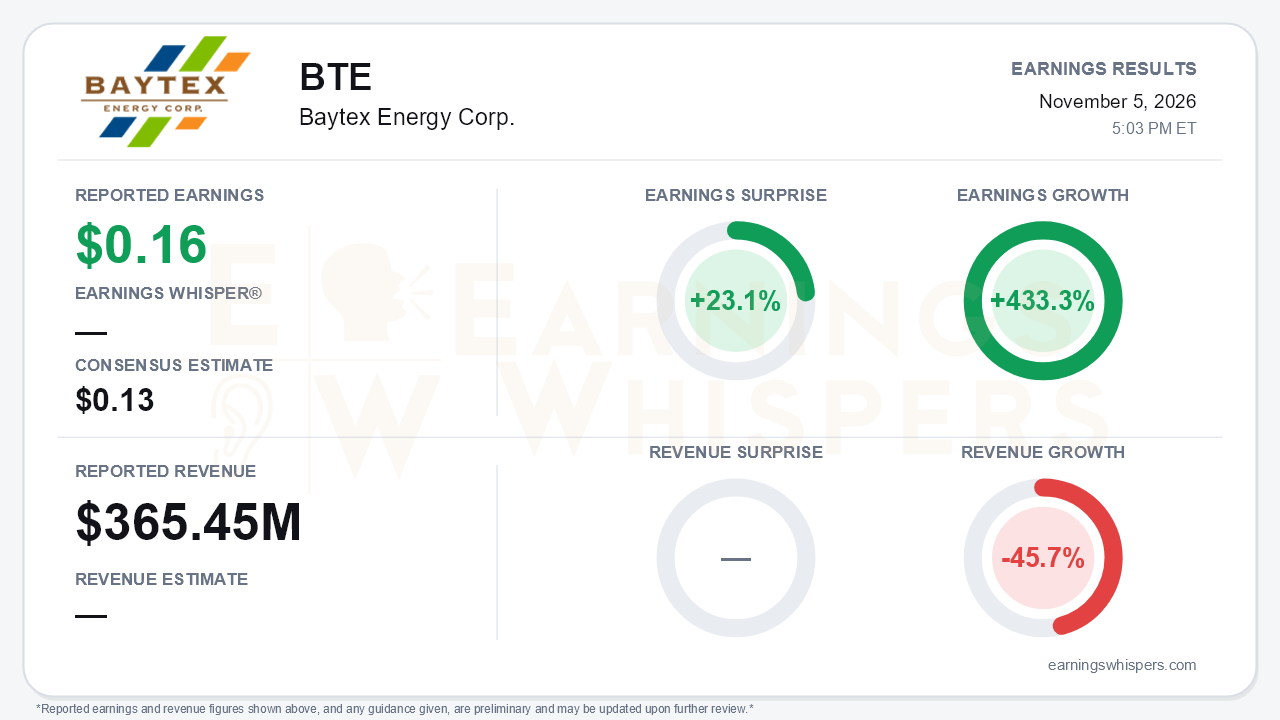
Baytex Energy delivered a clean third-quarter beat, but the more important development was strategic. The company is turning a cash-rich, post-divestiture balance sheet into an accelerated organic growth plan. Reported EPS of $0.16 topped the $0.13 consensus by 23.1%, and earnings grew 433.3% year over year. Management paired the beat with first 2027 guidance of 76,000-79,000 boe/d and raised its three-year production growth target to 8%-10%. The central tension is that the forward story improved materially just as near-term growth, capital returns and the balance sheet cushion all started to soften at the margin.
The headline numbers need context. The 45.7% year-over-year revenue decline reflects the December 2025 sale of the U.S. Eagle Ford business. The year-ago quarter still included about 82,800 boe/d of discontinued production. On a continuing Canadian basis, petroleum and natural gas sales rose to C$606 million from C$438 million, and the operating netback climbed to C$53.06/boe from C$36.10.
The earnings leap has three main sources:
- **Higher oil prices.** WTI averaged US$85.79, versus US$64.93 a year earlier.
- **Interest expense eliminated.** A swing from roughly C$40 million of quarterly cash interest expense to net interest income.
- **A smaller share count.** Weighted shares fell about 9%.
Sequentially, the picture is less flattering. Sales, netbacks and net income all slipped from Q2 as WTI eased. Adjusted funds flow rose to C$332 million, but that was helped by a C$5.8 million hedging gain versus an C$84 million loss in Q2. (The call summary cited C$313 million; the release reports C$332 million.) Free cash flow of C$139 million improved modestly from C$128 million despite heavier spending.
Operationally, the quarter showed efficiency gains rather than volume acceleration. Production of 71,606 boe/d was in line with plan, but year-over-year growth slowed to 5% from 11% in Q2. The Duvernay was the clear standout:
- Record output of 12,806 boe/d, up 26%.
- Drill-and-complete costs of C$930/ft, 11% below 2025 and better than the C$1,000 budget.
- Faster cycle times that freed up two additional wells this year.
- Tuck-in deals that lifted acreage 16% to 106,000 net acres.
Those gains pulled the 25,000 boe/d Duvernay target forward 18 months to the second half of 2028. Operating cost guidance improved to about C$13.30/boe. The sustaining breakeven is expected to fall to US$50 WTI in 2027 from US$52. The growth target has now climbed in steps, from roughly 4% at the midpoint early in the year, to 6%-8%, to 8%-10%. The call preserved a credible, and increasingly self-funded, growth story.
Bears still have legitimate ammunition. Several items moved the wrong way:
- 2026 capex rose to C$665 million, but management says the extra spending will not add 2026 volumes.
- 2027 spending steps up to C$775-850 million, with about 60% weighted to the second half.
- Transportation cost guidance worsened to about C$3.75/boe, and the royalty rate rose to about 16%.
- Net cash has eroded from C$591 million in Q1 to C$522 million, and management guided toward about C$400 million at year-end.
- The initial 2027 buyback allocation is just C$150 million, versus about C$650 million in 2026.
- Wide WCS differentials and modest cost inflation were flagged, with no 2027 WCS or WTI hedges in place.
- A Gemini thermal FID in the second half of 2027 would add spending.
- The Peavine waterflood response will not be known until mid-2027.
In short, shareholders are being asked to accept slower buybacks in exchange for barrels.
Investor sentiment moved decisively in Baytex's favor. It rose from 0.17 to 0.50, a meaningful shift toward optimism heading out of the report. Price action is more sobering. Shares reached a 52-week high of $5.61 on October 27, then fell 25.5% to $4.18. That leaves the stock just 2% above its open after the July report and 5.6% below its 200-day moving average of $4.43. The stock also traded near the bottom of its post-report range. The Earnings Whispers trend readings are mostly neutral, with sequential growth negative, consistent with the Q2-to-Q3 softening.
The bottom line is that Baytex used a solid beat to reset its long-term trajectory higher, backed by real cost and cycle-time improvements rather than price alone. The market setup is more complicated than the surprise implies. Near-term growth is decelerating, capital returns are being dialed back, and the stock has surrendered its October gains. The plan's payoff depends on 2027 execution, back-half-weighted Duvernay ramps and heavy oil differentials that remain unhedged.
Read our earnings preview for Baytex Energy Corp.: https://www.earningswhispers.com/article/BTE/22253
This earnings review was originally published on Earnings Whispers.
This article is for informational purposes only and is not investment advice. Earnings Whispers and its staff may hold positions in the securities mentioned. It is AI-assisted, based on proprietary Earnings Whispers data and company reports, and edited by Earnings Whispers staff.
Mentioned In This Article
Latest News
| 1 hour | |
| Nov-05 | |
| Nov-05 | |
| Nov-05 | |
| Oct-29 | |
| Oct-28 | |
| Oct-27 | |
| Jul-31 | |
| Jul-31 | |
| Jul-30 | |
| Jul-30 | |
| Jul-30 | |
| Jul-23 | |
| Jul-23 | |
| Jul-08 |
