Ocular Therapeutix Misses As Spending Climbs, But The AXPAXLI NDA Filing And A Redrawn SOL-R Timeline Define The Quarter
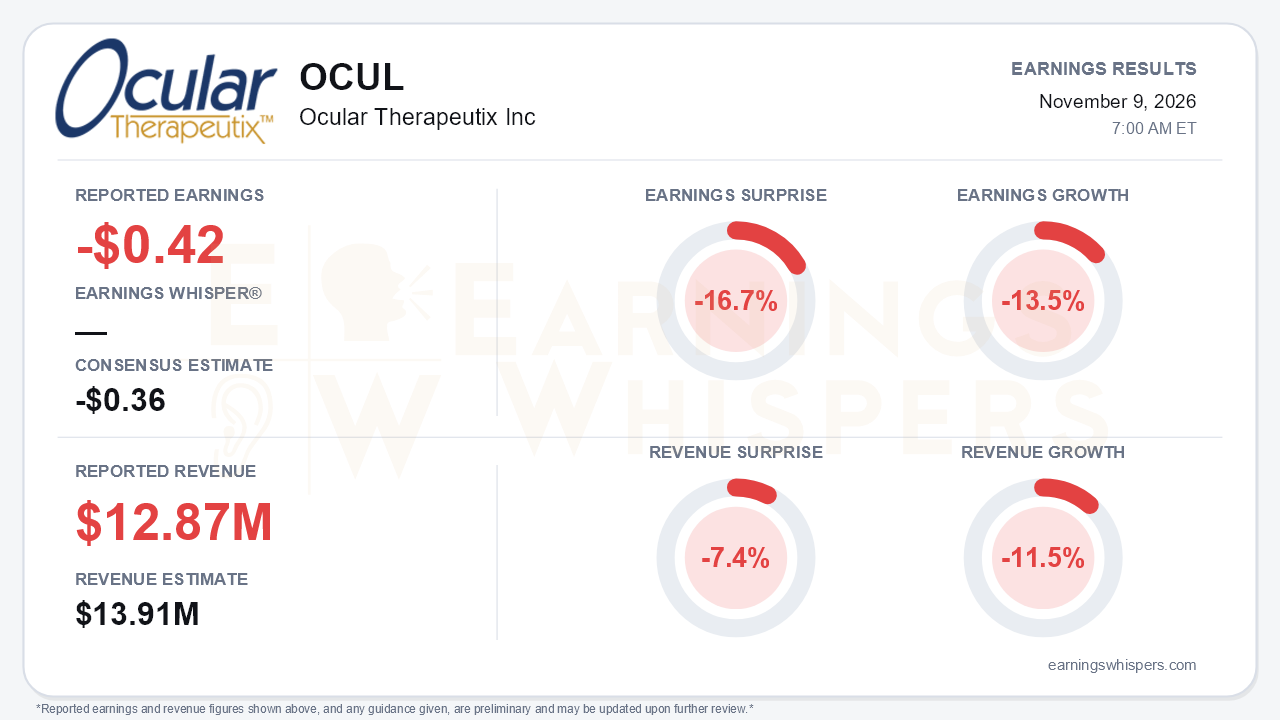
Ocular Therapeutix reported a third-quarter loss of $0.42 per share, wider than the $0.36 consensus by 16.7%. Revenue of $12.87 million missed the $13.91 million estimate by 7.4%. Earnings fell 13.5% year over year, and revenue declined 11.5% as DEXTENZA sales slipped from $14.5 million. For a company whose value rests almost entirely on AXPAXLI, the miss matters less than what surrounds it. Ocular is heading into a fourth-quarter NDA filing with firmer FDA alignment and a thinner competitive field. At the same time, it has changed the timing of its second Phase 3 trial in a way that leaves investors waiting longer for the data that will shape AXPAXLI's commercial case. That is the central tension.
The quality of the loss is straightforward. Net loss widened to $94.8 million from $69.4 million, driven by:
- R&D of $74.8 million, up from $52.4 million, as HELIOS-3 and SOL-X enrollment accelerated;
- selling and marketing of $15.7 million, reflecting pre-launch hiring;
- G&A of $18.8 million.
The per-share deterioration looks milder than the dollar loss only because the weighted share count rose to roughly 225.5 million from 183.9 million. Cash fell to $530.6 million, down from about $667 million at the end of the first quarter and $737.1 million at year-end. Management kept its runway guidance into 2028, but that projection explicitly excludes the full cost of scaling manufacturing and the commercial team. Bears have legitimate grounds to expect another financing around approval.
On the regulatory front, the call delivered real progress. The NDA has moved over the past year from contingent on FDA discussions to on track for this quarter, following a positive September pre-NDA meeting. The filing will rest on SOL-1 Week 52 efficacy plus a combined safety database of more than 300 patients with at least one year of follow-up. Ocular plans to file under the 505(b)(2) pathway, which management says could shorten review by up to 60 days.
The competitive backdrop also shifted. A peer TKI program was discontinued, and management now calls AXPAXLI the only intravitreal sustained-release maintenance agent with positive Phase 3 wet AMD data. Commercial preparation advanced as well:
- pre-approval payer discussions now cover 100% of top-priority accounts, representing about 84% of commercial lives;
- former Alcon executive Riad Sherif joined the board;
- SOL-X dosing was extended to every 48 weeks, a signal of confidence in annual dosing.
The SOL-R changes are where skepticism is warranted. The primary endpoint moved from Week 56 to Week 40 so that every subject passes the efficacy visit before the Week 52 interim safety unmasking. Management had previously described Week 56 as the optimal timepoint, and analysts pressed on whether the FDA drove the change. The interim look carries an alpha penalty that management characterized as minimal.
More consequentially, SOL-R will stay masked through Week 96, and the release now places topline results in the first quarter of 2028. Earlier in the year, management had pointed to the first quarter of 2027, and the call did not reiterate that timing. The release and the call are consistent in substance: non-inferiority data against Q8W aflibercept, the readout that matters most for U.S. positioning, appears to have slipped roughly a year.
The new post-hoc analyses carry their own caveats. They show that 28% of SOL-1 patients had early persistent fluid and worse outcomes, and that SOL-R screened out about 20% of otherwise eligible subjects for similar traits. Management frames this as validating SOL-R's enrichment design. Post-hoc slicing is not prospective evidence, however. Enrichment also raises the question of how broadly AXPAXLI's results will translate in real-world practice. Peer TKI setbacks could also invite class-level scrutiny of non-inferiority designs. HELIOS-2 went unmentioned.
The market had been treating the stock harshly before the report. Shares closed at $6.60 on November 6, down 20.4% from the $8.28 open after the August report. The stock had spiked to $11.74 on August 19, then gave all of that back and more, setting a 52-week low of $6.00 on October 19. It sits less than 10% above that low and 26.8% below its 200-day moving average of $9.01, with price and AVWAP trends still negative. Investor sentiment remained negative but improved meaningfully, rising from -0.33 to -0.18. That suggests expectations had become depressed enough that the filing reaffirmation could register as incremental good news rather than old news.
The bottom line is that Ocular's financial miss is largely noise for a pre-launch biotech, while the regulatory story genuinely firmed. The NDA is days or weeks from submission, FDA alignment looks solid, and the competitive field has narrowed. The cost is a longer wait for SOL-R efficacy and a shrinking cash cushion that does not fully fund a launch. With shares near their lows and sentiment still below neutral, the setup now hinges on FDA acceptance of the filing and on whether investors will tolerate the delayed SOL-R readout.
Read our earnings preview for Ocular Therapeutix Inc: https://www.earningswhispers.com/article/OCUL/22581
This earnings review was originally published on Earnings Whispers.
This article is for informational purposes only and is not investment advice. Earnings Whispers and its staff may hold positions in the securities mentioned. It is AI-assisted, based on proprietary Earnings Whispers data and company reports, and edited by Earnings Whispers staff.
Mentioned In This Article
Latest News
| Nov-09 | |
| Nov-09 | |
| Nov-09 | |
| Nov-09 | |
| Nov-06 | |
| Nov-02 | |
| Nov-02 | |
| Oct-29 | |
| Oct-09 | |
| Oct-08 | |
| Oct-04 | |
| Oct-01 | |
| Oct-01 | |
| Sep-28 | |
| Sep-18 |
