Orthofix's EPS Beat Masks A U.S. Spine Breakdown And A Deeper Guidance Reset
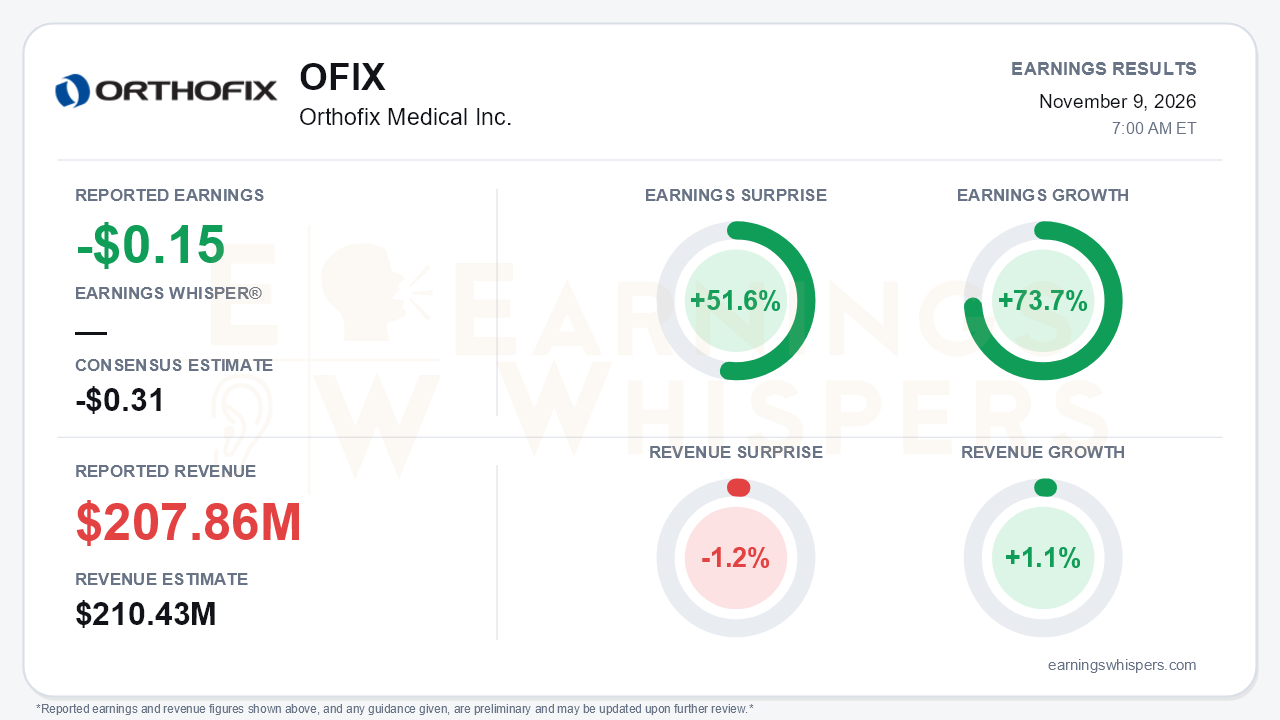
Orthofix Medical (NASDAQ: OFIX) cleared the earnings bar with room to spare but delivered the kind of quarter that changes the investment debate for the worse. The company reported a third-quarter loss of $0.15 per share, well ahead of the -$0.31 consensus, a 51.6% surprise and a 73.7% year-over-year improvement from the $0.57 loss a year earlier. Revenue told a different story. Net sales of $207.86 million rose just 1.1% and missed consensus by 1.2%. Management cut full-year net sales guidance to $825-$830 million from $845-$855 million. It also lowered adjusted EBITDA guidance to $86-$88 million from the $95-$98 million range it had held since the fourth-quarter report. That is the central tension: a narrower loss on the income statement alongside a top-line trajectory that broke down in the company's largest business.
The quality of the beat deserves scrutiny. Most of the swing from a $17.0 million operating loss to $1.5 million of operating income came from SG&A. Litigation and investigation costs fell to $0.3 million from $21.5 million in the prior-year quarter. Adjusted EBITDA did improve to $26.0 million, or 12.5% of pro forma sales, from $24.6 million (12.1%), and management credited cost discipline and resource alignment. But the release also cited lower Spine revenue, unfavorable geographic mix and reduced operating leverage. Adjusted gross margin slipped to 70.7% from 72.1% on a pro forma basis a year ago. That is below the second quarter's 71.7% and well short of the 72.5% full-year target set earlier in the year. The beat came from the cost line, not from operating momentum.
The call made the deterioration in U.S. Spine explicit. U.S. spine fixation fell 5%, after growing 4% in the first quarter and 3% in the second. Global spine fixation growth slowed to 1% from 10% in the second quarter. Growth among the top 30 distributors decelerated to mid-single digits from 27% in the first quarter. Management's explanation also widened. In the second quarter, the issue was framed as underperforming small distributors. Now management also points to unplanned supplier delays on instruments and interbody lines, plus procedural softness visible even in top accounts. Supply problems are fixable. Softness at the best accounts is a more uncomfortable admission. The tone shifted accordingly, from presenting the business as proof of a turnaround to describing a recovery plan.
There were bright spots, and they are real. Global Limb Reconstruction grew 9% in constant currency to $36.4 million, with FitBone and TrueLock Elevate each up more than 20%. Even here, growth slowed from 11% in the second quarter, and U.S. limb recon was flat despite an earlier goal of double-digit U.S. growth in the second half. Therapeutic Solutions accelerated to 4.5% growth. U.S. biologics turned positive year over year in October. Management also highlighted two 7D navigation 510(k) clearances, a 510(k) submission for an automated TrueLock Elevate system, and a Virada full launch still slated for the fourth quarter. The main corrective lever is accelerated exits of non-strategic U.S. spine distributors, with instrument sets redeployed to core partners representing roughly 80% of U.S. spinal implant revenue. That should be cleaner over time, but it explicitly weighs on near-term sales.
The balance sheet adds pressure. Cash fell to $86.9 million from $104.4 million in the second quarter and $120.9 million in the first. Nine-month free cash flow was -$61.3 million, compared with -$18.1 million a year earlier. Long-term debt climbed to $221.8 million from $157.4 million at year-end, and inventories rose to $190.4 million. Looking ahead, management flagged a roughly $22 million European MDR spine headwind for 2027. The long-range plan, which called for a 6.5%-7.5% revenue CAGR and mid-teens EBITDA margins by 2028, has effectively been shelved, with no timeline for reinstating it. Bears have legitimate ammunition.
The market had already been bracing for trouble. Shares closed at $7.87 on the pre-report snapshot, down 36.9% from the $12.48 opening after the August report and 28.3% below the 200-day moving average of $10.98. The stock was trading within 1% of a fresh 52-week low of $7.81, set at the bottom of the inter-earnings range. Price and AVWAP trend readings remain negative. Investor sentiment flipped from mildly positive (0.11) to mildly negative (-0.14), a meaningful shift in direction even if the absolute level is not extreme. Much of the bad news was arguably priced in. But the guidance cut and the deferred long-range plan remove the credibility cushion the turnaround story had leaned on.
The bottom line is that Orthofix's EPS beat is the least important number in the report. The narrower loss reflects lapping heavy legal costs and tighter spending. Meanwhile, U.S. Spine slipped into decline, margin targets moved further away, and both revenue and EBITDA guidance came down. Limb Reconstruction, Therapeutic Solutions and a recovering biologics line give management something to build on. Even so, the stock now needs evidence that the distributor reset and supply fixes can stabilize spine before the 2027 MDR headwind arrives.
Read our earnings preview for Orthofix Medical Inc.: https://www.earningswhispers.com/article/OFIX/22582
This earnings review was originally published on Earnings Whispers.
This article is for informational purposes only and is not investment advice. Earnings Whispers and its staff may hold positions in the securities mentioned. It is AI-assisted, based on proprietary Earnings Whispers data and company reports, and edited by Earnings Whispers staff.
Mentioned In This Article
Latest News
| 6 hours | |
| 8 hours | |
| 9 hours | |
| Nov-02 | |
| Oct-23 | |
| Oct-13 | |
| Oct-12 | |
| Aug-05 | |
| Aug-05 | |
| Aug-05 | |
| Jul-29 | |
| Jul-21 | |
| Jul-20 | |
| Jul-15 | |
| Jun-05 |
