Sable Offshore's Revenue Beat Is Overshadowed By An October Sales Shock And A Q4 Liquidity Squeeze
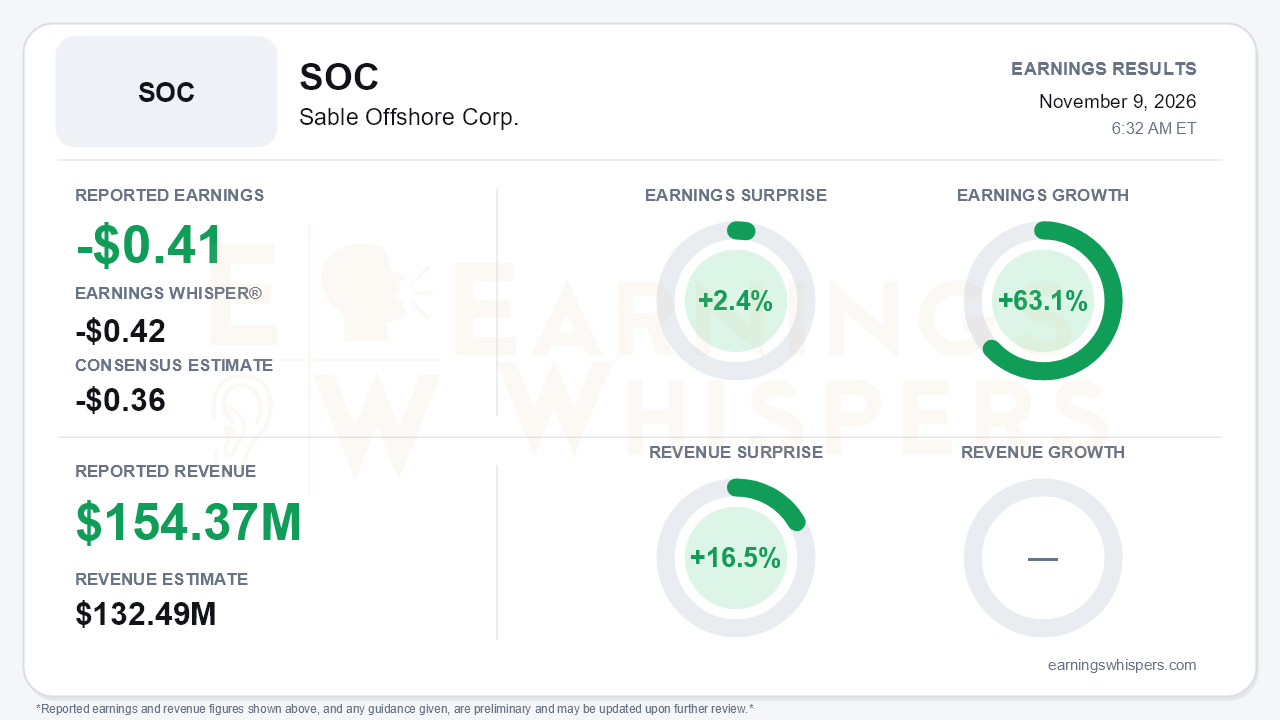
Sable Offshore's third quarter delivered decent headline numbers and an unsettling outlook. The company lost $0.41 per share on revenue of $154.37 million. Revenue topped the $132.49 million consensus by 16.5%. The earnings picture was more mixed: Earnings Whispers scores the result a 2.4% beat because the loss came in narrower than the -$0.42 Whisper number, but it was wider than the -$0.36 consensus estimate. Year over year, earnings improved 63.1%, a meaningful narrowing of the loss as the Santa Ynez Unit moved further into production. The central tension is that Q3 was a good operating quarter, and October then turned the story into one about liquidity.
The operating data were genuinely strong. Net sales volumes averaged about 27 thousand barrels of oil per day, up 29% from Q2, and revenue rose 13% sequentially. Wells produced an average of 795 gross barrels per day across roughly 37 active wells. Management reported little to no production decline and stable reservoir pressure across the Monterey zones. Perforation additions now average more than 700 barrels per day each, up from about 600 cited last quarter. The reservoir appears to be doing its job. The problem is everything downstream of the wellhead and the balance sheet.
In early October, Sable's sole purchaser halted crude purchases for refinery tank maintenance. Per the call, that was Chevron. The result was about two and a half weeks of zero sales, only about 160,000 barrels sold, and a roughly 900,000-barrel shortfall for the month. Sable ended September with just $38.0 million of cash. Management outlined roughly $165–175 million of Q4 cash needs, including about $53 million of year-end debt service. Closing that gap depends on several pieces:
- a bulk forward sale of up to 1.3 million barrels of stored crude that has not yet been executed (NDAs are signed and term sheets are expected; $60–75 million was cited as illustrative);
- a $100 million unsecured loan basket;
- and/or a PIPE.
The ATM already absorbed 16.1 million shares in Q3 at an average of about $4.75. With the stock now under $2, any further equity would be far more dilutive. The CEO apologized on the call for the Q2 promise that marketing bottlenecks would be resolved by Q4. That apology says plenty about the credibility reset.
Almost every forward marker moved the wrong way relative to the Q2 call:
- **Hondo restart:** slipped from end of September to late November, with all wells expected to flow to sales in December at about 10,000 gross barrels per day.
- **Sales guidance:** now a wide 20–30 thousand barrels per day for Q4, or 31 thousand for November, excluding the bulk sale. Last quarter management talked about a 40 thousand barrel exit rate.
- **Differentials:** stuck near $30 per barrel, versus the ~$20 relief expected for Q4, with a heavy-crude glut adding pressure.
- **SPR designation:** expected "this fall," still pending.
- **Costs and constraints:** Q4 operating costs are elevated by Hondo commissioning, and water handling at Las Flores Canyon remains a constraint.
- **Cash flow:** the Q2 framework of $152 million in second-half unlevered free cash flow now looks implicitly at risk.
The call still preserved a credible longer-term case. All four major Los Angeles-area refineries are now taking SYU crude, up from one, and term contracts could eventually narrow differentials. Possible Line M70 sales to PBF could add 10–15 thousand barrels per day on top of 45 thousand of firm Line 2000 capacity. Hondo's lighter, sweeter crude should improve field-wide sulfur content. Management also floated a gas-reinjection strategy it says could double recovery from 15% to 30% and halve base decline. Those are management aspirations, with a full reserve audit not targeted until the end of 2027. Sable also made its first Term Loan B amortization payment and noted legal wins at the Ninth Circuit.
The market had largely priced in distress before the release. Shares fell 59.4% from the $4.75 open after the Q2 report to $1.93. That is 77.6% below the 200-day moving average and just 8.7% above a fresh 52-week low of $1.78 set on November 6. The stock never held its August 21 high of $5.44. Investor sentiment remains negative at -0.34, though it improved from -0.47 a quarter ago, suggesting expectations were already deeply washed out. Sequential growth and AVWAP trend readings remain negative.
The bottom line is that Sable's reservoir and production metrics are improving, but the investment setup now hinges on near-term financing execution rather than barrels. A diversified customer base and the Hondo restart are real positives. Until the bulk sale closes and the Q4 cash gap is bridged without punishing dilution, though, bears hold the more immediate argument.
Read our earnings preview for Sable Offshore Corp.: https://www.earningswhispers.com/article/SOC/22591
This earnings review was originally published on Earnings Whispers.
This article is for informational purposes only and is not investment advice. Earnings Whispers and its staff may hold positions in the securities mentioned. It is AI-assisted, based on proprietary Earnings Whispers data and company reports, and edited by Earnings Whispers staff.
Mentioned In This Article
Latest News
| 9 hours | |
| 11 hours | |
| 12 hours | |
| 12 hours | |
| 16 hours | |
| Nov-02 | |
| Oct-26 | |
| Oct-05 | |
| Sep-28 | |
| Aug-19 | |
| Aug-12 | |
| Aug-10 | |
| Aug-10 | |
| Jul-01 | |
| Jul-01 |
