Fervo Energy Beats On A Narrower Loss As Cape Station Goes Live And Google Deal Lifts Backlog, But Shares Sit 65% Below Their Post-IPO Report Level
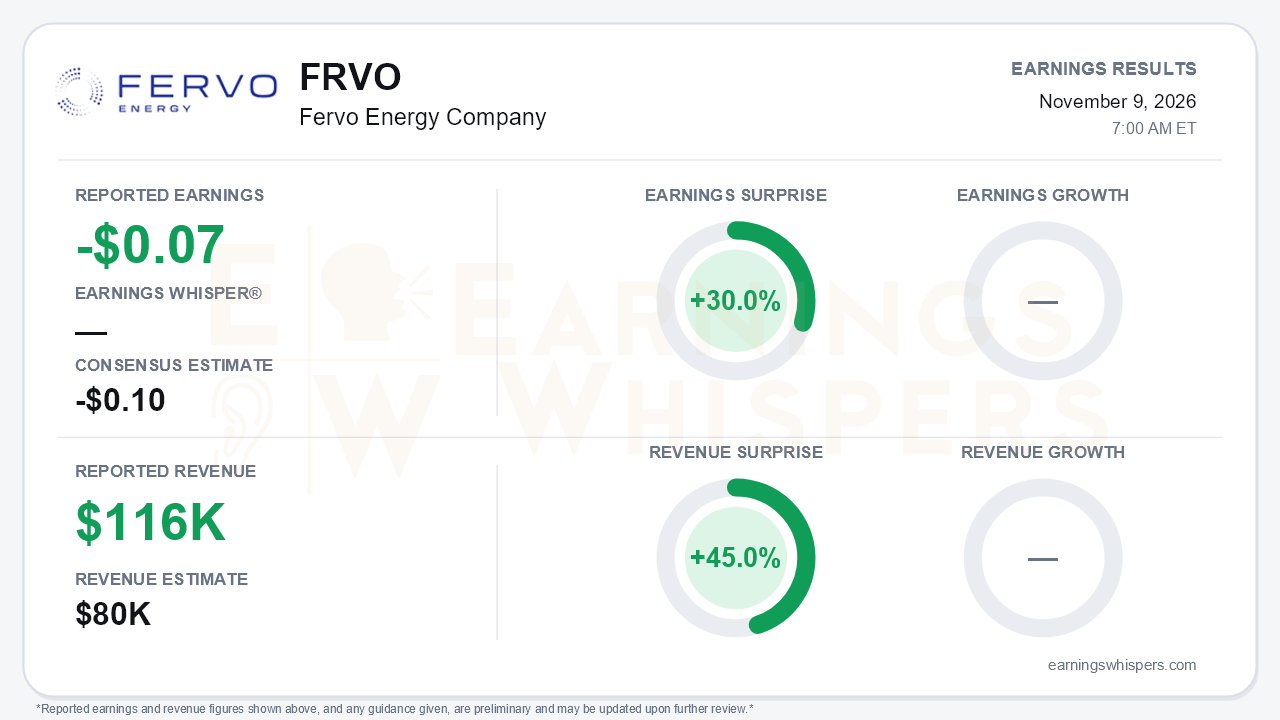
Fervo Energy reported a third-quarter loss of $0.07 per share, beating the consensus estimate of a $0.10 loss by 30.0%. Revenue of $0.12 million topped the $0.08 million consensus by 45.0%. Revenue that small is a rounding error for a company with $1.9 billion in cash. The quarter mattered because Fervo crossed from construction story to operating company. GeoBlock 1 at Cape Station declared commercial operation on September 30, ahead of its contractual deadline. Fervo also signed a 396-megawatt, 15-year take-or-pay power purchase agreement with Google, which lifted binding contracted capacity to 1,054 megawatts and contracted revenue to roughly $11.9 billion, from 658 megawatts and $7.2 billion. The central tension is that the operating and commercial milestones arrived as the stock was collapsing. Shares have fallen 65% since the open after the August report.
The quality of the reported earnings deserves scrutiny. Fervo posted $11.7 million of net income, but that figure rests on a $29.9 million tax benefit from investment tax credits earned as Phase I assets were placed in service, an $11.8 million non-cash swap gain, and $15.4 million of interest income on its IPO cash. After income attributable to the redeemable noncontrolling interest, common stockholders still bore a loss. The operating loss widened to $43.7 million, and the main driver was overhead. G&A jumped to $39.4 million from $27.4 million in Q2 and about $17 million in Q1. Roughly $14 million of the latest figure was stock compensation, and management acknowledged that public-company costs are running high. Capital expenditures rose to $256.7 million from $226.5 million. Cash slipped to $1.9 billion from $2.1 billion, while debt climbed to $301.6 million from $228.4 million.
Execution on the ground looks considerably stronger than the income statement. Management said GeoBlock 1 was built in 23 months and is performing in line on flow and temperature. GeoBlock 2 is grid-synced, and GeoBlock 3 is in cold commissioning, with commissioning from GB1 to GB3 running about 50% faster. Both remain on track for commercial operation by January 1, 2027. Fervo added a fourth drilling rig, up from two in Q1. Work on Cape Google 400 is also advancing:
- Drilling is about 18% complete.
- The first 50-megawatt turbines passed factory acceptance.
- More than 60% of the air-cooled condensers are on site.
An independent DeGolyer & MacNaughton study nearly doubled Cape Station's capacity potential to 8.4 gigawatts. The second-half capex cut to $700-$750 million from $850-$900 million should not be mistaken for a cost win. Management framed it as timing, with the roughly $2.2 billion Cape Google 400 budget and commercial operation dates unchanged.
Bears still have legitimate ammunition:
- The 2027 revenue expectation of $60-$80 million was only held, not raised.
- There is still no new visibility on a one-time 2027 substation outage tied to a third-party solar interconnection.
- About 400 megawatts of earlier PPAs are being amended, with delivery pushed to around 2032 and dependent on transmission into California.
- Analysts continued to press on thermal decline and water loss at Project Red.
- The trigger for Google's roughly 600-megawatt expansion option remains vague, tied to data center development and Utah regulatory approval.
- Phase I costs remain near $7,000 per kilowatt.
That makes the reaffirmed $5,500-per-kilowatt target for Cape Google 400, and the $3,000 long-term goal, the key proof points still ahead. Potential catalysts include project financing for Cape Google 400, targeted for mid-2027 at about 70% loan-to-value, and possible federal permitting legislation, which is not in the base plan.
The market setup is more complicated than the surprise implies. Investor sentiment collapsed from strongly positive (0.72) after the August report to slightly negative (-0.07) heading into this one. The stock entered the release at $9.03, down from a $25.80 post-report open and about 60% below its 200-day moving average of $22.34. It had hit a 52-week low of $7.64 on November 5, just days before reporting, and sits only 18% above it, near the bottom of its inter-earnings range. The Earnings Whispers trend readings are mixed: momentum is positive, but the AVWAP trend remains negative, consistent with a stock still trading below where most recent buyers entered.
What changed in the investment setup is the risk profile, not the near-term earnings power. Fervo now has a producing asset, a hyperscaler anchor with parent guarantees from Fervo and Alphabet, and a materially larger resource base. Sentiment and price, meanwhile, have reset from euphoria to skepticism. Reported profitability, however, remains an accounting artifact, and overhead is outrunning revenue.
The bottom line is that Fervo delivered the operational and commercial milestones that matter most: first commercial power, a 60% jump in binding capacity, and a doubled resource estimate. The EPS beat itself says little, because it leaned on tax credits and swap gains. With the stock near its lows and sentiment reset, the next tests are Phase I completion by January, clarity on the delayed California PPAs and the 2027 substation outage, and proof that Cape Google 400 can hit its $5,500-per-kilowatt cost target.
Read our earnings preview for Fervo Energy Company: https://www.earningswhispers.com/article/FRVO/22564
This earnings review was originally published on Earnings Whispers.
This article is for informational purposes only and is not investment advice. Earnings Whispers and its staff may hold positions in the securities mentioned. It is AI-assisted, based on proprietary Earnings Whispers data and company reports, and edited by Earnings Whispers staff.
Mentioned In This Article
Latest News
| Nov-09 | |
| Nov-09 | |
| Nov-09 | |
| Nov-09 | |
| Nov-03 | |
| Nov-02 | |
| Oct-30 | |
| Oct-30 | |
| Oct-19 | |
| Oct-16 | |
| Oct-13 | |
| Oct-08 | |
| Oct-08 | |
| Oct-05 | |
| Oct-01 |
