Motorcar Parts Misses Badly And Slashes A Sales Outlook It Reaffirmed Just One Quarter Ago, Betting On A Back-End-Loaded Recovery
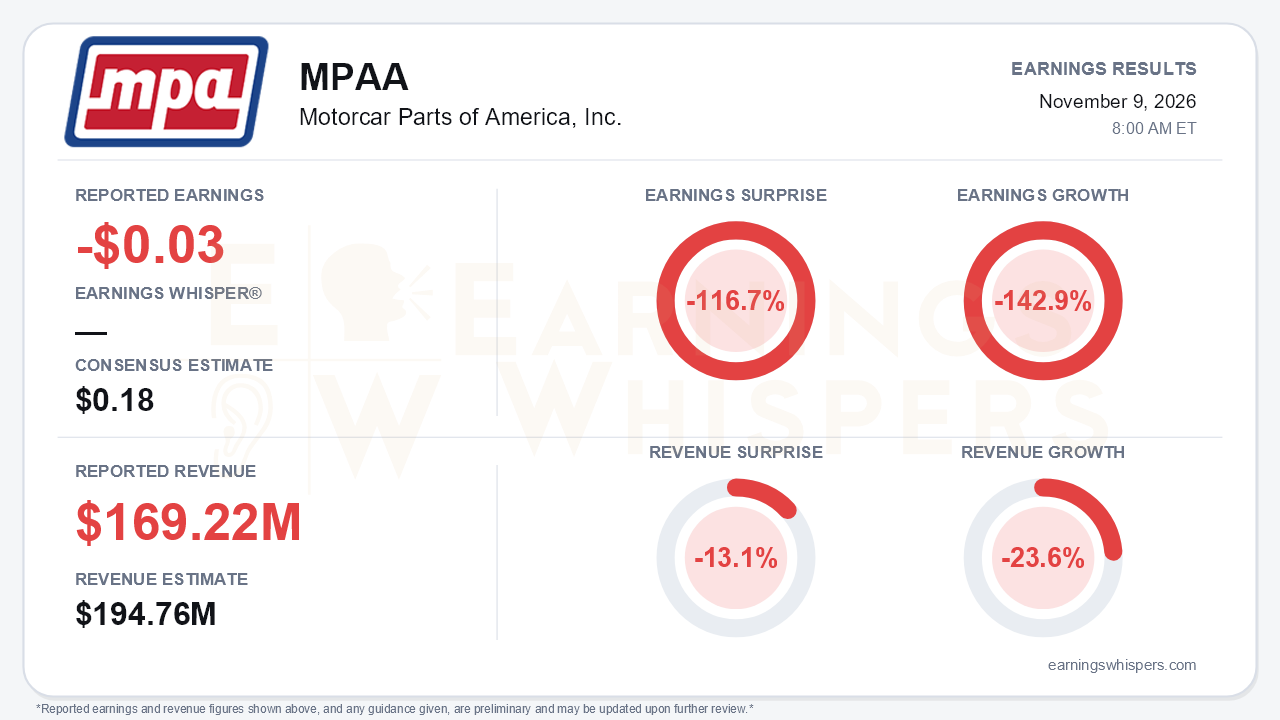
Motorcar Parts of America (NASDAQ: MPAA) delivered a fiscal second-quarter miss that matters less for the quarter itself than for what it does to management's credibility. The company reported a diluted loss of $0.03 per share against a $0.18 consensus, a 116.7% shortfall. Revenue of $169.22 million missed the $194.76 million estimate by 13.1% and fell 23.6% year over year, while earnings fell 142.9%. Net income was technically positive at $1.4 million, or $0.07 per basic share, but dilution tied to the company's convertible notes pushed the diluted figure into a loss. The more consequential news was guidance. Fiscal 2027 sales are now expected at $715 million to $740 million, down from $780 million to $800 million. That range was reaffirmed last quarter, when the CEO described the company as still on target.
The quality of the quarter deserves scrutiny. The headline 24.2% gross margin, up from 19.3% a year ago, included roughly $11.1 million of IEEPA tariff refunds, worth about $0.49 per diluted share. Net one-time items contributed 5.7 points of gross margin and $0.30 of per-share benefit. Without the refund, the quarter would have shown a meaningfully deeper loss. Revenue was essentially flat sequentially, at $169.2 million versus $168 million in the first quarter. Of the year-over-year decline, $14.8 million reflects a prior-year core revenue benefit. Management attributed the remaining $37.5 million primarily to delayed customer orders and lower tariff pass-throughs. Peso strength cost another $2.4 million, or 1.4 points of gross margin. There is a genuine positive buried here: adjusted gross margin of roughly 22.7% improved from 20.2% in the first quarter. That improvement, however, is being earned on a revenue base that has stalled.
The call made clear that conditions moved against the company faster than management expected. Executives cited DIY softness and repair deferrals that "took us by surprise." They also pointed to two sources of delay:
- one customer's distribution-center inventory realignment, which held back orders;
- customers working through inventory bought from bankrupt competitor First Brands, which pushed out the ramp of new brake business.
The longer-term ambitions were scaled back as well. The prior framing of more than $100 million in additional annualized sales and a run-rate above $900 million has been replaced by about $60 million of firm awards plus roughly $25 million in advanced discussions. The $95 million to $100 million EBITDA target was not reiterated. Operating income guidance of $37 million to $44 million includes about $35 million of non-cash and relocation costs. On a comparable basis, that implies roughly $72 million to $79 million, down from the prior $86 million to $91 million. This is the second guidance cut in four calls, and the change in tone from bullish to defensive was noticeable.
The balance sheet is where bears have the most legitimate ammunition. Trailing adjusted EBITDA has slid to about $70 million from $86.1 million two quarters ago. Over the same three quarters, net bank debt climbed from $70.5 million to $105.8 million and leverage rose from 0.84x to 1.5x. Liquidity fell from $146 million to $104.8 million, and revolver borrowings reached $126.6 million. Inventory rose to $415 million even as sales disappointed. No shares were repurchased, leaving the $20.1 million authorization untouched. One partial offset: operating cash burn narrowed to $4.1 million from $11.3 million in the prior quarter.
The bull case now rests almost entirely on the second half. Implied sales of $378 million to $403 million would represent 5.0% to 11.9% growth excluding prior-year core revenue. That outcome depends on launches that management says will land mostly near fiscal year-end. Supporting catalysts include:
- the completed heavy-duty relocation to Mexico, which should lower manufacturing costs;
- expansion with customers into Mexico, Canada, and potentially South America;
- the Centric brake relaunch, which management excludes from estimates;
- a reported return of order vibrancy over the last four weeks.
These are credible levers. But a back-end-loaded guide from a team that just missed its own reaffirmed numbers will get little benefit of the doubt.
Investor sentiment already reflected that skepticism. It fell from essentially neutral at 0.01 to a clearly negative -0.33 heading into the report. Shares were $10.52 as of the pre-report snapshot, barely changed from the $10.37 open after last quarter's release. That flat result masks a round trip: the stock peaked at $12.83 the day after that report, then slid to a $9.80 low in late October. It sits 10.5% below its 200-day moving average and closer to the bottom of its range than the top, with price and AVWAP trend readings both negative.
The bottom line is that MPAA's quarter was weaker than its tariff-flattered margin suggests. The guidance reset, dropped targets and rising leverage outweigh sequential margin progress. The new-business pipeline is real, but the investment case has shifted from execution on a stated plan to a show-me story that depends on fourth-quarter launches arriving on time.
Read our earnings preview for Motorcar Parts of America, Inc.: https://www.earningswhispers.com/article/MPAA/22577
This earnings review was originally published on Earnings Whispers.
This article is for informational purposes only and is not investment advice. Earnings Whispers and its staff may hold positions in the securities mentioned. It is AI-assisted, based on proprietary Earnings Whispers data and company reports, and edited by Earnings Whispers staff.
Mentioned In This Article
Latest News
| Nov-09 | |
| Nov-09 | |
| Nov-09 | |
| Nov-02 | |
| Nov-02 | |
| Oct-28 | |
| Aug-10 | |
| Aug-10 | |
| Aug-10 | |
| Aug-06 | |
| Aug-04 | |
| Jun-30 | |
| Jun-08 | |
| Jun-08 | |
| Jun-02 |
