SIGA's Narrower Q3 Loss Masks A Revenue Air Pocket As US Contract Remains Unresolved And PEP Filing Slips To 2028
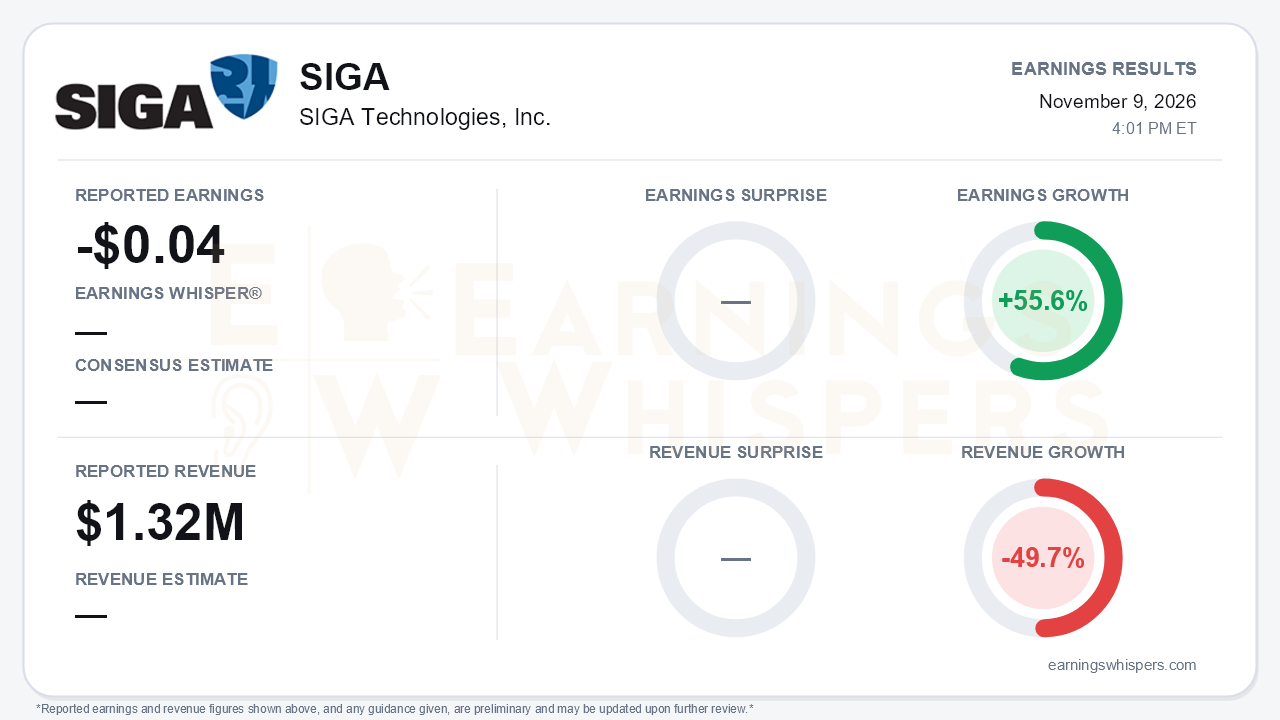
SIGA Technologies reported a third-quarter loss of $0.04 per share on revenue of $1.32 million. The loss narrowed from $0.09 a year ago, which Earnings Whispers calculates as 55.6% earnings growth, while revenue fell 49.7%. No consensus estimate or Earnings Whisper was available, so there is no beat or miss to judge. That matters less than the quarter itself. With the BARDA-19C contract fully delivered and no new U.S. procurement award in hand, SIGA sold almost no product. The narrower loss reflects cost cuts and a tax benefit, not a healthier business. That is the central tension: the year-over-year earnings comparison improved while the commercial pipeline visibly thinned.
The quality of the improvement deserves scrutiny. Product sales and supportive services were just $0.2 million, down from $0.9 million a year ago and $38 million in the second quarter. The call analysis described Q3 product sales as zero, so the reported figure appears to consist essentially of supportive services. R&D revenue also slipped, to $1.1 million from $1.7 million.
The smaller operating loss, $6.5 million versus $10.2 million, came almost entirely from research and development expense. That line fell to $2.6 million from $7.1 million. Below the operating line, an income tax benefit of $2.6 million cut the $5.5 million pretax loss to a $2.9 million net loss.
The sequential picture is starker. Second-quarter operating income was about $14 million and EPS was $0.17. Through nine months, SIGA has earned $0.09 per share, compared with $0.40 in the same period of 2025. Revenue for the period was $48.6 million versus $90.8 million.
The call was quieter and more cautious, and the wording around the next U.S. government contract has steadily softened. Management described talks as "active and constructive" late last year. They became "slower than in the past" through the first half and are now characterized as "timing remains uncertain." A post-election transition has been added as a variable, although management said it does not expect midterm results to materially affect biodefense funding or procurement.
The other notable cut was the post-exposure prophylaxis (PEP) supplemental filing. Management pushed it to 2028 after the FDA requested additional validation and lab work. A year ago the target was "within the next 12 months," and as recently as the second quarter it was the first half of 2027. Management also flagged that removal of the EU MPOX label requires "additional discussion" with some European customers, which could affect order timing. Chief Scientific Officer Dennis Hruby is retiring after more than 30 years, though he will remain an adviser.
The offsets are real but modest:
- **Canada contract:** The Canadian Department of National Defence awarded a contract for up to roughly $15 million of oral TPOXX through March 2031. About $9 million is firm over the first three years, or around $3 million a year, and about $6 million depends on option exercises. Deliveries are now expected to start in 2027. That is vaguer than the second-quarter suggestion of a delivery by March 2027.
- **Other international demand:** Another international customer is in late-stage negotiations, and management cited rising European preparedness interest.
- **Pediatric formulation:** Phase 1 results are still expected by year-end.
None of these replaces a U.S. stockpile order, which historically has driven SIGA's results. CEO Diem Nguyen's framing of international business as diversification "over time" is an honest acknowledgment of that gap.
The balance sheet buys patience. SIGA has no debt and $116 million in cash, down from $155 million at year-end. The $0.60-per-share special dividend paid in April accounts for much of that decline. Inventory of $41.6 million gives SIGA product ready to ship once orders arrive, and deferred IV TPOXX revenue has been fully recognized. Bears still have legitimate ammunition: the company has no visible U.S. product backlog and keeps spending on operations while it waits.
Investor sentiment readings were not available for this report. The supplied technical data is limited but points the same way. Shares opened at $3.15 after the second-quarter report, well below the current 200-day moving average of $4.30. That suggests the market had already been marking down the stock as the U.S. contract outlook dimmed, although current price data was not provided.
The bottom line is that SIGA's narrower year-over-year loss reflects lower R&D spending and a tax benefit rather than commercial progress. The quarter exposed how dependent the story remains on a new U.S. procurement contract whose timing keeps slipping. The Canadian award, a pending international deal and a strong cash position limit the downside. However, the delayed PEP filing, European label complications and a near-empty product line keep the burden of proof on management until a U.S. order is signed.
This earnings review was originally published on Earnings Whispers.
This article is for informational purposes only and is not investment advice. Earnings Whispers and its staff may hold positions in the securities mentioned. It is AI-assisted, based on proprietary Earnings Whispers data and company reports, and edited by Earnings Whispers staff.
Mentioned In This Article
Latest News
| Nov-09 | |
| Nov-09 | |
| Nov-09 | |
| Oct-29 | |
| Oct-28 | |
| Aug-07 | |
| Aug-06 | |
| Jul-30 | |
| May-07 | |
| Apr-30 | |
| Mar-26 | |
| Mar-17 | |
| Mar-10 | |
| Mar-10 | |
| Mar-03 |
