Turkcell's Core Telco Re-Accelerates, But FX Losses, A Stalled Data Center Business And Rising Leverage Keep Investors Skeptical
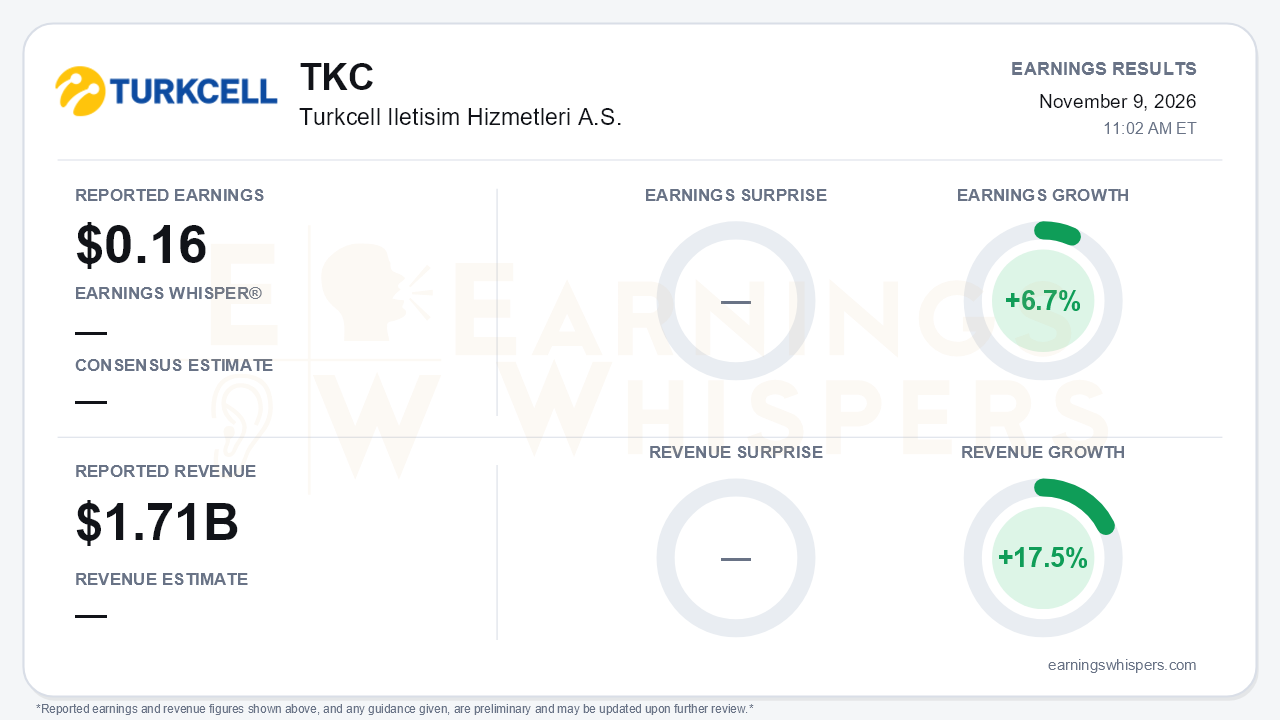
Turkcell reported third-quarter earnings of $0.16 per share on revenue of $1.714 billion. Earnings grew 6.7% and revenue grew 17.5% from a year ago in dollar terms. No consensus estimate was available, so this quarter cannot be judged as a beat or miss. It has to be judged on its trajectory. On that basis the core telecom business clearly re-accelerated. Inflation-adjusted group revenue rose 6.2%, up sharply from 2.5% in the second quarter. EBITDA margin climbed to 44.2%, from 41.8% in Q2 and 41.4% in Q1, which is comfortably above the 40-42% full-year guidance. The central tension is that operating momentum is improving while much of what sits between EBITDA and shareholders is moving the other way: FX exposure, depreciation, data center growth and leverage.
The quality of the bottom line deserves scrutiny. In the company's IAS29 lira reporting, net income fell 3.8% to TRY 6.7 billion, and EPS slipped to TRY 3.10 from TRY 3.21. That contrasts with the dollar-based growth figure. EBITDA rose 6.8%, but depreciation jumped 10.3% as 5G assets entered the books, so EBIT grew only 1.4%. Finance costs roughly doubled, and net FX losses after hedging widened to TRY 8.2 billion from TRY 1.9 billion as the lira weakened. Three items rescued the result:
- a TRY 3.7 billion monetary gain, against a loss a year ago;
- lower income tax from a fixed-asset revaluation;
- a much smaller drag from the TOGG stake.
Those are real contributions, but they are not the same as recurring operating earnings power.
Beneath the surface, the consumer franchise looks healthier than it has in some time. Mobile number portability volumes fell below 2.3 million for the quarter, versus about 5 million per quarter in 2025. Consumer revenue returned to positive growth, and mobile churn improved to 1.6% from 2.6%. Other subscriber metrics also strengthened:
- Postpaid net adds reached 701,000, versus 284,000 in Q2.
- Superbox added 101,000 subscribers, its best quarter since 2019.
- Fiber added 39,000, versus 31,000 in Q2.
ARPU is the swing factor, and the two sources measure it differently. The call cited strong nominal gains, with mobile ARPU at 512 TL and roughly 28% year-over-year growth excluding M2M. The release's inflation-adjusted data still show blended mobile ARPU down 3.9% year over year, despite an 8.0% sequential gain. Management expects the 2026 pricing actions to become more visible from Q4 onward. That is an expectation, not yet a result.
The corporate side carried the top line. Digital Business Services revenue rose 65%, and the systems-integration backlog climbed to TRY 21.6 billion from TRY 16 billion in Q2. However, the release attributes much of that growth to hardware sales tied to one-off projects. That mix pushed gross margin down 1.2 points. Paycell grew 23%, though its margin compressed as lower-margin POS revenue expanded. Financell's revenue fell year over year, but its EBITDA more than doubled. The regulator's decision to double the 12-month installment cap to TRY 40,000 provides a Q4 tailwind.
The call also delivered a clear disappointment. Data center and cloud growth slowed to roughly 4%, down from 10% in Q2 and 21% in Q1. That is far below the 18-20% full-year target. Management blamed global memory shortages and customers deferring server purchases, and it now accepts a 'more gradual' trajectory. This matters because management has flagged the data center unit as a prime candidate for an IPO or strategic partner.
Capital allocation is the other sore point. Several Q4 commitments will drive leverage higher:
- an Istanbul headquarters purchase of about $400 million;
- an additional 11% of TOGG for EUR 88 million, raising the stake to 34%;
- the dividend;
- the next 5G installment.
Management expects net debt/EBITDA to rise from 0.31x to about 0.7-0.75x by year-end, versus 0.4x expected last quarter. Meanwhile, the net short FX position of roughly $1.3 billion is expensive to hedge, and FX-carry income is likely to shrink after swap activity was scaled back. The TRY 1.9 billion buyback offers some offset, but bears have legitimate ammunition on how cash is being deployed.
The market has not been rewarding the operating improvement. Shares are down 12.8% since the open after the August report and sit about 18% below the 200-day moving average of $5.82. Investor sentiment, already slightly negative, deteriorated meaningfully, falling from -0.14 to -0.40. The Earnings Whispers price and AVWAP trend readings remain negative, while sequential growth is neutral. Together these suggest investors are weighing the leverage, FX and capital-allocation concerns more heavily than the margin rebound.
The bottom line is that Turkcell delivered the operating quarter bulls wanted: faster real revenue growth, record-level margins, rational competition and strong subscriber momentum. But the quality of earnings leans on monetary and tax items. The data center growth story has stalled, and Q4 spending on real estate and TOGG will more than double leverage. Until promised ARPU gains show up in inflation-adjusted numbers and capital deployment looks more disciplined, the stock's weak positioning and souring sentiment reflect real, not imagined, concerns.
This earnings review was originally published on Earnings Whispers.
This article is for informational purposes only and is not investment advice. Earnings Whispers and its staff may hold positions in the securities mentioned. It is AI-assisted, based on proprietary Earnings Whispers data and company reports, and edited by Earnings Whispers staff.
Mentioned In This Article
Latest News
| Nov-10 | |
| Nov-09 | |
| Nov-09 | |
| Oct-05 | |
| Aug-13 | |
| Aug-13 | |
| Jul-07 | |
| May-13 | |
| May-11 | |
| Apr-17 | |
| Mar-23 | |
| Mar-06 | |
| Mar-05 | |
| Mar-05 | |
| Feb-15 |
