DHT Holdings Posts Second Straight Record Quarter And Guides Higher, But The Orderbook Shadow Is Growing
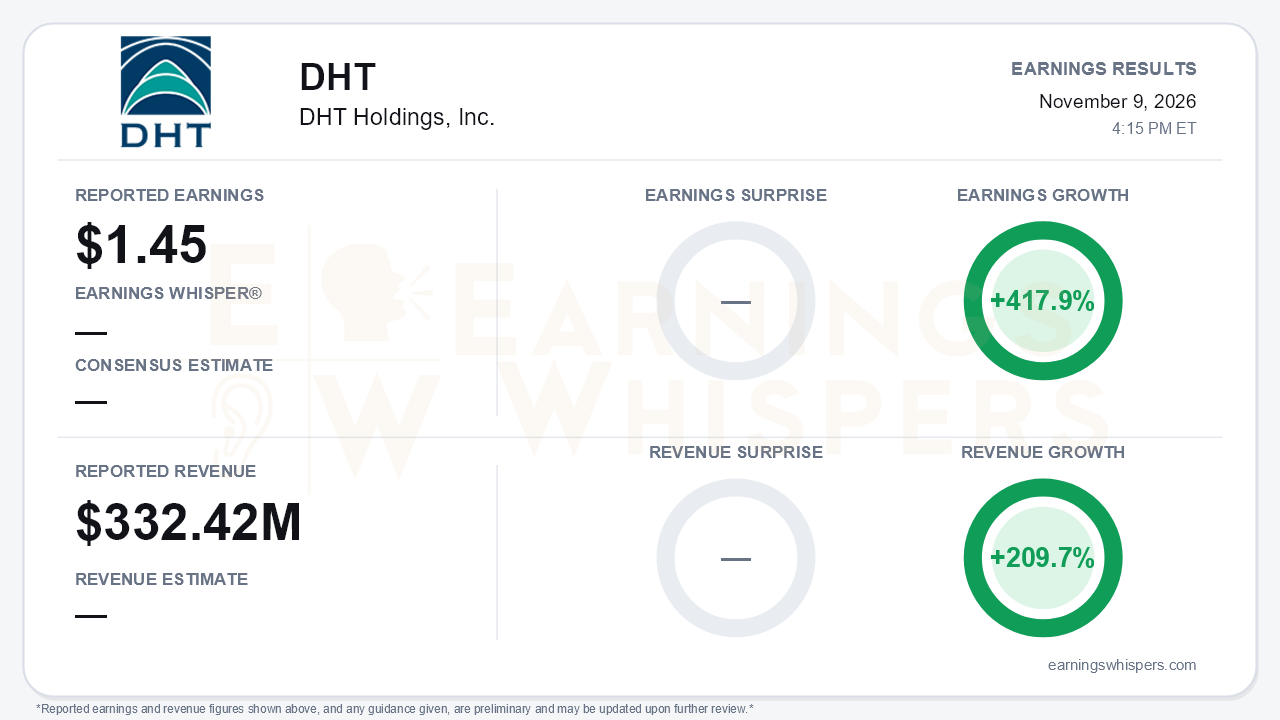
DHT Holdings delivered another record quarter for the September period, and management indicated the next one should be bigger. The VLCC owner reported earnings of $1.45 per share on revenue of $332.42 million. Earnings rose 417.9% from a year earlier and revenue rose 209.7%. No consensus estimate or Earnings Whisper was available, so the quarter can't be framed as a beat or miss. It also needs no such framing to be notable. The first nine months of 2026 already exceeded DHT's prior full-year earnings record, and management said fourth-quarter results will surpass the third quarter. The central tension is that DHT is printing peak-cycle earnings while the industry's supply response grows harder to ignore.
The quarterly progression shows how quickly the cycle has turned:
- **Ordinary EPS:** $0.41 in Q4 2025, $0.64 in Q1, $1.22 in Q2 and $1.45 in Q3.
- **Dividend:** set equal to EPS, making this the 67th consecutive payout.
- **Adjusted EBITDA:** reached $269.5 million, up from $231 million in Q2 and $95 million a year-end ago.
- **TCE revenue:** $290 million, versus $255 million in Q2. This figure strips out voyage costs, so it sits below the $332.42 million headline.
The quality of the sequential gain deserves a closer look. The step-up from Q2 was considerably smaller than the near-doubling from Q1 to Q2. It also came mostly from the fixed-income book rather than the spot market:
- Spot TCE edged up only to $167,100 per day from $162,600.
- Time-charter TCE jumped to $114,200 from $90,800.
- Combined fleet TCE rose to $141,300 from $126,700.
In other words, Q3 reflected higher-rate charters rolling into the portfolio more than a further leg up in spot earnings.
The forward bookings are what make the call striking. DHT said 68% of its 930 fourth-quarter spot days are fixed at a reported rate of roughly $579,900 per day. At the Q2 call, Q3 bookings stood at $152,700. On the time-charter side, 1,174 days are booked at $100,200 per day, versus 1,020 days at $75,900 guided for Q3. None of those voyages involve the Persian Gulf. That reported spot figure is extraordinary even by this cycle's standards. Some transcript figures appear garbled, so investors should verify it against the full financial report. Still, management's own framing points the same way: it described rates easing from early-September peaks of $800,000-900,000 per day toward roughly $600,000, which remains far above Q3 realized levels.
Management is also using the windfall to lock in durability. DHT Panther was fixed on a three-year charter at $100,000 per day, after DHT Jaguar began a three-year charter at $75,000 in September. The balance sheet keeps improving:
- Leverage fell to 10.5%, from 14.1% in Q2 and 16.8% in Q1.
- The 2027 cash breakeven is guided at $20,600 per day, down from $22,600 for the second half of 2026.
- Fleet renewal is advancing: DHT Impala delivered about five months early, and a sixth Antelope-class newbuild was ordered from Hanwha Ocean for April 2029.
- The 2026 drydock program is complete, with only four drydocks scheduled for 2027.
Liquidity slipped to $555 million from $569 million, against $91 million of remaining newbuild capex. That leaves ample capacity to act on the industry orderbook, which management described as a source of potentially discounted ships "without natural homes."
That orderbook is where bears have legitimate ammunition:
- **Supply:** management cited 320 VLCCs on order over four years against a fleet of about 940. At the Q4 2025 call, the figure was 171 ships over three years. Roughly 77% are being built in China.
- **Hormuz:** part of today's rate strength rests on trade inefficiencies around the Strait. A U.S.-Iran deal or a reopening could unwind them. Management argued the market would not be "falling out of bed" in that scenario and pointed to government and corporate inventory restocking as support, but that is management's expectation rather than a demonstrated result.
- **Charter roll-offs:** in early 2027, the Puma profit-share charter expires and about five one-year charters at roughly $101,000 per day roll off. Management declined to commit to a redeployment strategy and acknowledged profit-share structures are difficult to replicate in today's market.
Market context is thin for this report. No sentiment reading or current price was supplied. Shares opened at $18.48 the day after the August report, and the 200-day moving average stands at $18.96. Without a current quote, it isn't possible to judge how the market priced this quarter or the Q4 outlook.
The bottom line is that DHT is executing nearly flawlessly at what looks like a cyclical peak. Earnings, cash returns and balance-sheet strength have all reached record territory, and fourth-quarter bookings point higher still. The key question for 2027 is not this quarter's strength but how much survives a swelling orderbook, a possible Hormuz normalization and a wave of charter expirations. DHT's low breakeven and modest leverage give it unusual resilience, and its push into multi-year charters suggests management is preparing for a market that will not stay this extreme.
This earnings review was originally published on Earnings Whispers.
This article is for informational purposes only and is not investment advice. Earnings Whispers and its staff may hold positions in the securities mentioned. It is AI-assisted, based on proprietary Earnings Whispers data and company reports, and edited by Earnings Whispers staff.
Mentioned In This Article
Latest News
| Nov-10 | |
| Nov-09 | |
| Nov-09 | |
| Oct-26 | |
| Oct-20 | |
| Oct-12 | |
| Oct-12 | |
| Sep-14 | |
| Aug-28 | |
| Aug-17 | |
| Aug-06 | |
| Aug-05 | |
| Aug-05 | |
| Jul-24 | |
| Jul-22 |
