LENSAR's Wider GAAP Loss Masks Margin Gains, But Slipping Backlog And Thin Cash Cushion Temper The Recurring-Revenue Story
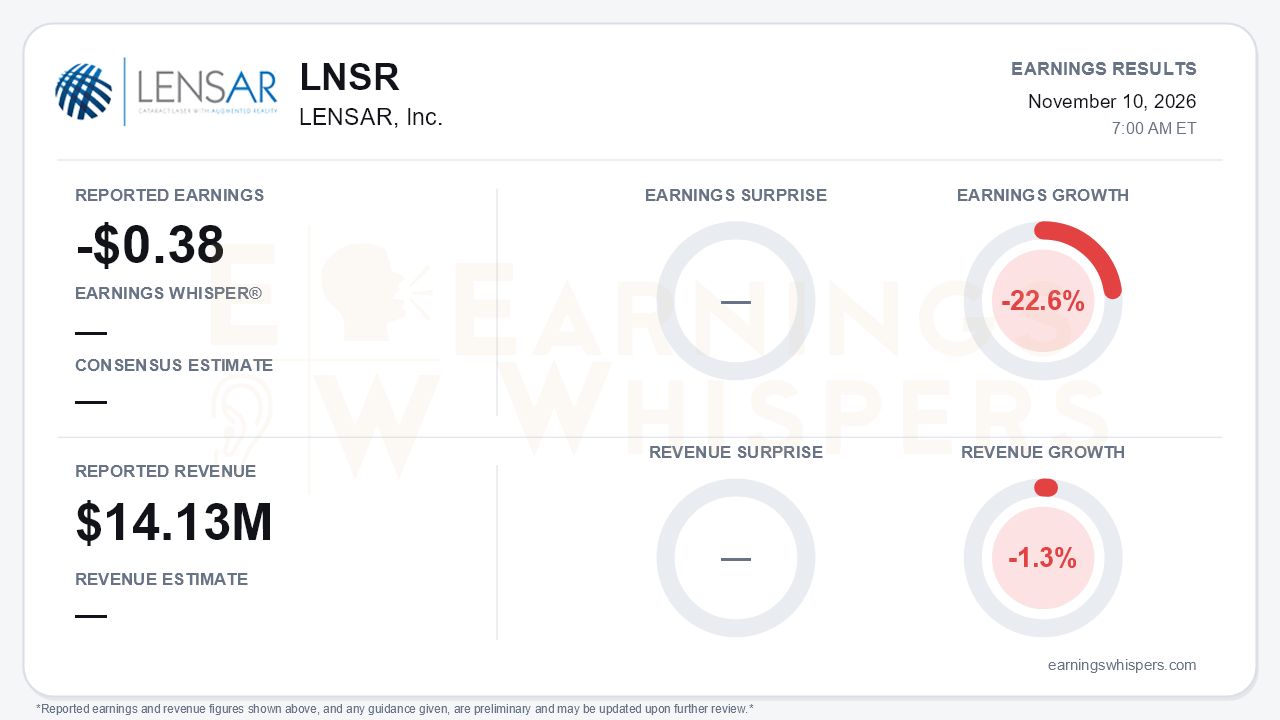
LENSAR (NASDAQ: LNSR) reported a third-quarter loss of $0.38 per share, wider than the $0.31 loss a year earlier. That is a 22.6% year-over-year deterioration in earnings. Revenue of $14.13 million slipped 1.3%. No consensus estimates were available, so the quarter has to be judged on its own merits. On those merits, the headline understates what happened operationally. The wider GAAP loss came almost entirely from a $3.4 million non-cash charge for the change in fair value of warrant liabilities. Underneath it, LENSAR delivered its best gross margin of the year, a sharply narrower operating loss and positive adjusted EBITDA. The central tension is that profitability is improving while the growth engine visibly cooled from a strong second quarter.
The revenue mix explains both the flat top line and the margin expansion. System revenue fell to $1.5 million from $3.5 million against a strong prior-year comparison. Recurring revenue rose 17% to $12.6 million and reached 89% of total revenue, up from 75% a year ago. Procedure revenue grew 17% to $9.2 million on a 12% increase in volume to 52,545. Because procedures carry far better economics than capital equipment, product cost of revenue dropped to $3.5 million from $5.6 million. Gross margin reached 58%, compared with 52% excluding tariffs in Q2, 48% in Q1 and the original fiscal 2026 range of 46% to 49%. Operating loss narrowed to $1.4 million from $7.6 million, and adjusted EBITDA swung to a $1.7 million gain from a $0.3 million loss. The quality of that improvement deserves some scrutiny, however. The prior-year quarter carried $5.3 million of acquisition-related costs. Management also flagged the unusually low Q3 service costs as non-recurring, so investors should not extrapolate a 58% margin.
The sequential picture is softer. Management had pre-signaled summer seasonality in August, and the decline was consistent with that warning. Even so, revenue fell from $16.5 million in Q2, when it grew 18% year over year. Procedure volume dropped from 58,682 to 52,545, and adjusted EBITDA roughly halved from $3.6 million, although Q2 included a $1.1 million tariff refund. More concerning are the forward indicators:
- ALLY placements were flat at 10.
- Backlog edged down to 12 systems from 13 in Q2 and trails last year's level. An analyst on the call raised the possibility of capital-spending tightening among customers.
- The CEO described U.S. cataract volumes as down slightly, the first market decline he has seen.
- Reimbursement changes in Germany and Switzerland are slowing international activity, and the OUS recovery has been pushed to mid-2027.
There were genuine positives. U.S. procedure share rose to 24.5% from 24.1% in Q2 and 23.4% in Q1, which means LENSAR is gaining ground even as the market softens. The ALLY installed base grew 22% year over year to about 225 systems, which supports the annuity model. Management also offered its most detailed pipeline commentary yet. Robotic docking features shown at AAO are targeted for the end of Q1 or early Q2 2027. A corneal/LASIK flap capability is in development. A femto-phaco integration could follow on an 18-to-24-month timeline if a partner is secured, with $1.2 million of strategic transaction-related costs booked this quarter. Management also cited active discussions with several high-volume accounts after the fall conferences. No formal guidance was updated.
The balance sheet is the bear case's strongest ammunition. Cash and investments fell to $12.6 million from $18.0 million at year-end. Q3 burn was a modest $0.9 million, but management expects about $2 million more in Q4 for inventory and deferred Alcon-related fees. Breakeven is pointed only to 'some point in 2027.' A new $10 million revolver lifts total liquidity to $22.6 million, which buys time, but inventory has climbed to $25.1 million. The risk factors also still reference the effects of the terminated merger. Market context is limited. Shares opened at $7.50 after the August report, slightly above a 200-day moving average now at $7.28, but no current price or sentiment reading was available to gauge how investors are treating the stock.
The bottom line is that LENSAR's quarter was better than its widening GAAP loss suggests. Recurring revenue, share and margins all moved in the right direction, and the warrant charge is an accounting item rather than an operating one. The investment setup has nonetheless grown more complicated. Capital placements and backlog are softening, the U.S. market is contracting slightly, international recovery has been deferred to mid-2027, and the company is funding the gap with a thin cash cushion and a new credit line. The recurring-revenue story remains credible, but proving it now depends on the backlog stabilizing and the 2027 product launches arriving on time.
This earnings review was originally published on Earnings Whispers.
This article is for informational purposes only and is not investment advice. Earnings Whispers and its staff may hold positions in the securities mentioned. It is AI-assisted, based on proprietary Earnings Whispers data and company reports, and edited by Earnings Whispers staff.
Mentioned In This Article
Latest News
| 1 hour | |
| 4 hours | |
| Nov-03 | |
| Aug-13 | |
| Aug-13 | |
| Aug-12 | |
| Aug-06 | |
| May-08 | |
| Apr-30 | |
| Apr-03 | |
| Mar-31 | |
| Mar-30 | |
| Mar-17 | |
| Mar-17 | |
| Mar-16 |
