Scholar Rock Beats On Narrower Per-Share Loss As ISEMBYLD Launch Begins, But Revenue Ramp Will Lag Demand
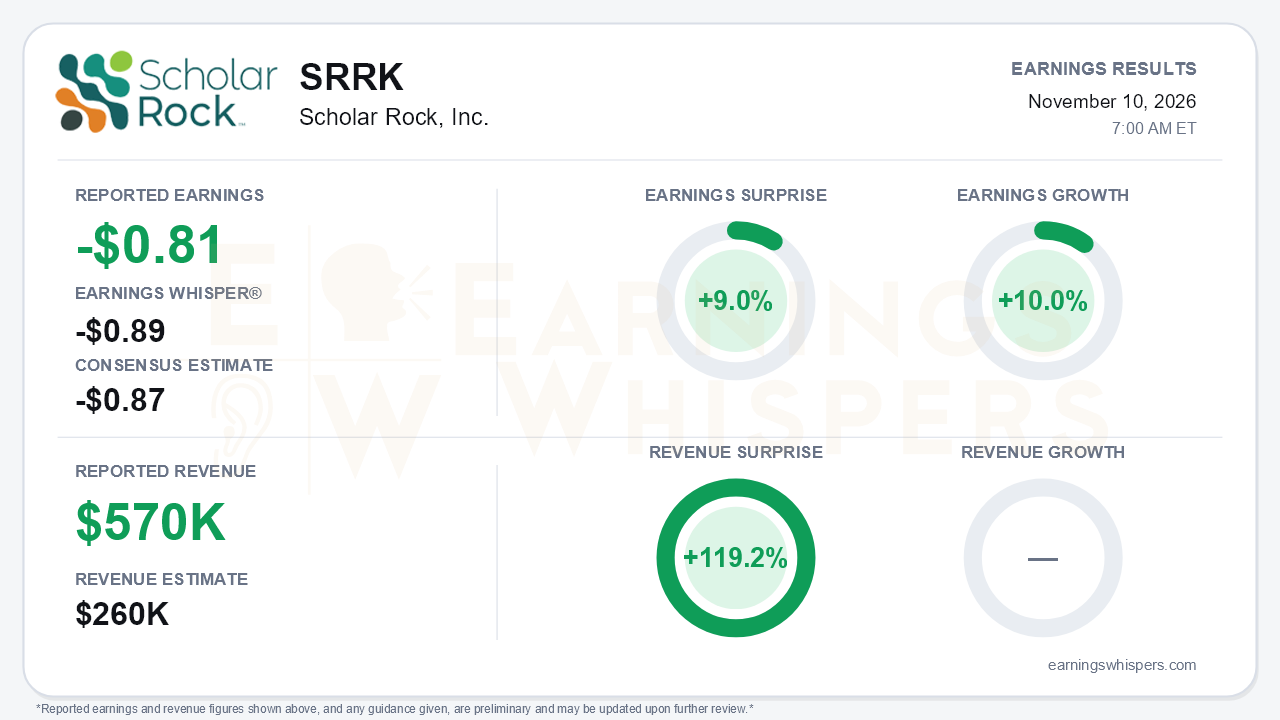
Scholar Rock (NASDAQ: SRRK) delivered its first quarter as a commercial-stage company, and the headline numbers cleared a low bar. The company lost $0.81 per share, beating the -$0.87 consensus by 9.0% and the -$0.89 Earnings Whisper number. Per-share earnings improved 10.0% from the $0.90 loss a year earlier. Revenue of $0.57 million from ISEMBYLD, approved by the FDA on September 11, more than doubled the $0.26 million consensus, a 119.2% surprise. The central takeaway is not the beat. Scholar Rock has moved from regulatory limbo to a launch with broad early physician engagement, yet the revenue that demand implies is still mostly a 2027 story.
The quality of the beat deserves scrutiny. The narrower per-share loss came from a larger share count, not a smaller loss. Weighted shares rose to 132.4 million from 113.7 million, helped by at-the-market issuance of $98 million in Q1 and $63 million in Q2. The net loss actually widened to $107.2 million from $102.2 million. Operating expenses were roughly flat. R&D rose to $54.1 million from $50.5 million, while SG&A edged down to $52.5 million. Other income swung to a $1.2 million expense from a $1.3 million gain, consistent with long-term liabilities nearly doubling to $197 million. The $0.6 million in revenue reflected the initial shipment to the specialty network, not patient pull-through. Cost of revenue was immaterial because pre-approval product costs had already been expensed through R&D, so early gross margins will look flattering.
The call preserved a credible launch narrative. Management said its field team engaged 95% of the top 140 SMA centers within six weeks. More than a third of those centers enrolled patients, and treatment-naive patients outnumbered transitions from the expanded access program and clinical trials. Management also described enrollment as steady week to week. The label is broad, covering patients aged two and older on any SMN2-targeted therapy with no ambulatory restriction. Anthem and Centene have published label-aligned coverage policies covering 47 million lives, and an ISEMBYLD-specific J-code takes effect April 1, 2027. Non-GAAP operating expenses stayed disciplined at $88.7 million, versus $89.2 million in Q2.
Bears still have legitimate ammunition. Management declined to quantify enrollments, so investors have only qualitative signals on demand. Management also flagged a 60-to-90-plus-day lag between prescription and infusion, meaning most patients enrolled through October will not begin treatment until 2027. Early payer denials, prior-authorization hurdles, and slow hospital formulary approvals add friction. A bone fracture warning sits on the label, though management says it has not dented demand. The mix effect of weight-based pricing remains unclear. Europe is the clearest setback. The original application was withdrawn and resubmitted with the alternate fill-finish site, which pushes the CHMP opinion from mid-2026 to the first half of 2027 and a German launch into later 2027. Japan partially offsets that delay. The JNDA was filed two months early and accepted under priority review, with a launch targeted near year-end 2027.
The balance sheet changed most materially. Cash fell to $413.6 million from $492 million in Q2. Adding the $205 million priority review voucher sale and a newly available $150 million debt tranche gives roughly $770 million of potential resources. Management said that means no equity raise is needed at this time, a meaningful shift for a company that leaned on ATM issuance earlier in the year. The voucher proceeds still depend on Hart-Scott-Rodino clearance.
Investors went into the report more skeptical. Earnings Whispers sentiment weakened from -0.34 to -0.42, a moderate move deeper into negative territory. The stock's path explains some of that caution. Shares hit a 52-week high of $61.76 on August 26, then slid to $38.69 by October 16, after approval. They have since recovered to $51.55, about 33% off the low. That leaves the stock 16.5% below the high, 7.0% above its 200-day moving average, and only 2.7% above the open following the August report. The trend readings are mixed: momentum is positive, while the price and AVWAP trends remain negative.
The bottom line is that Scholar Rock's beat was a function of dilution and a stocking shipment, but the quarter's substance was stronger than its numbers. The company secured a broad label, drew early center-level demand, landed key payer policies, and largely de-risked funding. The near-term tension is timing. Infusion lags, access friction, and the European delay mean reported revenue will trail the demand management describes, and the company has yet to put a number on enrollment. Until it does, sentiment is likely to stay cautious.
Read our earnings preview for Scholar Rock, Inc.: https://www.earningswhispers.com/article/SRRK/22710
This earnings review was originally published on Earnings Whispers.
This article is for informational purposes only and is not investment advice. Earnings Whispers and its staff may hold positions in the securities mentioned. It is AI-assisted, based on proprietary Earnings Whispers data and company reports, and edited by Earnings Whispers staff.
Mentioned In This Article
Latest News
| 11 hours | |
| 16 hours | |
| Nov-03 | |
| Nov-03 | |
| Oct-20 | |
| Oct-16 | |
| Oct-08 | |
| Oct-02 | |
| Sep-28 | |
| Sep-21 | |
| Sep-18 | |
| Sep-14 | |
| Sep-14 | |
| Sep-14 | |
| Sep-14 |
