Greystone Housing Impact (GHI) Swings To Profit And Covers Its Distribution With Cash, But Book Value Erosion And A New Texas Credit Problem Temper The Progress
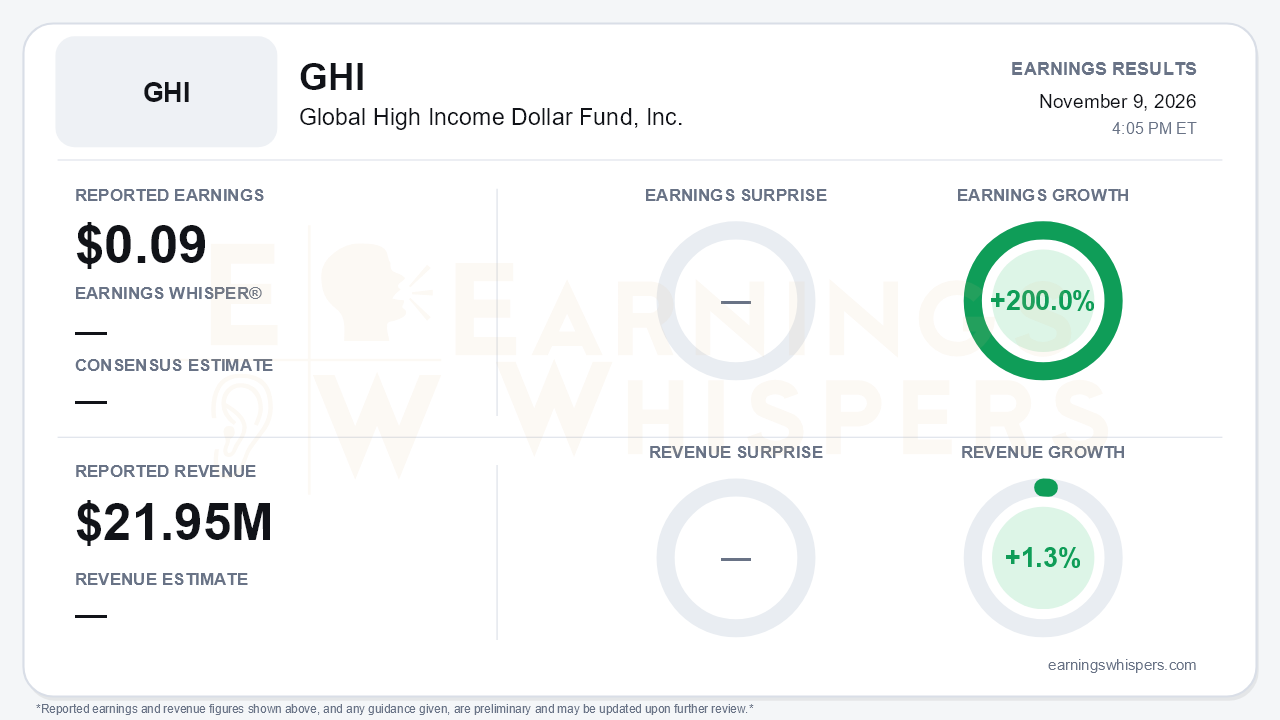
A note on identification first: the normalized earnings record lists GHI as Global High Income Dollar Fund, Inc. The press release and conference call, however, are clearly from Greystone Housing Impact Investors LP (NYSE: GHI), and this review is based on that partnership's results. Greystone reported third-quarter 2026 net income of $0.09 per BUC on revenue of $21.95 million. That reverses a loss of $0.01 per BUC a year earlier and represents earnings growth of 200.0%. Revenue grew a modest 1.3% year over year. No consensus or whisper figure was available, so there is no surprise to measure. The more relevant story is that this was the first quarter in which the partnership's strategic pivot, exiting market-rate joint venture equity and recycling capital into tax-exempt mortgage revenue bonds, produced something tangible. That progress arrived alongside a sharp drop in book value and a fresh credit issue. That is the central tension.
The quality of the GAAP profit deserves scrutiny. Net income of $3.2 million leaned heavily on a $4.3 million net gain from derivative transactions, including $4.0 million of unrealized swap gains. It also benefited from a small credit-loss reversal and a roughly $1.3 million drop in G&A. Beneath those items, the core engine softened:
- Investment income fell to $16.9 million from $17.7 million.
- The revenue gain came almost entirely from $1.95 million of property revenues tied to real estate taken back through deeds in lieu of foreclosure.
- Losses from unconsolidated entities widened to $3.5 million from $1.9 million.
The cleaner read is Cash Available for Distribution of $0.17 per BUC. That is essentially flat with $0.18 a year ago but well above $0.10 in Q2, $0.13 in Q1 and $0.12 in Q4. For the first time this year, CAD exceeds the $0.14 quarterly distribution. Investors should remember that the payout was reset from $0.30 a year ago, and nine-month CAD of $0.40 still trails the prior year's $0.71.
The call supplied the evidence of execution that had been missing. The August sale of Vantage at Loveland returned about $23.6 million, consisting of the full $21.1 million of remaining contributed equity plus $2.5 million of preferred return. It was the first market-rate JV exit in over a year. Management, which called the strategy "very early in the ballgame" last quarter, now describes it as "out of the first inning." Other signs of progress:
- Valage Senior Living Carson Valley was listed for sale in October.
- A $10 million tax-exempt MRB marked the first redeployment.
- GIL originations transferred to the BlackRock construction lending JV reached $116.7 million, versus $95.9 million cited on the Q2 call.
- Debt fell about $23 million to $802.7 million.
- Unhedged debt shrank to 14% from 24% in Q1.
- Non-Texas stabilized MRB occupancy edged up to 94%.
Bears have legitimate ammunition, though. Diluted book value per unit fell roughly 14% to $9.67 from $11.20, extending the slide from $11.70 at Q4. The drop reflects unrealized MRB losses from the late-September municipal sell-off. Five Texas MRBs tied to a single borrower fell behind on payments after prior calls had described the portfolio as fully current. The release notes that four of the five have since paid, but management remains in discussions with the borrower.
Liquidity and pipeline indicators also weakened:
- Line-of-credit availability shrank to $16.1 million from $34.2 million in Q2 and $49.2 million at Q4.
- On-balance-sheet MRB/GIL funding commitments thinned to $2.8 million from roughly $9 to $12 million earlier in the year.
- Overall stabilized MRB occupancy remains stuck near 86%.
The CEO also explicitly cautioned that Loveland is not a read-through for the remaining Texas Vantage assets, which face oversupply in San Antonio and Austin. LIHTC equity demand remains challenged, and no formal guidance was provided.
There are offsets worth watching. The 10-year MMD has retraced to 3.21% from 4.10% at the September 30 marks, which implies at least a partial recovery of the book-value hit. Management also pointed to a possible lift in LIHTC demand from the CRA assessment cycle beginning in January 2027.
The market has been unforgiving. Units opened at $5.66 after the August report and were cited at $4.31 on the call, down from $5.71 at the Q2 call. That price is a 55% discount to book value and well below the $5.86 200-day moving average. Investor sentiment data were not available for this report. The price action alone shows the market is treating credit and liquidity risk as more important than the first exit.
The bottom line is that Greystone delivered the proof of concept turnaround skeptics wanted: a clean JV exit, initial redeployment, and CAD that now covers a reduced distribution. However, the GAAP profit was swap-assisted, and book value, liquidity headroom and credit quality all moved the wrong way in the same quarter. Until the remaining Texas JV exits and the delinquent borrower are resolved, the deep discount to book is likely to reflect skepticism about how much of that book value is realizable.
This earnings review was originally published on Earnings Whispers.
This article is for informational purposes only and is not investment advice. Earnings Whispers and its staff may hold positions in the securities mentioned. It is AI-assisted, based on proprietary Earnings Whispers data and company reports, and edited by Earnings Whispers staff.
Mentioned In This Article
Latest News
| Nov-10 | |
| Nov-09 | |
| Nov-09 | |
| Oct-22 | |
| Sep-16 | |
| Aug-17 | |
| Aug-11 | |
| Aug-10 | |
| Aug-10 | |
| Aug-10 | |
| Jul-23 | |
| Jun-18 | |
| Jun-16 | |
| Jun-08 | |
| May-12 |
