Bionano Misses As Growth Slows And Cash Thins, Leaving A Reimbursement-Driven 2027 Story To Carry The Weight
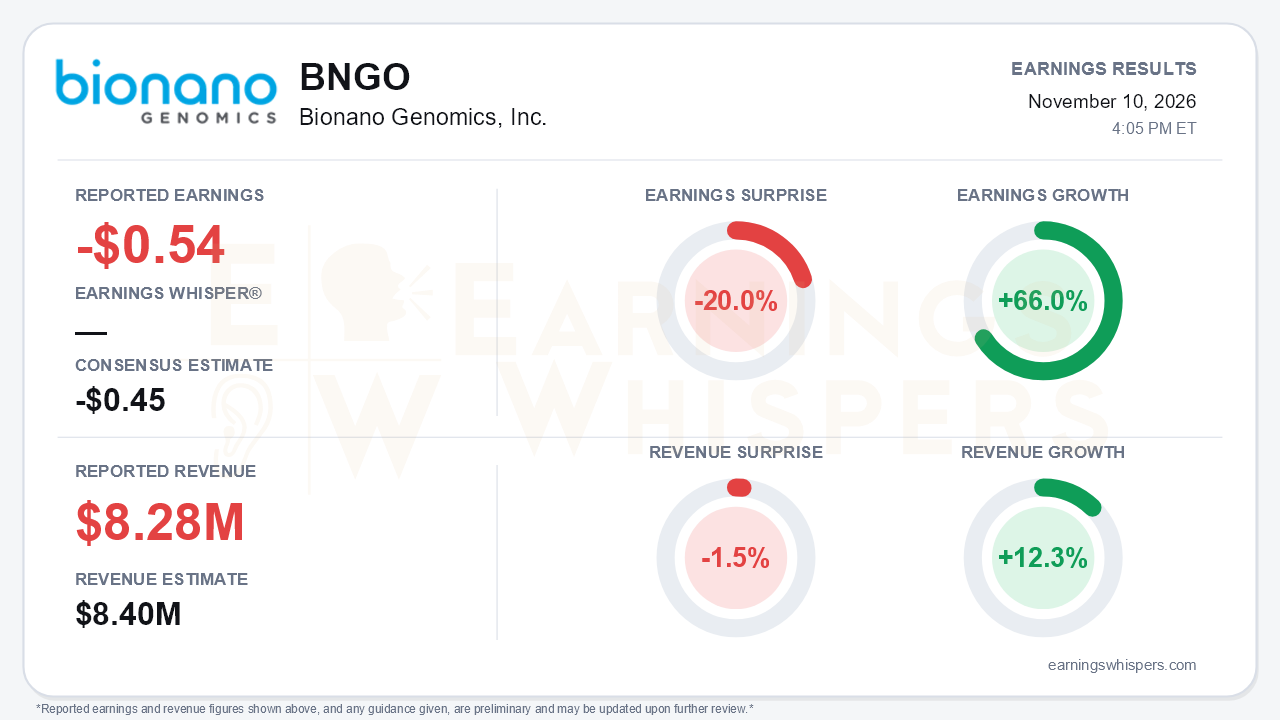
Bionano Genomics reported a third-quarter loss of $0.54 per share, missing the consensus estimate of a $0.45 loss by 20.0%. Revenue of $8.28 million rose 12.3% year over year but fell 1.5% short of the $8.4 million consensus. It also landed at the low end of the company's own $8.2 million to $8.6 million guide. Loss per share improved 66.0% from a year ago, and the GAAP net loss narrowed to $6.5 million from $8.5 million. That is real progress on cost control. The central tension is that the catalysts for optical genome mapping (OGM) kept strengthening while the financial engine cooled. Bionano now has thinner cash reserves to bridge the gap.
The quality of the quarter is mixed. Revenue growth slowed to 12% from 21% in the second quarter. Flowcell growth eased to 18% from 27%, even though the 9,870 flowcells sold set a record and rose from 9,219 in Q2. Consumables revenue grew 24% to $4.7 million and Americas revenue climbed 35%. Those are the recurring, utilization-driven lines that matter most. The drag came from software, where revenue fell 31% to $1.1 million. Management now expects that decline to continue as array-based VIA customers migrate to OGM. Gross margin of 48% improved from 46% a year ago but dropped sharply from a record 53% in Q2. Cost of service revenue jumped to $639,000 against just $449,000 of service revenue, so that line was unprofitable for the quarter. Operating expenses fell 12% to $10.5 million and adjusted operating expense fell 9% to $8.8 million. Those cuts drove the narrower loss, not top-line leverage.
The call sounded more confident than the numbers. The headline new catalyst is a proposed MolDX local coverage determination for OGM in hematologic neoplasms, spanning 31 states and roughly 61% of the U.S. population. The comment period has closed but a final determination is pending. That adds to the existing Category I CPT code for heme testing, priced at $1,853.22. New York State approved OGM lab-developed tests at University of Rochester Medicine, and Memorial Sloan Kettering launched OGM heme malignancy testing. Three new peer-reviewed publications in high-risk myeloid cancers extend the evidence base. Management cited large customers coming online as the main 2027 growth driver. It also set a concrete target of adjusted EBITDA neutrality by the end of 2027, replacing the vaguer "over time" language from Q2.
The forward framework is ambitious, and the bears have legitimate ammunition. Management referenced a $50 million to $54 million revenue framework for 2027. Against roughly $32 million this year, that would require growth well above 50%. Third-quarter growth was 12%, and supply constraints on silicon wafers persist through year-end. Flowcell capacity is not expected to double until mid-2027, though the backlog should clear by the end of 2026. Full-year 2026 revenue guidance was reaffirmed at $31 million to $33 million, with management steering toward the midpoint and offering no upside raise. Management also could not detail how MSK will implement OGM, and a permanent CEO has still not been named.
The balance sheet is the most pressing risk. Cash, investments and restricted cash totaled about $8.7 million, down from $10.4 million in Q2 and $29.6 million at the end of 2025. Part of that decline reflects repaying roughly $10 million of convertible debentures. Still, at the current quarterly loss rate the cushion is thin. The call gave no update to the prior runway guidance of at least the first quarter of 2027. The release retains going-concern language and explicitly references the need for significant additional financing. For a company targeting break-even more than a year out, dilution risk sits squarely in the investment setup.
Investor sentiment improved heading into the report, moving from modestly negative to modestly positive, about a 0.14-point swing on a scale of -1 to +1. Price action tells a more sobering story. Shares spiked to a 52-week high of $2.23 on September 15, then gave back the entire move. They sat at $1.16 entering the report, exactly where they opened after the August release. The stock is 5.9% below its 200-day moving average and only 8% above the inter-earnings low of $1.07 set days before the print. Earnings Whispers trend readings are mixed, with sequential growth and momentum positive while price and AVWAP trends remain negative.
The bottom line is that Bionano delivered a narrower loss and a stronger reimbursement narrative, but missed on both lines. Growth slowed, margin progress stalled sequentially, and cash fell below $9 million. The MolDX decision, clinical adoption at major cancer centers, and the capacity build give the 2027 story credibility. However, the company must fund that story first, and the path from 12% growth to the 2027 framework remains largely unproven.
Read our earnings preview for Bionano Genomics, Inc.: https://www.earningswhispers.com/article/BNGO/22725
This earnings review was originally published on Earnings Whispers.
This article is for informational purposes only and is not investment advice. Earnings Whispers and its staff may hold positions in the securities mentioned. It is AI-assisted, based on proprietary Earnings Whispers data and company reports, and edited by Earnings Whispers staff.
Mentioned In This Article
Latest News
| Nov-10 | |
| Nov-10 | |
| Nov-03 | |
| Oct-27 | |
| Sep-14 | |
| Aug-24 | |
| Aug-11 | |
| Aug-10 | |
| Aug-07 | |
| Jul-27 | |
| Jun-24 | |
| Jun-18 | |
| Jun-11 | |
| May-28 | |
| May-26 |
