Mobile Infrastructure Matches Estimates As Same-Location NOI Accelerates To 18%, But Guidance Fails To Reflect The Momentum
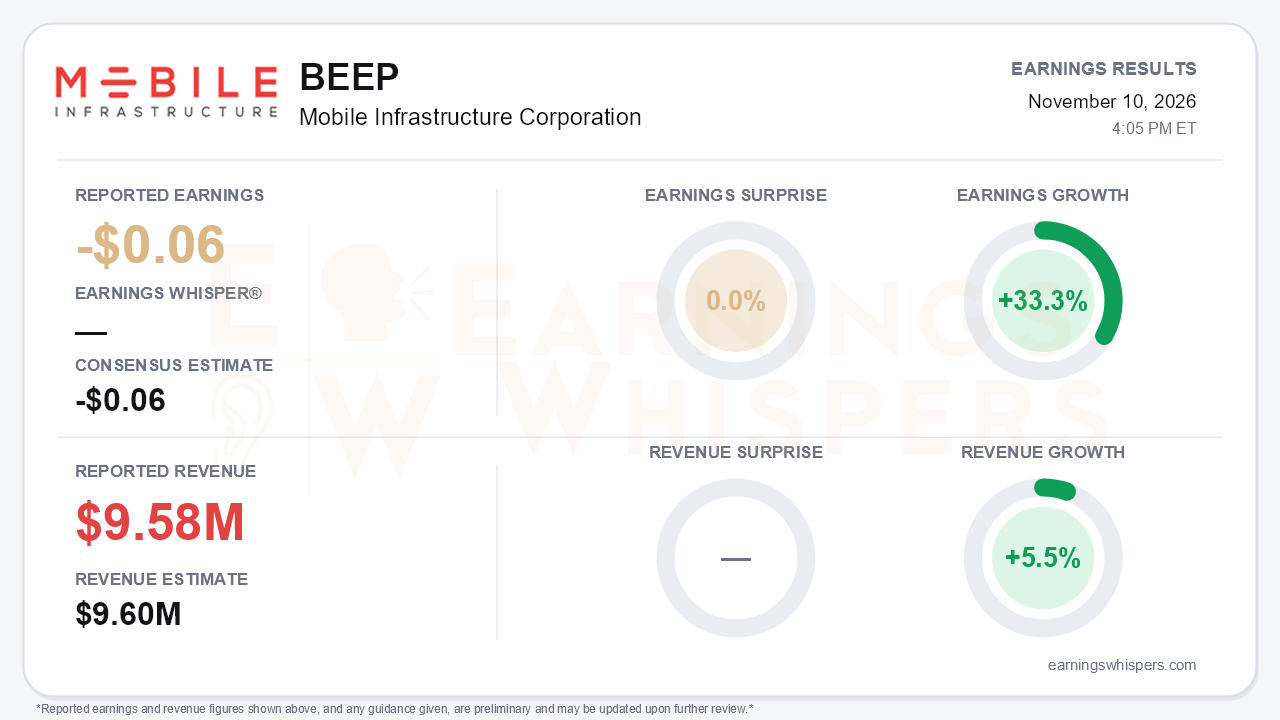
Mobile Infrastructure (NASDAQ: BEEP) delivered a quarter whose headline undersells what happened underneath it. The parking-garage owner reported a loss of $0.06 per share, exactly matching consensus. Earnings improved 33.3% year over year as the loss narrowed from $0.15 a share. Revenue of $9.58 million rose 5.5% but missed the $9.6 million consensus by 0.2%. Those figures look unremarkable. The operating data do not. Same-location NOI rose 18.4% to $6.3 million, adjusted EBITDA climbed 23.2% to $4.8 million, and RevPAS hit a record $245.83. That is the central tension of the report: the portfolio is clearly accelerating, but management declined to raise its outlook and steered full-year revenue to the low end of its range.
The acceleration is real and sequential. Same-location NOI growth moved from 4.4% in Q1 to 12% in Q2 to 18.4% in Q3. Same-location revenue went from roughly flat to 5.6% to 12.8% over the same stretch. Adjusted EBITDA growth jumped from 5.5% in Q2. Reported revenue growth trails the same-location figure because of asset sales and the shrinking base of leased properties. Base rental income fell to $1.0 million from $1.3 million, and nine-month total revenue was essentially flat year over year. Expense discipline helped: property taxes and operating expenses fell to $3.3 million from $3.6 million.
The quality of the GAAP improvement deserves scrutiny. Last year's quarter carried a $2.5 million impairment. Depreciation also dropped by more than $1.1 million. Both flattered the year-over-year narrowing of the net loss. Meanwhile, interest expense rose to $4.8 million, effectively matching adjusted EBITDA. That reality explains why debt reduction through asset sales matters as much as garage-level growth.
On the call, management framed the quarter as validation of its "utilization first, pricing later" strategy. Utilization rose about 13 percentage points year over year, and trailing-twelve-month utilization reached roughly 73%. Contract volumes grew about 13%, after 12% in Q2 and 6% in Q1, which builds a more recurring revenue base. Baseline transient transactions rose 11%, with Nashville transactions nearly doubling. In-house pricing tools pushed third-party reservation revenue up as much as 70%. Still, the growth is overwhelmingly volume-led, with transient rates up only about 3%. The pricing payoff has also drifted further out. Management now describes 2027 as a year of optimizing its parker mix, with broad rate increases framed for the second half of 2027 and into 2028. That reads as a later timeline than the earlier "rate follows utilization" messaging.
The forward catalysts are tangible. Four lease-to-management conversions are scheduled for 2027, which should bring more revenue under the company's direct operating control. The asset rotation program has generated about $33 million at a roughly 2% cap rate. Management argues those private-market valuations expose a disconnect with the share price. About $25 million of additional assets are now under contract or in final negotiation, up from merely "negotiating" last quarter. Bears have legitimate ammunition, however. Sale processes have elongated amid interest-rate moves, and management says it is "not managing to a calendar." Reopening tailwinds in Cincinnati, Nashville and Denver lap in December and January, so the comparisons get harder. The BOM Asset Management take-private proposal remains under special committee review with no update. Cash also fell to $10.6 million from $15.3 million at year-end, even as total debt declined to $198.3 million from $207.7 million.
The market setup is more complicated than the in-line print implies. Investor sentiment swung sharply, from -0.35 at the prior report to +0.83, a genuinely large shift toward optimism. The stock has not followed. Shares sat at $2.37 heading into the release, down 16.8% from the open after the August report. That leaves them just 5.3% above the inter-earnings low of $2.25 set the day after that report, and 25.2% below the September 8 high of $3.17. Any lift from the summer's operating momentum had largely evaporated before this report arrived.
The bottom line is that Mobile Infrastructure is executing on the operating side, with same-location NOI, contract volumes and RevPAS all accelerating for a third straight quarter. Management's reiterated guidance, low-end revenue outlook and pushed-out pricing timeline suggest it is not yet prepared to extrapolate that momentum. With interest costs absorbing nearly all of adjusted EBITDA, the investment case hinges on closing asset sales and eventually converting utilization into pricing. Until those milestones arrive, the gap between upbeat sentiment and a stock pinned near its lows is likely to persist.
Read our earnings preview for Mobile Infrastructure Corporation: https://www.earningswhispers.com/article/BEEP/22723
This earnings review was originally published on Earnings Whispers.
This article is for informational purposes only and is not investment advice. Earnings Whispers and its staff may hold positions in the securities mentioned. It is AI-assisted, based on proprietary Earnings Whispers data and company reports, and edited by Earnings Whispers staff.
Mentioned In This Article
Latest News
| 1 hour | |
| 3 hours | |
| Nov-03 | |
| Oct-22 | |
| Oct-13 | |
| Aug-11 | |
| Aug-10 | |
| Aug-06 | |
| Jul-14 | |
| May-13 | |
| May-12 | |
| May-11 | |
| Apr-24 | |
| Apr-15 | |
| Mar-31 |
