Seer Narrows Its Loss Through Cost Cuts, But A 20% Guidance Reset Undercuts The Revenue Rebound
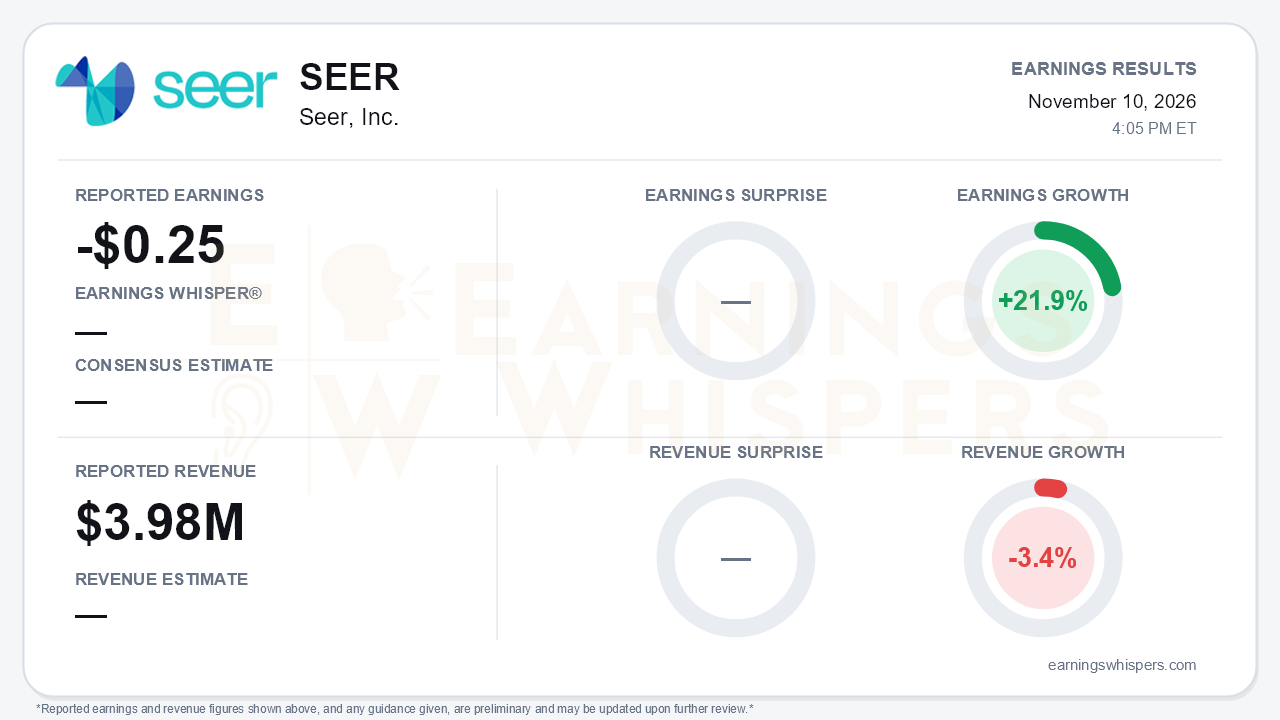
Seer's third quarter shows a sequential revenue rebound inside a year that is coming in well below plan. The company lost $0.25 per share, compared with $0.32 a year earlier, which Earnings Whispers measures as 21.9% year-over-year earnings growth. Revenue of $3.98 million fell 3.4% from the prior year but rose from $3.1 million in the second quarter and $2.8 million in the first. No consensus estimate was available, so this is not a beat-or-miss story. The defining development is guidance. Seer cut full-year 2026 revenue guidance to $13.5 million to $14.5 million from $16 million to $18 million. Management had reaffirmed the old range on three consecutive calls.
The quality of the earnings improvement deserves scrutiny. The narrower loss came almost entirely from spending cuts, not business growth. Operating expenses fell 23% year over year to $16.5 million. Research and development dropped to $6.4 million from $10.8 million, and stock-based compensation fell to $1.2 million from $3.6 million. Gross profit actually declined to $1.9 million from $2.1 million a year ago. Gross margin slipped to 47% from 49% in the second quarter and 52% in the fourth quarter of 2025. The company characterized the sequential decline as 130 basis points, which suggests the rounded percentages overstate it. That level remains far below the 70% to 75% long-term target. Interest income also fell to $2.0 million from $2.8 million as the cash pile shrinks. Cutting R&D this deeply protects the balance sheet, but it is a trade-off for a company whose pitch rests on technological differentiation.
The guidance math is more revealing than the quarterly revenue line. Through nine months, Seer has booked $9.9 million in revenue. The new range therefore implies fourth-quarter revenue of roughly $3.6 million to $4.6 million, essentially flat with the third quarter at the midpoint. The prior range implied a fourth quarter well above $6 million. On the second-quarter call, management pointed to a second-half ramp driven by consumable pull-through from 2025 installs and a new commercial leader. Instead, pull-through was flat sequentially. Management attributed the shortfall to two factors:
- pressure on academic and government funding, which has extended sales cycles;
- customer hesitancy tied to the activist campaign and acquisition proposals, with some buyers questioning Seer's long-term support.
The call's tone shifted accordingly, from second-quarter enthusiasm to a more defensive posture. Management offered no 2027 guidance, only an expectation that 2027 will be a growth year.
The call did preserve a credible scientific and commercial story, and some of the overhangs are clearing. The Special Committee concluded its review on October 29 with Seer remaining independent. That should remove one cited source of customer hesitation. In the ITC case, Nanomics withdrew from defending, and the ITC staff recommended full exclusion and cease-and-desist orders. The call notes render the respondent as "Nanomix"; the release identifies it as Nanomics Biotechnology Co., Ltd. A final determination is expected by year-end. Other supportive developments include:
- Publications reached 116, up from 70 at the end of 2025.
- PRECISE-SG100K data showed roughly 8,800 protein groups across 9,658 samples.
- Several large pharma customers adopted the platform this year.
- Management said sales cycles have shortened to about six months.
- Management expects to announce, within weeks, a customer with more than 10,000 samples and an initial order of a couple thousand samples.
Bears still have legitimate ammunition. Management flagged planned customer price reductions, which could pressure revenue per sample and gross margin. CFO and President David Horn departed. His duties passed to a Treasurer and principal financial officer, not a named CFO. Cash and investments fell to $198.1 million from $209.5 million in the second quarter and $241 million at year-end.
The balance sheet frames the market setup. Seer has about 55.8 million shares outstanding, so cash and investments equal roughly $3.55 per share. Third-quarter buybacks were modest, about 61,000 shares at an average of $1.64. Shares opened at $2.02 after the August report and have been trading around a 200-day moving average of $1.91. The market has been valuing the operating business at a steep discount to its cash, and this guidance cut will not quickly change that skepticism. Management says it has sufficient capital to reach cash flow breakeven, which remains the key support for the thesis.
The bottom line is that Seer delivered a narrower loss and a sequential revenue recovery, but both are overshadowed by a second-half ramp that did not arrive. Cost discipline is doing the work that revenue growth was supposed to do. The pending ITC ruling, the large-sample customer announcement, and evidence that consumable pull-through is finally inflecting are now the tests of whether 2027 becomes the growth year management expects.
This earnings review was originally published on Earnings Whispers.
This article is for informational purposes only and is not investment advice. Earnings Whispers and its staff may hold positions in the securities mentioned. It is AI-assisted, based on proprietary Earnings Whispers data and company reports, and edited by Earnings Whispers staff.
Mentioned In This Article
Latest News
| Nov-10 | |
| Nov-10 | |
| Nov-05 | |
| Nov-02 | |
| Oct-29 | |
| Oct-21 | |
| Sep-23 | |
| Sep-21 | |
| Sep-16 | |
| Sep-04 | |
| Aug-13 | |
| Aug-12 | |
| Aug-11 | |
| Aug-10 | |
| Aug-03 |
