EuroDry Beats By 21.5%, But Earnings Plateau And Shares Retreat To Book Value As Drybulk Rates Cool
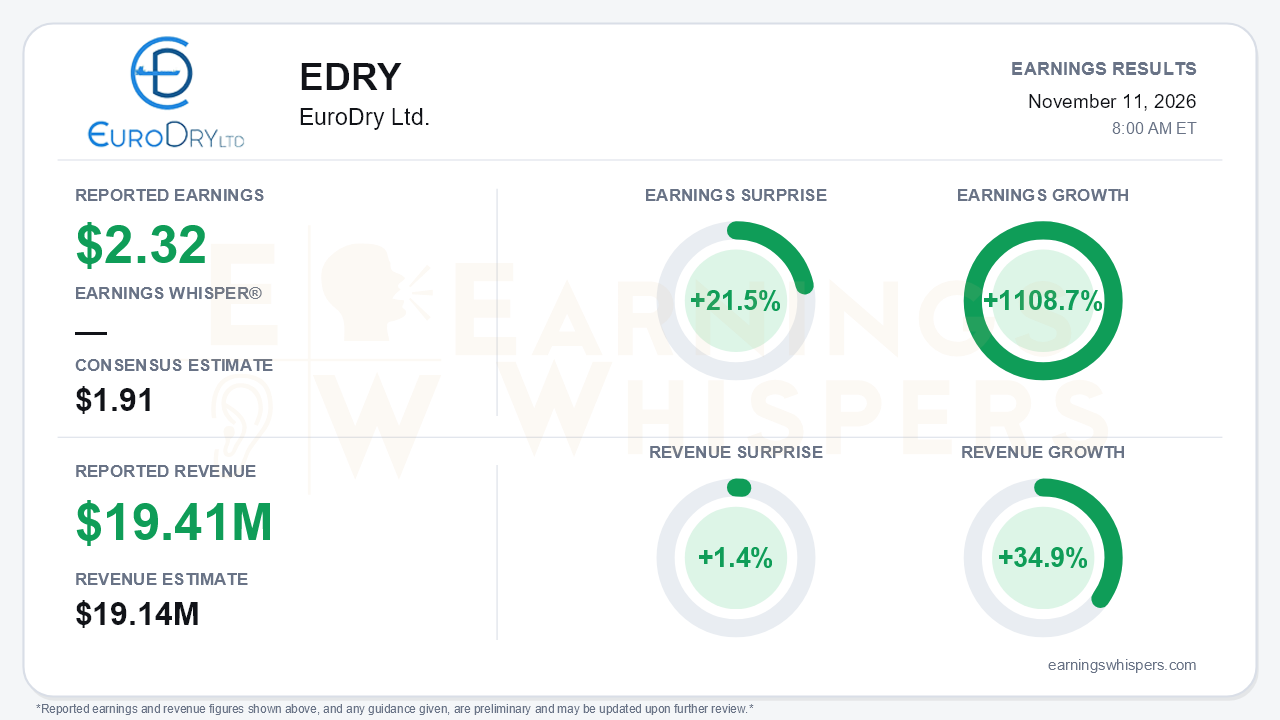
EuroDry (NASDAQ: EDRY) delivered a clear beat in the third quarter. Adjusted EPS of $2.32 topped the $1.91 consensus by 21.5%, and revenue of $19.41 million edged past the $19.14 million estimate by 1.4%. The year-over-year comparison is dramatic: earnings grew 1108.7%, swinging from an adjusted loss of $0.23 per share a year ago to a solid profit, while revenue rose 34.9%. The more important story, however, is sequential. Adjusted diluted EPS slipped from $2.44 in the second quarter, and adjusted EBITDA eased to $11.34 million from $11.71 million. That happened even though charter rates were at multi-year highs. The quarter looks less like an inflection than a plateau at peak conditions, and that is the central tension for investors.
The top line held up well. Revenue rose to $19.4 million from $17.7 million in Q2 and $12.8 million in Q1. The fleet's time charter equivalent rate was $20,551/day, up 55.3% from $13,232 a year earlier and essentially flat against Q2's $20,398. That growth came despite a smaller fleet of 11.0 vessels versus 12.0 a year ago, and utilization was nearly perfect at 99.7%. Costs ate into the gains, though. Total daily vessel operating expenses rose to $7,687 from $7,444 in Q2 and $7,013 a year ago. Management attributed the increase to a weaker dollar, higher supply costs tied to the Middle East conflict, and higher stock-compensation expense. GAAP diluted EPS of $2.39 ran slightly ahead of the adjusted figure because of a $0.19 million unrealized gain on forward freight agreements. Note that the call cited a $556K FFA loss, while the release shows a much smaller net Q3 derivatives loss of about $51K. The larger figure appears to reflect a broader period, so the quarterly drag was modest.
The call tempered the outlook more than the headline beat suggests. Panamax spot rates fell to $17,200/day by early November from an $18,000 Q3 average. One-year time charters have drifted steadily lower: $16,875 now, versus $17,125 at the Q2 call and roughly $18,000 at the Q1 call. CEO Aristides Pittas acknowledged softening in October, more pronounced for Panamax/Kamsarmax vessels than Ultramaxes. He said he expects 2027 rates to be "a little bit lower" than today and called the market extremely difficult to forecast. That matters because most of the fleet is up for repricing almost immediately: eight of eleven charters reach their earliest redelivery in November or December 2026. Several older Panamaxes are fixed at $13,400 to $15,000/day. Meanwhile, the forward cash breakeven is rising toward roughly $13,000/day, up from $11,663 at year-end 2025, driven partly by about $4 million of drydocking for three vessels spread across Q4 and Q1. Bears have legitimate ammunition here: margins are being squeezed from both sides just as the cycle may be cresting. The industry order book has also climbed to 15.7% from 12.4% in February.
Management did use the strong tape well. It re-established its ATM program and raised $10.7 million at an average $67.54 per share, roughly at or above its estimated NAV of $66-67. It also refinanced a vessel and ended the quarter with more than $50 million in unrestricted cash against $105.7 million of debt. That liquidity funds the equity portion of an expanded five-ship newbuilding program, which now includes a third Kamsarmax ordered at Hengli for about $37 million with 2029 delivery. That order remains conditional on a bank refund guarantee. The program would take the fleet to 16 ships and about 1.14 million dwt. Clarksons' upgrade of its 2026 ton-mile growth forecast to 4.1% from 3.7% offers some support for management's constructive long-term view.
The market setup has deteriorated sharply. Shares spiked to a 52-week high of $73.07 on September 17, then gave back nearly half of that move. The stock sits at $38.80, essentially at book value of about $38.90 per share and far below the price at which the company just sold equity. The stock is still 41% above the open following the August report and 27.4% above its 200-day moving average, so the longer-term gain remains intact. Shorter-term trend readings are mixed, with momentum positive but AVWAP negative. Investor sentiment has swung decisively, falling from +0.69 to -0.30, a genuine reversal from optimism to caution.
The bottom line is that EuroDry beat expectations comfortably and strengthened its balance sheet at an opportune moment, but the quarter likely captured peak-cycle earnings. Sequential profits slipped, rates are easing, costs and breakevens are climbing, and much of the fleet reprices into a softer market. With shares already retreating from NAV to book value, the stock's next move will depend on whether drybulk rates stabilize near current levels rather than on the size of this beat.
Read our earnings preview for EuroDry Ltd.: https://www.earningswhispers.com/article/EDRY/22957
This earnings review was originally published on Earnings Whispers.
This article is for informational purposes only and is not investment advice. Earnings Whispers and its staff may hold positions in the securities mentioned. It is AI-assisted, based on proprietary Earnings Whispers data and company reports, and edited by Earnings Whispers staff.
Mentioned In This Article
Latest News
| Nov-11 | |
| Nov-11 | |
| Nov-05 | |
| Nov-05 | |
| Oct-14 | |
| Aug-14 | |
| Aug-06 | |
| Jul-31 | |
| Jul-24 | |
| Jun-23 | |
| May-28 | |
| May-20 | |
| May-18 | |
| Apr-03 | |
| Mar-09 |
