Solana Company Misses On Normalized EPS As A $105 Million GAAP Profit Rides SOL's Rally, While Staking Revenue Rebounds
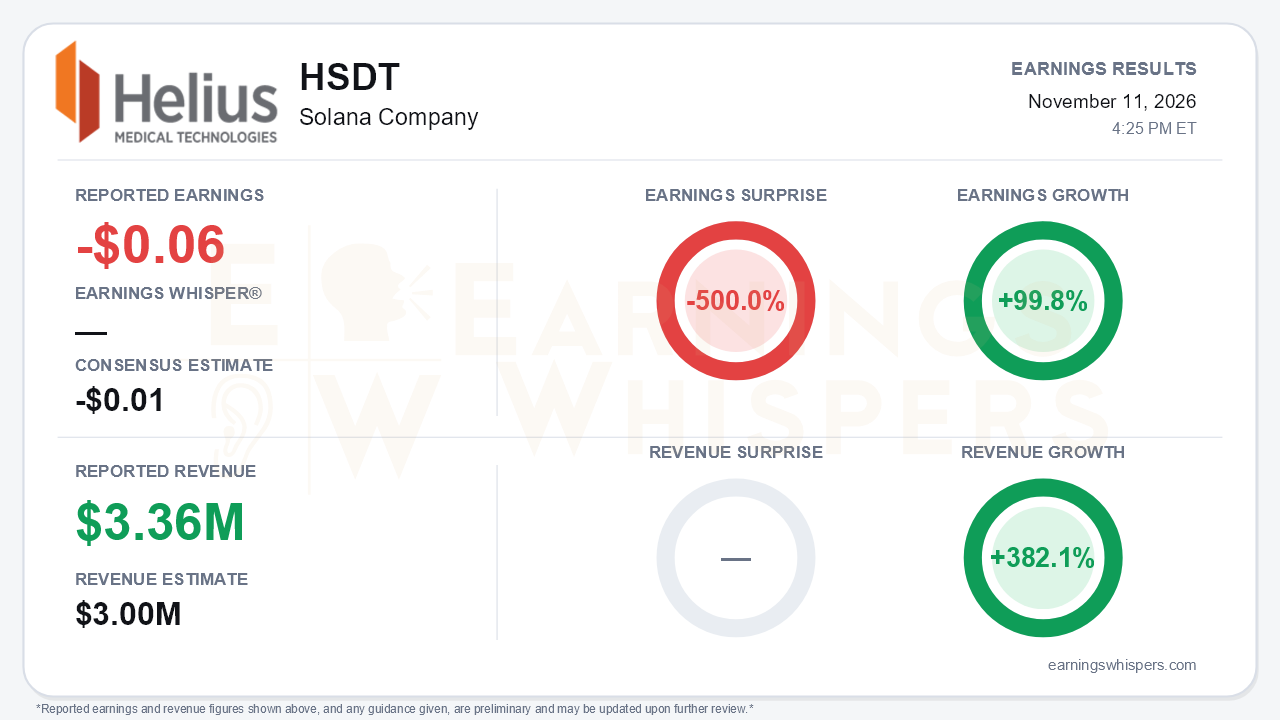
Solana Company (NASDAQ: HSDT) posted a third quarter in which the GAAP and normalized results tell opposite stories. On the Earnings Whispers normalized basis, the company lost $0.06 per share. That was well short of the $0.01 consensus loss, a 500.0% miss, although it still represents 99.8% year-over-year earnings growth from a deeply negative base. GAAP results look very different: net income of $105.2 million, or $1.17 per diluted share, against a $352.8 million loss a year ago. Almost all of that profit came from a $102.7 million unrealized gain on digital assets as SOL rallied roughly 60% during the quarter. Revenue was the cleaner positive. Sales of $3.36 million beat the $3.0 million consensus by 12.0% and grew 382.1% year over year. The central tension is that the treasury's mark-to-market swung sharply in the company's favor while the underlying operating business still does not cover its costs on a normalized basis.
The quality of the quarter deserves scrutiny. Gross profit was $2.7 million at roughly an 82% margin. General and administrative expense fell to $3.4 million, the lowest level yet, down from $11.1 million in Q2 (which included $6.8 million of PoNS severance), $5.2 million in Q1, and $13 million in Q4 FY25. Even at that trough, G&A still exceeded gross profit. Management also signaled that G&A will drift back toward somewhere between current and historic levels as the business grows. Cost of revenue climbed to $617 thousand from $180 thousand in Q1 as validator operations scaled, so the cost advantage from the divestiture may already be near its best.
The call did show the operating machinery starting to work. Revenue rebounded to $3.4 million from $2.5 million in Q2, back near Q1's $3.6 million. The Pacific Backbone validator moved from build-out to operation, and third-party delegated stake ramped from about 300 thousand SOL in late July to roughly 1 million SOL, about 1.3 million SOL including the company's own delegation. The CEO described that ramp as "above our expectation." Management's tone shifted from "building" earlier in the year to a flywheel that has "started to turn." The SOL-denominated yield base is moving the other way, however:
- Net staking yield fell to about 5.9% APY from 6.9% in Q1, even as outperformance versus the network widened to roughly 100 basis points.
- SOL earned from staking slipped to 30,767 from 32.5 thousand in Q1 and 34 thousand in Q4 FY25.
The headline revenue recovery owes a good deal to SOL's price rather than to more tokens being earned.
Forward visibility is limited, and the company offers no formal guidance. Management said third-party stake growth will slow in Q4 and will not reach 3 million SOL by year-end. It also warned that yield outperformance may become more volatile after the Alpenglow upgrade as the network average rises. Advisory contracts described as being signed earlier in the year were not quantified, and the Anchorage/Kamino yield-enhancement opportunity went unmentioned. Capital management was the bright spot. The company bought back stock below NAV, reaching $8.7 million year to date plus $4.4 million after quarter-end. It then raised about $15 million at a 5% premium to NAV ($3.433 per share) and used the proceeds to buy roughly 125 thousand SOL. The Hong Kong OASIS designation, the planned regional headquarters, the trust-company investment, and a targeted ISO 27001 certification all extend the Asia-Pacific institutional strategy. Bears still have legitimate ammunition:
- Cash stood at only $1.1 million against a $15 million broker payable for SOL that settled October 1.
- Warrants struck at $3.776 add an overhang.
- SOL has fallen about 30% from its late-September high, pressuring the NAV that the entire model depends on.
The market has already priced much of that reversal. Shares hit $3.42 on September 22, almost exactly the level of the premium raise, and now sit at $1.83. That is 46.7% below the inter-earnings high, only 12.7% above the August low, and 11.5% under the 200-day moving average of $2.06. The stock is up just 7.4% from the $1.70 open after the prior report, so the entire SOL-driven spike has largely evaporated. Investor sentiment improved from -0.75 to -0.60, a meaningful move but one that leaves positioning clearly negative. The Earnings Whispers trend readings lean negative, with AVWAP still negative while price and sequential growth are neutral.
The bottom line is that HSDT's quarter proved the infrastructure and capital-markets pieces of its flywheel can work. Third-party stake, premium-to-NAV issuance, and record-low overhead are real progress. Yet the normalized miss, the declining SOL yield, rising validator costs, and thin liquidity show that the equity remains overwhelmingly a leveraged bet on SOL's price. With SOL and the stock both well off their September peaks, the GAAP profit is already stale, and the next quarter will hinge on whether third-party staking and advisory revenue can grow fast enough to matter independently of the token.
Read our earnings preview for Solana Company: https://www.earningswhispers.com/article/HSDT/23078
This earnings review was originally published on Earnings Whispers.
This article is for informational purposes only and is not investment advice. Earnings Whispers and its staff may hold positions in the securities mentioned. It is AI-assisted, based on proprietary Earnings Whispers data and company reports, and edited by Earnings Whispers staff.
Mentioned In This Article
Latest News
| 1 hour | |
| 3 hours | |
| 4 hours | |
| Nov-10 | |
| Nov-10 | |
| Nov-09 | |
| Nov-06 | |
| Nov-06 | |
| Oct-26 | |
| Oct-22 | |
| Oct-06 | |
| Oct-01 | |
| Sep-30 | |
| Sep-30 | |
| Sep-28 |
