CuriosityStream Beats On AI Licensing And Lifts Guidance Floor, But Thinner Margins And A Shrinking Cash Pile Explain Why The Stock Sits Near Its Lows
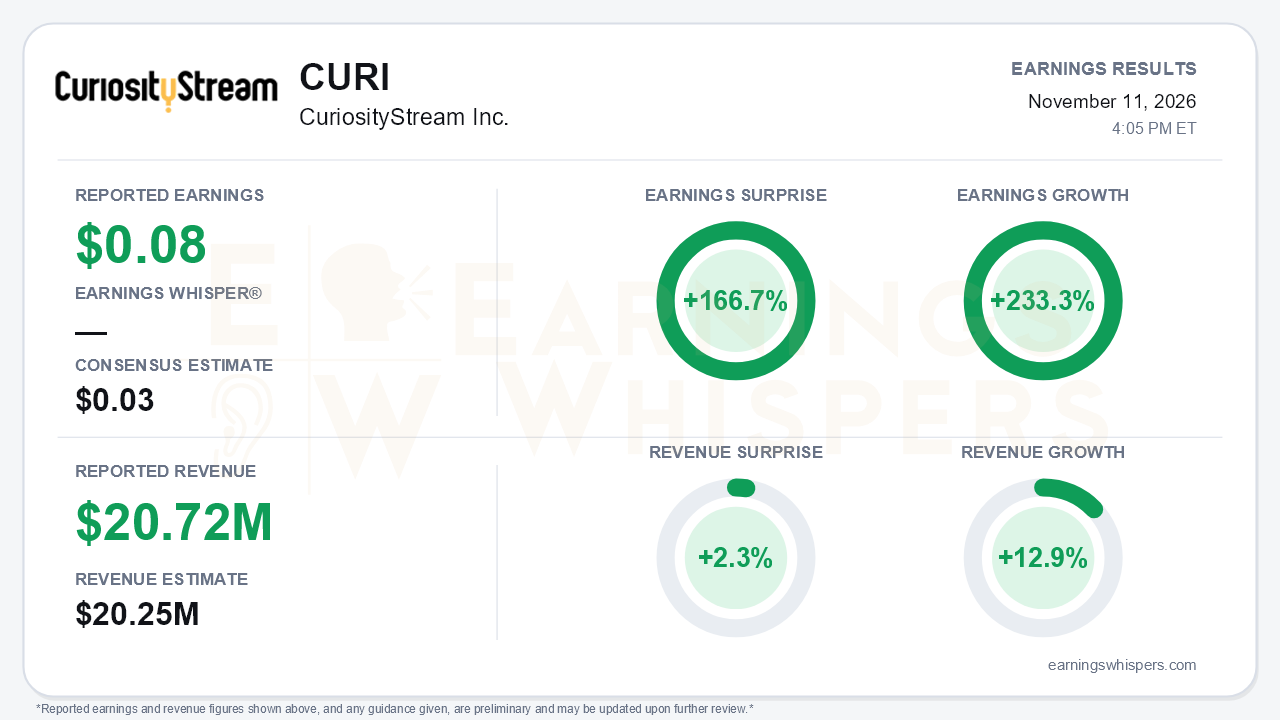
CuriosityStream delivered a clear headline beat for the third quarter. It earned $0.08 per share against a $0.03 consensus, a 166.7% surprise, on revenue of $20.72 million, which topped the $20.25 million estimate by 2.3%. Earnings grew 233.3% year over year as the company swung from a $0.06 loss to a GAAP profit of $4.8 million. Revenue rose 12.9%. Management also raised the low end of full-year guidance for the second straight quarter, to $79-82 million in revenue and $20-22 million in adjusted EBITDA. On the surface, the AI-licensing pivot is producing real earnings. Underneath, the revenue mix is diluting margins and consuming cash faster than the income statement suggests. That is the central tension.
The quality of the beat deserves scrutiny. Gross margin fell to 48.8% from 58.7% a year ago and from roughly 73% in the second quarter. The company attributed the decline to revenue-share payments on AI licensing deals, which run 50% or more on some contracts, along with barter amortization. Earnings growth came largely from the expense line. Operating expenses fell 25% year over year. General and administrative costs dropped to $4.9 million from $11.8 million, helped by stock-based compensation falling to $1.0 million from $7.0 million. Below the operating line, net income included a $0.9 million non-cash gain on the Spiegel Venture remeasurement and about $1.05 million of interest and other income. Operating income of $3.7 million was a sharp improvement on last year's $4.5 million loss, but it is a smaller number than the GAAP figure implies. The CEO said EPS was roughly equivalent to the $0.085 dividend. Strictly speaking, it fell just short.
The call confirmed licensing as the growth engine. Licensing revenue rose 35% to $11.7 million and now makes up 57% of revenue. More than $7 million of it was cash licensing, mostly from new deals with Tier 1 frontier AI labs. Adjusted EBITDA margin expanded to 24% from 16%. Subscription revenue slipped slightly year over year, running at roughly a $9 million quarterly rate. Sequentially, the picture was weaker. Revenue fell from $23.2 million in the second quarter, and adjusted EBITDA dropped from a record $11.4 million to $5.0 million. The narrowed guidance also implies fourth-quarter adjusted EBITDA of roughly $2.9-4.9 million, below the third-quarter level. That reinforces how lumpy the licensing model is. It also shows that the 'raise' was partly a function of a strong first half.
Cash is where bears have legitimate ammunition. Cash, restricted cash and investments totaled about $10 million, down from $27.3 million at year-end. The drawdown reflects buybacks, a larger bonus, the $1.9 million Spiegel buyout and roughly $15 million in dividends paid over nine months. Nine-month operating cash flow was only $1.5 million, versus $9.1 million a year earlier. Accounts receivable climbed, and a new $6.2 million non-current licensing receivable reflects the $10 million second-quarter deal, which pays in four $2.5 million installments starting mid-2027. Third-quarter operating cash flow did improve to $4.5 million, and management says AI deals require no working-capital investment. Still, the dividend is not yet self-funded, and management is targeting 2027 for that. The prior year-end cash outlook of $17-22 million looks difficult to reach from here. Licensing revenue is also concentrated among a handful of large AI labs, and part of it is non-cash barter.
The forward catalysts are tangible:
- a post-quarter reduction in force worth $1.2-1.5 million in annualized savings;
- a stated cost-plus-dividend structure below $40 million a year;
- full control of the German-speaking business;
- expansion of Prime Video channels into Canada and Latin America;
- AI-enabled translation that could expand language coverage from 13 to about 80 in 2027;
- monetization of the company's code and operational-data corpus.
A new CFO with a transactional and capital-allocation background adds another variable.
The market has not been rewarding the story. Shares closed at $2.41 the day before the report. That is 32.7% below the $3.58 opening price after the second-quarter release and 44.1% below the $4.31 inter-earnings high set that same day. The stock had given back the entire post-report spike and then some. It entered earnings just 2.6% above its quarter low of $2.35, set on November 10, and 17.9% below its 200-day moving average of $2.94. Price and AVWAP trend readings remain negative, though momentum has turned positive. Investor sentiment improved slightly, from -0.053 to -0.027, which amounts to a move from mildly negative to roughly neutral rather than a meaningful shift in conviction.
The bottom line is that CuriosityStream proved again that AI licensing can generate large, high-surprise earnings and justify a higher guidance floor. However, the economics are less attractive than the headline suggests: thinner gross margins, revenue-share leakage, barter and deferred cash collections. Until licensing converts more reliably into cash that covers the dividend, the stock's slide toward its lows reflects a credible skepticism that this beat alone does not resolve.
Read our earnings preview for CuriosityStream Inc.: https://www.earningswhispers.com/article/CURI/22827
This earnings review was originally published on Earnings Whispers.
This article is for informational purposes only and is not investment advice. Earnings Whispers and its staff may hold positions in the securities mentioned. It is AI-assisted, based on proprietary Earnings Whispers data and company reports, and edited by Earnings Whispers staff.
Mentioned In This Article
Latest News
| Nov-11 | |
| Nov-11 | |
| Nov-03 | |
| Oct-13 | |
| Sep-30 | |
| Aug-26 | |
| Aug-13 | |
| Aug-12 | |
| Jul-08 | |
| Jul-07 | |
| Jun-18 | |
| May-28 | |
| May-15 | |
| May-14 | |
| Apr-30 |
