Team Inc. Grinds Out Margin Gains From Cost Cuts, But A Steep Guidance Cut And Thinning Liquidity Push The Recovery Story Into 2027
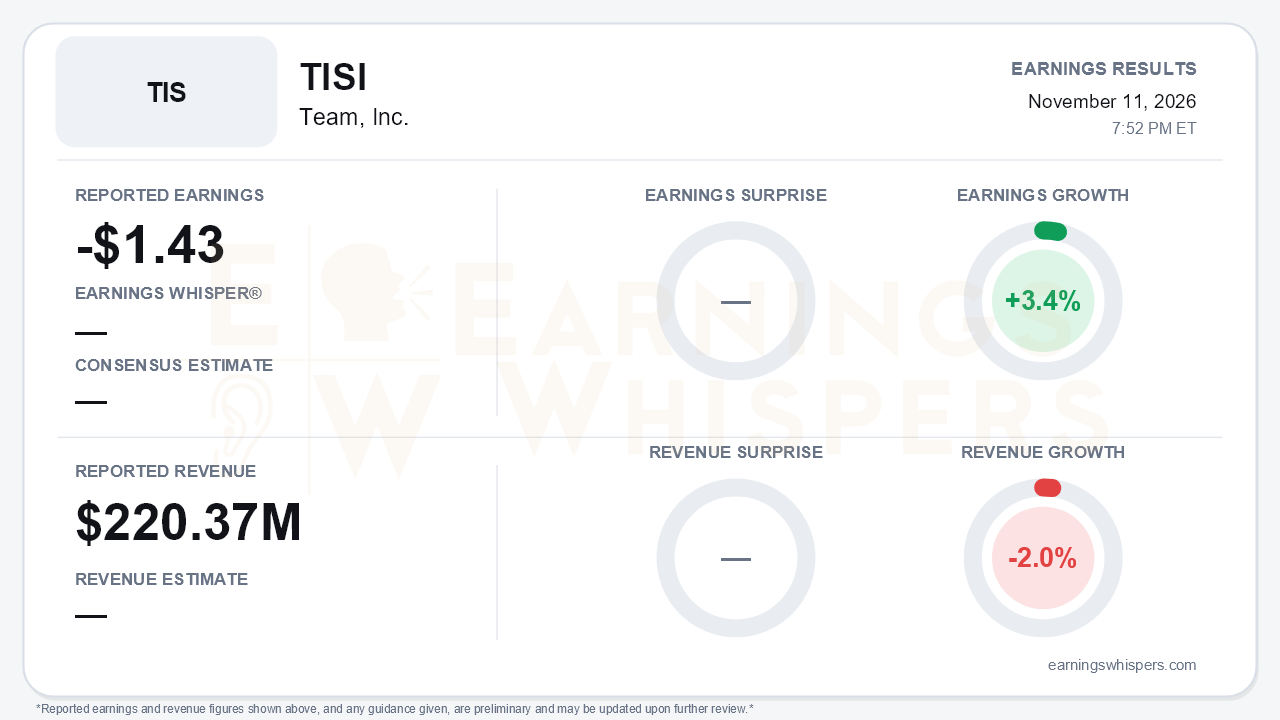
Team, Inc. reported an adjusted loss of $1.43 per share for the September quarter on revenue of $220.37 million. Earnings Whispers calculates earnings growth of 3.4% from the year-ago quarter, while revenue declined 2.0%. No consensus estimate was available, so there is no surprise to measure. The more consequential number was the full-year outlook, not the quarter. Management cut 2026 adjusted EBITDA guidance to $56 million to $59 million from $68 million to $73 million. Revenue guidance fell to $870 million to $890 million from $920 million to $945 million. That is the central tension: the cost program is working, but the revenue recovery it was supposed to amplify has been pushed into next year again.
The quality of the quarter deserves scrutiny. Adjusted EBITDA rose 8.2% to $15.7 million, and margin improved to 7.1% from 6.5%. That figure was also up sequentially from $12.8 million in the second quarter. Adjusted SG&A fell 7.4% to $43.3 million, or 19.7% of revenue. However, the gains came almost entirely from cost reduction rather than demand. On a GAAP basis:
- Gross margin slipped to 25.3% from 25.8%.
- Operating results swung to a $0.5 million loss from $1.3 million of income.
- Net loss attributable to common shareholders widened to $3.10 per share from $2.68.
The widening reflects $3.1 million of preferred dividends and accretion that did not exist at this scale a year ago. The adjusted figures also exclude $8.3 million of items, including $2.3 million of severance and $3.8 million of legal costs and reserves. These costs are tied to the transformation, but they are real cash costs.
Beneath the headline, the business split sharply in two:
- **Inspection and heat treating** grew 3.9% to $127.1 million, and segment adjusted EBITDA rose to $19.2 million from $17.3 million on stronger non-turnaround work.
- **Mechanical services** revenue fell 9.1% to $93.3 million, and segment operating income collapsed to $0.4 million from $3.4 million. Hot tapping and Canadian project profitability were particular weak spots.
Turnaround revenue fell roughly 49% year over year. On the second-quarter call, management had expected that deferred work to return in the back half of 2026. It did not. Management also acknowledged it is carrying underutilized mechanical labor to be ready for a 2027 rebound, which weighs on near-term margins. The tone shifted noticeably. Earlier in the year, management framed 2026 around growth. Now the message is that the work has been deferred rather than lost, with the recovery expected in early 2027. As the CEO noted, that timing ultimately depends on customer operating decisions.
The call did preserve some credible offsets. The structural cost program was raised to $30 million to $38 million at full run rate, from $20 million to $35 million. Expected 2026 realized savings rose to $15 million to $18 million. Management also described three new commercial opportunities, none of which is in guidance:
- Advanced talks on a long-term agreement with a leading aerospace manufacturer.
- A potential multi-year valve-testing contract for a European nuclear project.
- Resolution of a legal dispute with a global integrated oil company that historically generated more than $20 million in annual revenue and is now re-entering the pipeline.
The risks are more immediate. The Middle East conflict spread into the Saudi region, restricting facility access and pushing contracted work beyond year-end. The commercial sales leader role remains unfilled.
The balance sheet is where bears have the most legitimate ammunition. Liquidity fell to $43.5 million, down from $51.2 million in the second quarter and $77.4 million at year-end 2025. Net debt rose to $308.1 million. Free cash flow was negative $5.8 million in the quarter, and shareholders' deficit deepened to $63.9 million. Quarterly interest expense of $9.8 million, plus preferred dividends, consumes most of what the business earns at the EBITDA line. Management said it is reviewing its ABL and credit agreements to improve the capital structure. That is a necessary step, but it is not yet a solution. The revised guidance also requires a strong finish. With $36.2 million of adjusted EBITDA through nine months, the range implies roughly $20 million to $23 million in the fourth quarter, above the $15.7 million just delivered, despite ongoing deferrals.
Market context is limited. Shares opened at $21.00 after the August report, above a 200-day moving average now near $18.97. Current price and sentiment readings were not available, however, so it is unclear how much of the guidance reset the stock had already absorbed.
The bottom line is that Team is executing on what it controls. Costs are falling, inspection is growing, and adjusted margins are expanding. What it cannot control, the timing of refinery turnarounds and Middle East access, has again overwhelmed the outlook. The investment case now rests on a 2027 turnaround recovery and on new aerospace and nuclear wins converting to revenue before tightening liquidity forces the issue. Until deferred work shows up in reported revenue, the cost story alone is unlikely to carry a leveraged balance sheet.
This earnings review was originally published on Earnings Whispers.
This article is for informational purposes only and is not investment advice. Earnings Whispers and its staff may hold positions in the securities mentioned. It is AI-assisted, based on proprietary Earnings Whispers data and company reports, and edited by Earnings Whispers staff.
Mentioned In This Article
Latest News
| Nov-12 | |
| Nov-11 | |
| Nov-11 | |
| Nov-03 | |
| Aug-11 | |
| Aug-10 | |
| Aug-10 | |
| Aug-10 | |
| Aug-06 | |
| Jun-18 | |
| May-14 | |
| May-13 | |
| May-13 | |
| May-11 | |
| Mar-13 |
