Chicago Atlantic BDC Misses As Record Deployment Arrives Too Late, And The Revolver Is Now Nearly Full
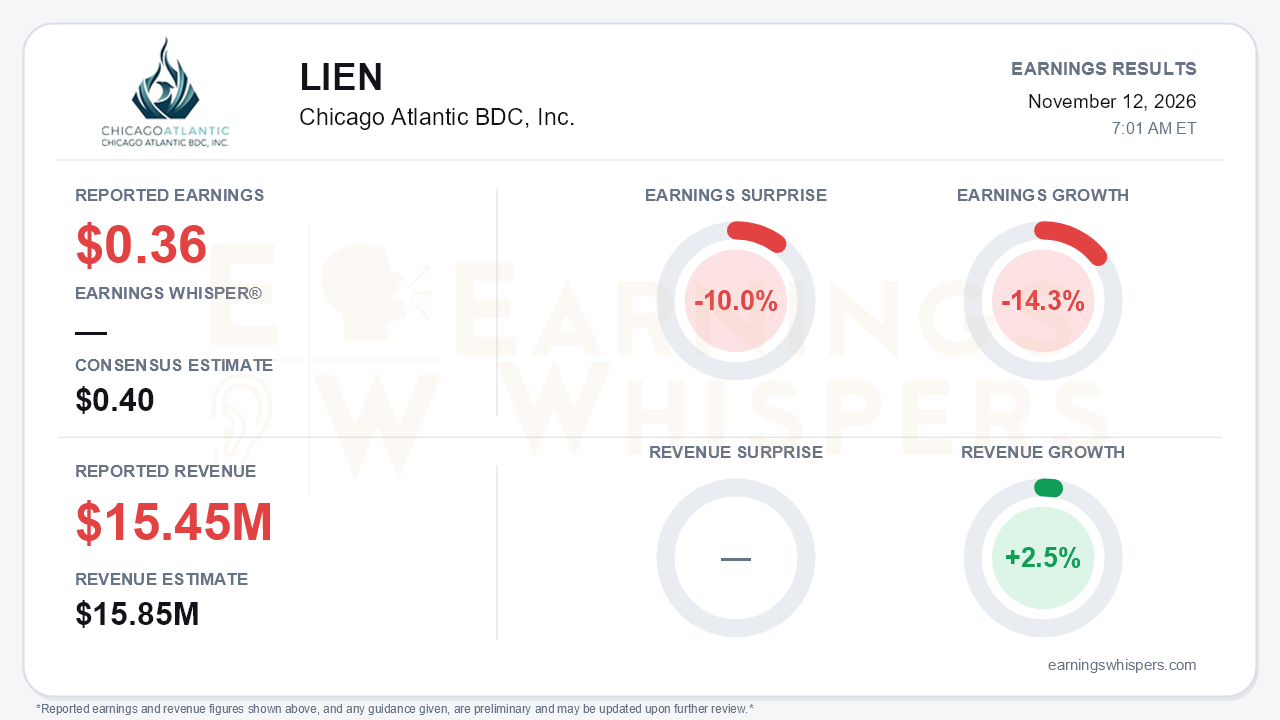
Chicago Atlantic BDC (NASDAQ: LIEN) finally put its underlevered balance sheet to work in the third quarter, but the earnings did not keep pace. Net investment income of $0.36 per share missed the $0.40 consensus by 10.0% and fell 14.3% year over year. Revenue of $15.45 million missed the $15.85 million estimate by 2.6% while growing just 2.5% from a year ago. NII did improve sequentially from $0.34 in the second quarter, but it remains well below the $0.44 record set in the first quarter. That is the central tension: the portfolio reached the largest size in company history, yet the earnings run rate has not caught up and the capacity to keep growing is now nearly exhausted.
The quality of the quarter deserves scrutiny. Interest income actually declined to $13.1 million from $13.8 million a year earlier, and the modest top-line growth came from fee income, which nearly doubled to $2.3 million from $1.2 million. Fee income tends to be lumpier than recurring interest. Expenses moved the other way. Interest expense jumped to $1.25 million from $0.34 million as borrowings climbed to $91 million. The prior-year quarter also benefited from a $230,000 expense-limitation waiver that did not recur. Net expenses rose to $7.1 million from $5.6 million, which explains most of the year-over-year NII erosion. On a GAAP basis, the net increase in net assets was $0.35 per share. Unrealized depreciation was small, and NAV per share held steady at $13.27. Credit remains the bright spot: there were no non-accruals, the book is 100% senior secured, and 95% of the portfolio carries a 2 risk rating. One small loan did migrate from a 2 to a 3 rating.
The operating story is about timing. LIEN funded $72.0 million to two new borrowers in the third quarter, compared with just $4.1 million of fundings in the second quarter. That pushed portfolio fair value to $399.6 million and year-to-date gross originations to a record of roughly $167 million. Management noted the deals closed late in the quarter, so the full interest benefit should show up in the fourth quarter. That gives a credible path to higher NII, and leverage of 0.30x remains far below typical BDC levels. The new money is coming in on less favorable terms, however. The weighted average debt yield slipped to 15.5% from 16.0% as maturities lengthened. More importantly, the share of debt protected by fixed rates or floors fell to 65% from 93% in the second quarter, leaving earnings more exposed if rates decline.
The forward picture got tighter. Liquidity fell to about $6.7 million as of November 11, down from $47.2 million in August, with $94.5 million drawn on a $100 million facility. Management cautioned that fourth-quarter closings may slow. The pipeline also shrank from roughly $1.1 billion at the second quarter, though no new figure was given. Management also cited growing competition from banks and larger platforms in parts of the lower middle market. The newly effective $500 million shelf is the obvious release valve, and management said it can be tapped before the merger closes. Still, issuing equity below NAV would be dilutive, and debt adds cost. The REFI merger, which would hand REFI holders roughly half the combined company, slipped from a prior fourth-quarter 2026 target into 2027 pending SEC review. On the positive side, management cited medical cannabis rescheduling and possible state reforms in Pennsylvania, Georgia and Texas, though adult-use rescheduling has slowed.
Investors were already braced for disappointment. Earnings Whispers sentiment remained deeply negative but improved modestly, rising to -0.85 from -0.96. Shares were at $9.17 before the report, down 1.4% from the open following the August release. They sit 5.7% below the 200-day moving average and only 1.9% above the inter-earnings low of $9.00 set October 19. The stock has given back the run to $10.50 in late September, and price and AVWAP trend readings remain negative. The shares trade well below the $13.27 NAV. Management's purchase of roughly 68,000 shares suggests insiders see value at these levels.
The $0.34 dividend was held again and was covered by $0.36 of NII, though the margin is thin. There is a minor discrepancy on the payout's history: the release describes the third-quarter payment as the eighth consecutive at that rate, while call commentary referred to a ninth straight quarter.
The bottom line is that LIEN delivered the deployment bulls wanted but not the earnings. Late-quarter originations should lift fourth-quarter NII. However, lower yields, reduced rate protection, a shrinking pipeline, a nearly tapped revolver and a delayed merger mean the next leg of growth depends on accessing capital on acceptable terms. With clean credit and a stable NAV, bears have legitimate ammunition on earnings power rather than asset quality.
Read our earnings preview for Chicago Atlantic BDC, Inc.: https://www.earningswhispers.com/article/LIEN/22995
This earnings review was originally published on Earnings Whispers.
This article is for informational purposes only and is not investment advice. Earnings Whispers and its staff may hold positions in the securities mentioned. It is AI-assisted, based on proprietary Earnings Whispers data and company reports, and edited by Earnings Whispers staff.
Mentioned In This Article
Latest News
| 11 hours | |
| 15 hours | |
| 15 hours | |
| Nov-06 | |
| Oct-22 | |
| Sep-25 | |
| Aug-13 | |
| Aug-13 | |
| Aug-13 | |
| Aug-11 | |
| Aug-04 | |
| Jul-23 | |
| Jun-18 | |
| May-14 | |
| May-14 |
