Boost Run Matches On EPS But Misses Badly On Revenue As Georgia Delay Undercuts Its $400 Million Exit ARR Target Despite A $2.7 Billion Backlog
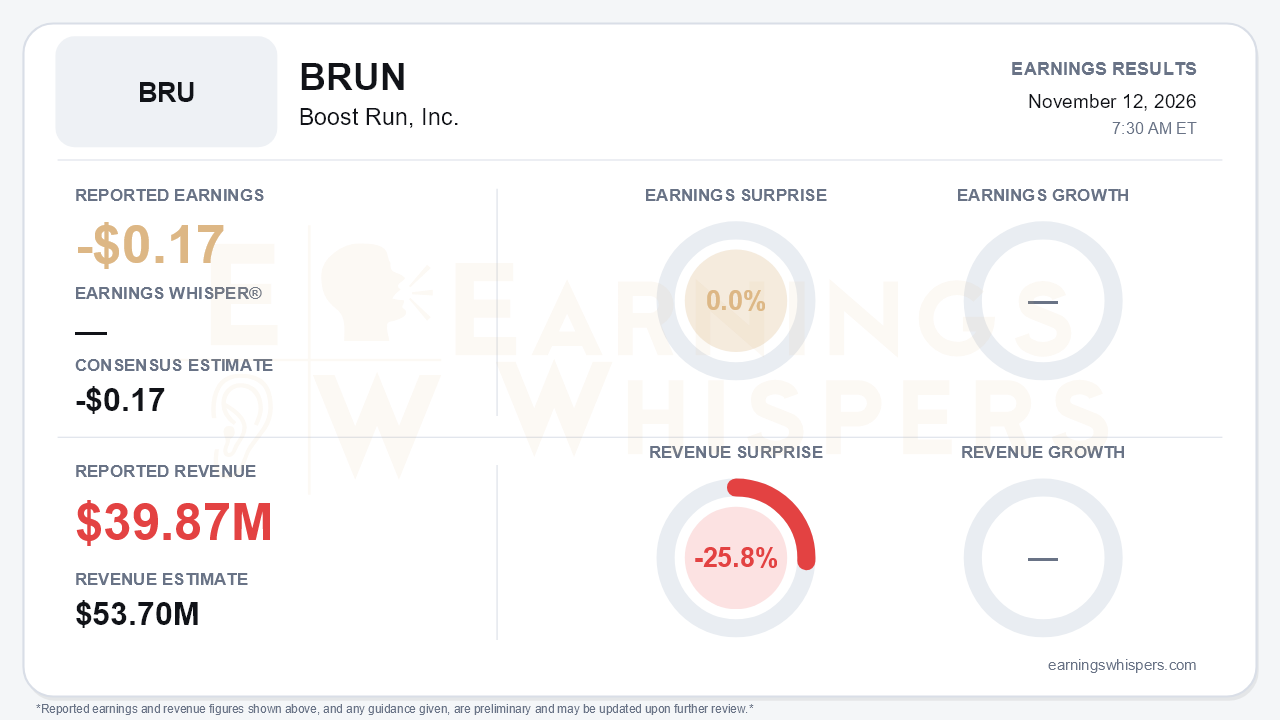
Boost Run's third quarter split cleanly in two. The company reported a loss of $0.17 per share, exactly in line with consensus. Revenue of $39.87 million, however, fell 25.8% short of the $53.7 million estimate. That revenue gap matters more than the in-line loss because it is not a one-quarter rounding error. It previews a deployment slip that will carry into year-end. Management's headline was the long-term contracted backlog: total contract value (TCV) jumped to $2.7 billion from $1.9 billion. The central tension is that the backlog is growing much faster than the company's ability to switch it on, and investors were judging this quarter on conversion, not bookings.
The release shows real scaling. The company said revenue grew 496% from $6.7 million a year ago and rose 28% sequentially from $31.1 million in the second quarter. But that sequential pace is a sharp slowdown from roughly 260% in the prior quarter, which helps explain the revenue shortfall. Other figures from the call were more encouraging:
- Adjusted EBITDA came in at $18 million.
- Lease-adjusted EBITDA margin reached 68.6%.
- The net loss narrowed to $14.1 million from $75 million in a second quarter heavy with one-time items.
The headline $65.6 million in operating cash flow deserves scrutiny. On the call, the CFO acknowledged it was driven mainly by working capital, including a $54.4 million increase in deposits and a $39.4 million increase in payables, and cautioned against annualizing it. Finance lease principal payments of $109.8 million exceeded operating cash flow in the quarter, and those payments will rise as the GPU fleet expands.
The call is where the quarter turned mixed. A Georgia project worth roughly $12.7 million to $13 million in monthly recurring revenue and more than 7,000 GPUs was delayed by city council requirements. Its full revenue contribution moves from the fourth quarter into the first quarter of 2027. Weather in Illinois also pushed two other handoffs back by one to two weeks. Management framed fiscal 2026 exit annual recurring revenue (ARR) at about $435 million "absent the delay." The implied actual figure is closer to $285 million to $290 million, well below the roughly $400 million target reaffirmed last quarter. Several other metrics also slipped:
- Only two of the four year-end project handoffs flagged in the second quarter are complete.
- The on-demand revenue share fell from more than 12% to more than 10%.
- Management's tone was more defensive, emphasizing risk management and debt tenor while minimizing the delay.
There is also a messaging inconsistency worth noting. The CEO's press release quote still points to sustainable 15% to 20% net cash flow margins in forward periods, but that target was not reiterated on the call.
The bull case remains intact on paper. Management sized fully deployed ARR on current contracts at roughly $750 million and said every customer is asking for more compute. Other supporting points from the call:
- Contract tenors are stretching toward five to six years.
- No single contract exceeds 23% of the portfolio.
- Two projects with about $455 million of combined TCV went live in the fourth quarter, adding roughly $9.5 million to $10 million of monthly recurring revenue.
Funding also strengthened:
- About $600 million of non-dilutive project financing has closed year-to-date, with another $482 million of customer prepayments due on deployment.
- Prepayments now average about 38% of capital expenditures.
- Customer deposits rose to $182.8 million.
- Unrestricted cash reached $157 million.
- The warrant overhang is gone after $131.5 million in total exercise proceeds.
Still, only about 26% of TCV is expected to be live by the end of November. That leaves a heavy 2027 execution load, including a $4 billion to $5 billion hardware procurement plan against which just $330 million of purchase orders have been accepted.
The market was not giving Boost Run the benefit of the doubt heading into the report. Shares closed at $7.38 on the eve of earnings, about 64.5% below the 200-day moving average of $20.80. That gap reflects a steep, sustained de-rating. Investor sentiment was negative at roughly -0.33, and the broader Earnings Whispers trend picture leaned more negative than positive. In that setup, a large backlog increase alone was unlikely to reset expectations. Skeptics wanted proof of on-time deployment, and the Georgia slip handed them exactly the evidence they were looking for.
The bottom line is that Boost Run is contracting demand faster than it can deliver it. The $2.7 billion backlog, stronger prepayment terms and cleaner capital structure support the long-term story, but the revenue miss and the effective shortfall against the exit ARR target show how much depends on deployment timing. The decline in shares suggests investors already discount execution risk, and the next few quarters will hinge on whether Georgia and the 2027 pipeline come online on schedule. Until revenue conversion catches up with bookings, the debate will center on delivery and cash flow quality rather than demand.
This earnings review was originally published on Earnings Whispers.
This article is for informational purposes only and is not investment advice. Earnings Whispers and its staff may hold positions in the securities mentioned. It is AI-assisted, based on proprietary Earnings Whispers data and company reports, and edited by Earnings Whispers staff.
Mentioned In This Article
Latest News
| 1 hour | |
| 7 hours | |
| Nov-04 | |
| Oct-26 | |
| Oct-26 | |
| Oct-06 | |
| Oct-06 | |
| Oct-06 | |
| Sep-18 | |
| Sep-18 | |
| Sep-17 | |
| Aug-26 | |
| Aug-14 | |
| Aug-14 | |
| Aug-14 |
