Saga Communications Takes $9.2 Million License Hit As Digital Crossover Slips; Political Dollars Mask Core Radio Erosion
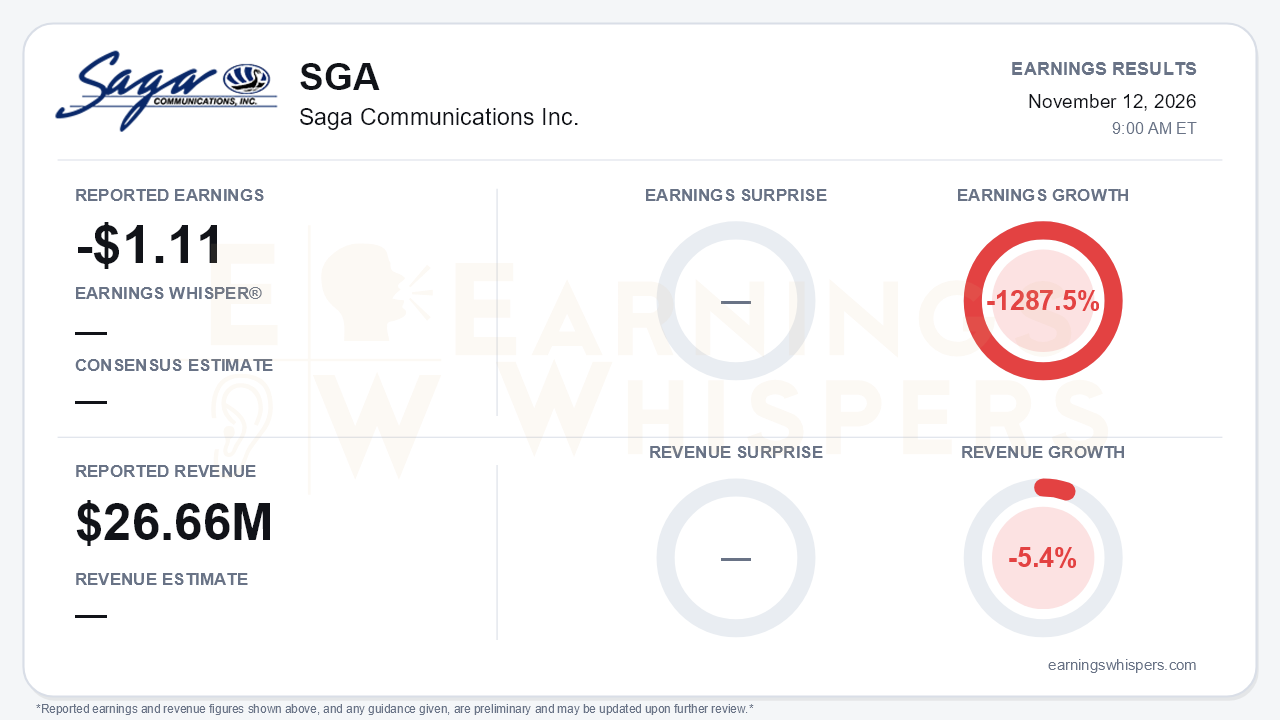
Saga Communications reported a third-quarter loss of $1.11 per share, compared with an $0.08 loss a year earlier, as earnings fell 1287.5% year over year. Revenue fell 5.4% to $26.66 million. No consensus estimate was available, so there is no beat or miss to judge. The headline loss came mostly from a $9.2 million non-cash impairment of FCC license values. Excluding that charge, Saga says it lost about $0.03 per share, narrower than last year's $0.08. That adjusted improvement is not the real story, though. The impairment was a write-down of the business's own outlook: management attributed it to higher discount rates, lower operating margins across Saga and the industry, and reduced market revenue projections. The quarter's central tension is that near-term revenue pacing looks better just as the long-term assumptions behind the asset base are being marked down.
The quality of the ex-impairment numbers deserves scrutiny. Station operating income, a non-GAAP measure, fell to $2.4 million from $3.5 million a year ago and from $3.0 million in the second quarter. The $563,000 operating loss before the impairment included a $990,000 gain on asset sales, so the improvement over last year's $626,000 loss depended on non-core asset disposals. Political revenue was also a large help: gross political revenue was $1.2 million versus $73,000 a year earlier, yet net revenue still declined 5.4%. Core advertising is shrinking faster than the headline suggests. Cash generation has also turned:
- Operating activities used $1.4 million over nine months, versus $5.5 million provided a year earlier.
- Trailing twelve-month consolidated EBITDA, as Saga calculates it, was just $740,000.
- Cash and short-term investments slid to $22.4 million by November 9 from $31.5 million in March.
The conference call offered some evidence of stabilization. Net revenue declines narrowed from 6.5% in the second quarter. Local revenue fell 11% and national fell 13.2%, better than the second quarter's declines of 16.4% and 25%. Digital reached 19% of gross revenue year to date versus 16% a year earlier, and third-quarter digital revenue rose to $4.9 million from $4.6 million. The engine of Saga's turnaround is losing speed, however:
- Blended digital growth slowed to 24.9% from 60.8% in the second quarter.
- E-commerce growth decelerated to 5% from 10.7% in Q2 and 23.2% in Q1.
More damaging was the tone. On the first-quarter call, management targeted a revenue-versus-expense crossover in the third quarter or early fourth quarter, and that crossover has not arrived. The CEO conceded that "something isn't working," acknowledged that some staff and clients were reverting to the old radio-only model, and asked for more time. Earlier calls carried a 'do it fast' urgency; this one sounded defensive.
Forward indicators are the bulls' best ammunition. Fourth-quarter revenue is pacing up 9%, a sharp turn from the mid-single-digit decline management had described for the third quarter on the prior call. Full-year political revenue is now expected at $5.7 million, with $3.6 million already sold for the fourth quarter. Excluding political, though, fourth-quarter pacing is down 5.7%. The mid-single-digit second-half growth promised on the fourth-quarter fiscal 2025 call will be delivered only in Q4 and only through election spending. The more interesting datapoint is first-quarter 2027: revenue is pacing up 5.8% with no political benefit, and digital is pacing up 29.5%. If that holds, it would be the first clean evidence that the blended model can grow the top line on its own. Management also cited larger blended wins, including a $500,000 annualized account in Columbus, and a finalist position for a potential $100,000-per-month account.
Capital allocation is becoming a pressure point. The board reaffirmed the $0.25 quarterly dividend, roughly $1.6 million per payment, and said it is still weighing buybacks and investment. Saga has no debt after repaying $5 million and terminating its credit facility, but the dividend is running well ahead of current cash earnings. Proceeds from asset sales, about $4 million year to date, are partly bridging that gap. Capex guidance was trimmed to $3.0-$3.5 million from $3.5-$4.5 million.
The market had already priced in much of the disappointment. Shares were at $7.25 heading into the report, down 27.5% from the $10.00 open after the August release. That left them about 26% below the 200-day moving average and less than 1% above a fresh 52-week low of $7.20 set on November 10. Earnings Whispers trend signals are uniformly negative. Investor sentiment improved from -1.0 to -0.72, which suggests capitulation has eased somewhat, but sentiment remains firmly negative.
The bottom line is that Saga's quarter offered encouraging pacing, especially the political-free first-quarter 2027 outlook, against weakening profitability, a missed crossover target, slowing digital growth, and a dividend outpacing cash generation. The impairment and management's own admission that the strategy is not yet working give bears legitimate ammunition. The first-quarter 2027 pacing is the one number that could change the narrative, and investors will need to see it convert into actual revenue before the turnaround story regains credibility.
Read our earnings preview for Saga Communications Inc.: https://www.earningswhispers.com/article/SGA/23001
This earnings review was originally published on Earnings Whispers.
This article is for informational purposes only and is not investment advice. Earnings Whispers and its staff may hold positions in the securities mentioned. It is AI-assisted, based on proprietary Earnings Whispers data and company reports, and edited by Earnings Whispers staff.
Mentioned In This Article
Latest News
| Nov-12 | |
| Nov-12 | |
| Nov-06 | |
| Oct-12 | |
| Sep-10 | |
| Aug-14 | |
| Aug-13 | |
| Jul-23 | |
| May-07 | |
| May-07 | |
| Apr-15 | |
| Mar-12 | |
| Mar-03 | |
| Feb-12 | |
| Dec-15 |
