Cibus Misses On Revenue As A Bigger Biofragrance Pitch Collides With Roughly One Quarter Of Cash
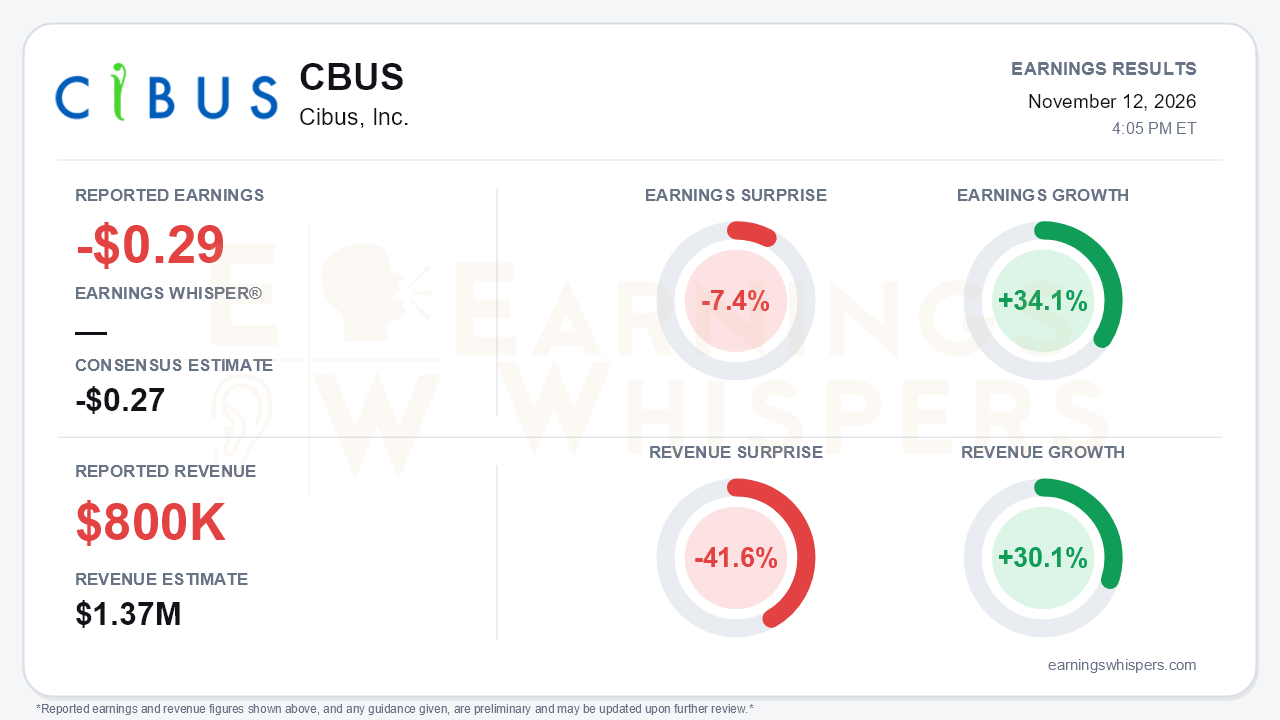
Cibus (NASDAQ: CBUS) missed on both lines in the third quarter. The company reported a loss of $0.29 per share, 7.4% worse than the -$0.27 consensus. Revenue of $0.8 million fell 41.6% short of the $1.37 million estimate. On a year-over-year basis the numbers look better: earnings improved 34.1% as the per-share loss narrowed from $0.44, and revenue grew 30.1% from $615,000. Those growth rates are not the story, though. The central tension is that management sharply enlarged the long-term opportunity in its sustainable ingredients business while the balance sheet ran down to a level that makes near-term financing the dominant issue.
The quality of the earnings improvement deserves scrutiny. Net loss narrowed only modestly, to $21.9 million from $24.3 million. Much of the per-share gain came from dilution: weighted average shares rose to about 76.9 million from 52.9 million.
The operating cost cuts are real:
- R&D fell to $7.9 million from $10.8 million on lower headcount, the Oberlin closure and the Roseville wind-down.
- Nine-month operating cash use dropped about 19%, to $30.2 million.
Two items work against those savings. SG&A was essentially flat at $5.4 million. Non-cash royalty liability interest climbed to $9.8 million, and the related-party royalty liability now stands at $263.4 million. Stockholders' equity has turned negative at -$5.7 million.
The revenue picture is also less encouraging than the annual growth rate implies. The call analysis notes Q2 revenue of roughly $1.0 million, so the $0.8 million reported for Q3 represents a sequential decline. The call analysis also said no Q3 revenue figure was disclosed, but the release's income statement plainly shows $0.8 million.
The call preserved a credible, and expanded, growth narrative around biofragrances. Cibus switched from a royalty model to direct sales through a contract manufacturer, with no capital spending required. That change lifted the estimated peak opportunity to about $100 million in annual revenue across eight ingredients, up from the $20-40 million royalty framing used through Q2. The CFO guided to gross margins of roughly 50%, potentially reaching 70% at scale. Supporting evidence is tangible:
- The partner approved both initial ingredients.
- Manufacturing has been initiated for anticipated production runs.
- The partner requested larger quantities of two additional scents.
The company also added a partner-funded Mustard program with Crystal Crop in India. In addition, rice customer Interoc began testing Cibus traits in its own varieties in Ecuador, with results due in Q1 2027. CEO Craig Wichner's tone was noticeably more confident.
Bears, however, have legitimate ammunition on execution and timing. The scale-up biofragrance orders management expected in the second half of 2026 have not arrived and still depend on partner formulation wins and purchase orders. Rice timelines keep drifting to the right:
- U.S. launch: originally targeted for 2028, then 2029, now 2029 or 2030.
- Latin American launch: once 2027, then 2028, now "as early as 2028" and contingent on Interoc's validation trials.
- Interoc agreement: no definitive commercialization deal has been signed.
The nutrient-use efficiency material transfer to the John Innes Centre slipped from Q3 to Q4. The exit-2026 burn target of about $35 million was reaffirmed, but it remains above the original goal of roughly $30 million or less.
The balance sheet overrides most of this. Cash fell from $30.3 million in Q1 to $20.4 million in Q2 and $10.7 million at September 30. Q3 operating cash use was $9.3 million, which leaves roughly one quarter of runway. Management itself says cash funds operations only into early Q1 2027, and the risk factors cite an "acute need for additional near-term funding." The bigger biofragrance numbers may help Cibus frame a raise. But at current prices, any equity financing would add to a share count that has already grown substantially.
The market has been pricing that reality. Shares closed at $1.16 heading into the report. That is down 32.9% from the $1.73 open after the August report and 36.4% below the 200-day moving average of $1.82. The stock set a 52-week low of $1.07 on November 10, just two days before earnings, and sits only 8.4% above it. That leaves shares near the bottom of an inter-earnings range that peaked at $1.79 the day after the last report. The Earnings Whispers price and AVWAP trend readings are both negative, consistent with that steady slide. Investor sentiment was essentially unchanged, edging to -0.19 from -0.20, so expectations remain mildly negative rather than capitulatory.
The bottom line is that Cibus delivered a narrower loss, real cost discipline and a materially larger biofragrance thesis. It also missed revenue expectations badly, pushed rice commercialization further out and reached the edge of its cash runway. Until biofragrance purchase orders, a signed Interoc agreement or a financing on tolerable terms materialize, the enlarged opportunity remains a projection, and dilution risk is likely to dominate the setup.
Read our earnings preview for Cibus, Inc.: https://www.earningswhispers.com/article/CBUS/22912
This earnings review was originally published on Earnings Whispers.
This article is for informational purposes only and is not investment advice. Earnings Whispers and its staff may hold positions in the securities mentioned. It is AI-assisted, based on proprietary Earnings Whispers data and company reports, and edited by Earnings Whispers staff.
Mentioned In This Article
Latest News
| Nov-12 | |
| Nov-12 | |
| Nov-12 | |
| Nov-04 | |
| Nov-03 | |
| Sep-28 | |
| Aug-17 | |
| Aug-17 | |
| Aug-14 | |
| Aug-13 | |
| Aug-13 | |
| Aug-12 | |
| Jul-30 | |
| Jul-21 | |
| Jul-21 |
