Vuzix Sells An AI Optics Story While Revenue Shrinks 38.5% And Cash Drops To $9.2 Million
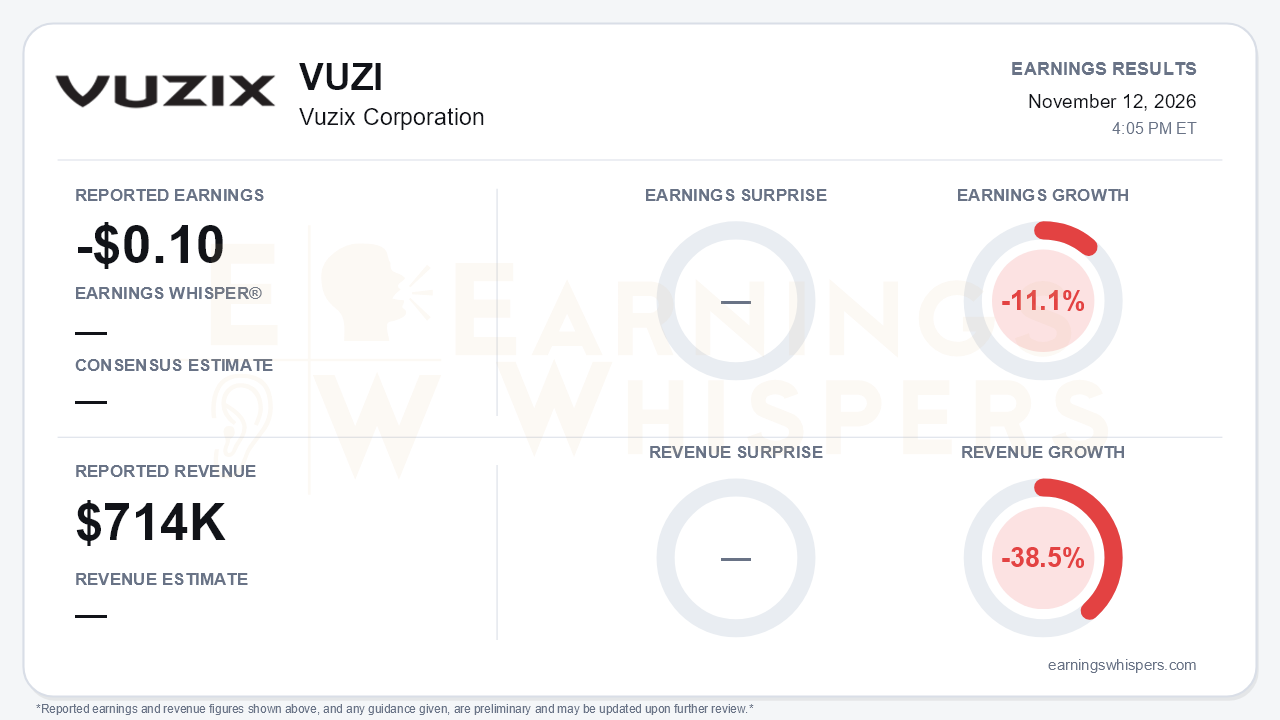
Vuzix (NASDAQ: VUZI) reported a third-quarter loss of $0.10 per share on revenue of $0.71 million. Earnings fell 11.1% year over year, as the net loss widened to $8.4 million from $7.4 million, and revenue fell 38.5%. No consensus estimate or Earnings Whisper was available, so there is no surprise to measure. The more useful benchmark is the company's own trajectory, and it is moving the wrong way. Revenue has declined every quarter, from $2.2 million in the fourth quarter of 2025 to $1.4 million, then $1.1 million, then $714,000. Meanwhile, cash fell to $9.2 million from $17.3 million at the end of June. That is the central tension. Management is building a broader opportunity set in defense, OEM waveguides and AI data center optics just as the core business shrinks and the balance sheet loses its cushion.
The quality of the quarter was weak throughout. Product sales fell to $494,000 from $896,000, reflecting the enterprise smart glasses models discontinued at the end of 2025 and lower M400 sales. The more troubling line is engineering services and OEM revenue, which fell to $220,000 from $265,000 a year ago and $350,000 in the first quarter. That is the segment management said on its fourth-quarter 2025 call would climb quarter after quarter and overtake enterprise sales within 2026. Instead, cost of sales held steady at $1.58 million against a much smaller revenue base. The gross loss more than doubled year over year to $868,000, driven by unbillable engineering costs and about $790,000 of unapplied overhead. One discrepancy is worth noting: call commentary characterized the year-over-year revenue decline as 33%, but the reported figures show a 38.5% decline, consistent with the release's 38%.
Spending moved the other way. Research and development rose 13% to $3.3 million and selling and marketing jumped 43% to $1.6 million. Both increases were largely due to external consulting tied to the new Causeway optical interconnect platform. Total operating expenses reached $7.6 million, including roughly $1.0 million in Causeway-related costs that management does not expect to recur. Excluding that charge, opex was about $6.6 million, roughly 7% below last year. Management guided fourth-quarter operating expenses to the mid-$6 million range and expects capex and cash burn to fall materially. That matters because operating cash burn rose to $6.7 million from $5.0 million a year ago. Year-to-date capex has also climbed to about $2.7 million, from $1.2 million at mid-year, as the Rochester waveguide upgrades were completed.
The catalyst list is genuinely longer than it was three months ago:
- **Causeway:** The platform went from inbound interest on the second-quarter call to shipped evaluation samples, a co-development letter of intent and engagement with more than 10 companies in the AI optical interconnect ecosystem. Management flagged potential strategic investments from Causeway partners.
- **Defense:** Vuzix has booked just under $1.0 million in new OEM defense orders so far in the fourth quarter. A multi-million dollar engineering services program is in final contracting, SHRIKE display units are shipping for evaluation, and Collins Aerospace production and next-generation work continues.
- **Automotive OEM:** The customer has advanced to production-validation systems and procurement negotiations.
Bears have legitimate ammunition on each of these, though. Causeway targets an unproven market with long qualification cycles, and management's own stated next step is converting technical engagements into customer-funded programs. Milestones flagged on the second-quarter call, including a government agency contract and clarity on the automotive rollout, have not yet converted. Quanta, the Ultralite Pro and the enterprise business received noticeably less emphasis.
The balance sheet is where the setup has changed most. Cash has fallen from $21.2 million at year-end 2025 to $9.2 million. At the third-quarter burn rate, that covers well under two quarters, and only $0.2 million came in through the at-the-market program. The "runway well into 2027" language used on the fourth-quarter and first-quarter calls was not repeated. Management referred instead to raising capital as needed. Vuzix carries no debt, but the prospect of dilution is now a concrete part of the story. A strategic investment from a Causeway partner would be the most constructive way to address it.
Market context is limited. Shares opened at $2.40 after the August report, below the current 200-day moving average of $2.71. Updated price, sentiment and range data were not available. Investors therefore lack a clean read on how much of the financing risk and the Causeway optionality the stock already reflects.
The bottom line is that Vuzix delivered more strategic narrative than financial progress. Revenue, gross margin, losses and cash all deteriorated, and the OEM revenue ramp promised earlier in the year has not appeared. Causeway, defense and the automotive program give the company credible shots on goal. However, none has yet produced meaningful revenue, and the shrinking cash balance means the company may need to fund the wait through dilution before those bets pay off.
This earnings review was originally published on Earnings Whispers.
This article is for informational purposes only and is not investment advice. Earnings Whispers and its staff may hold positions in the securities mentioned. It is AI-assisted, based on proprietary Earnings Whispers data and company reports, and edited by Earnings Whispers staff.
Mentioned In This Article
Latest News
| Nov-12 | |
| Nov-12 | |
| Nov-12 | |
| Oct-29 | |
| Oct-27 | |
| Oct-12 | |
| Oct-06 | |
| Sep-29 | |
| Sep-23 | |
| Aug-18 | |
| Aug-14 | |
| Aug-13 | |
| Aug-13 | |
| Aug-11 | |
| Jul-30 |
