StoneCo Misses, Cuts 2026 Outlook And Suspends 2027 Targets As Credit Growth Collides With Brazil's Macro Squeeze
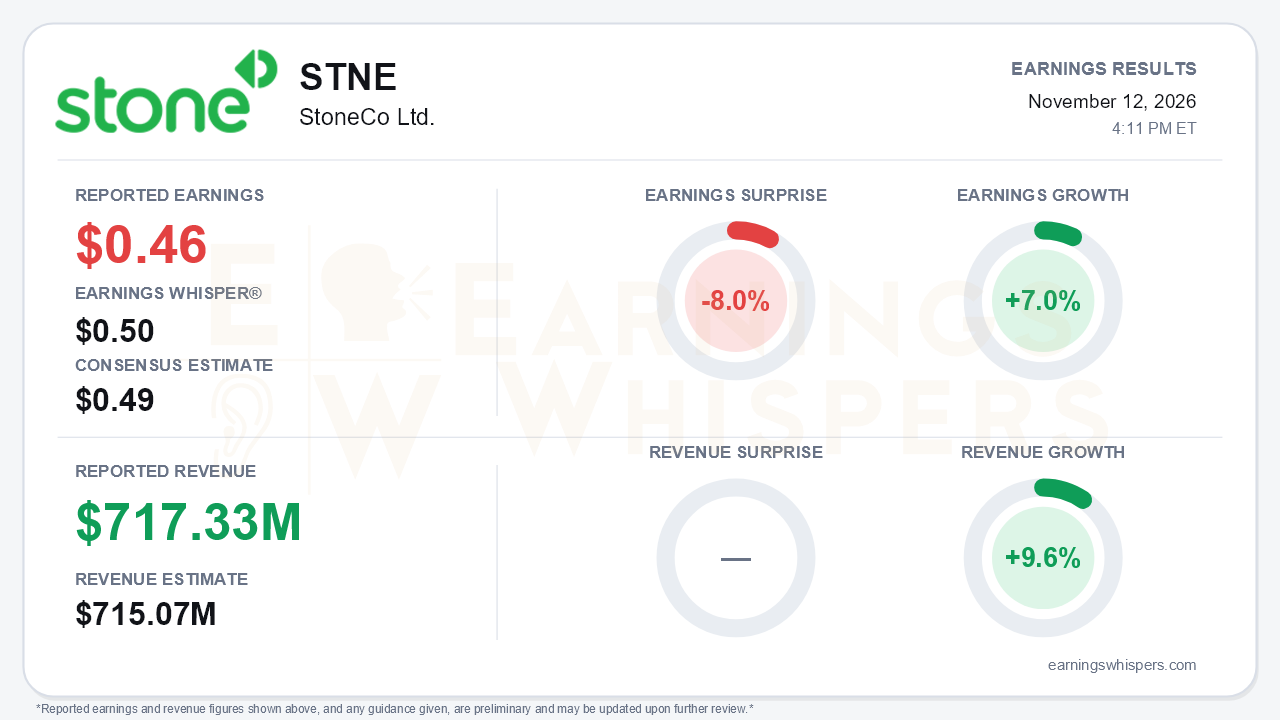
StoneCo's third quarter matters less for the earnings miss than for what management did to the outlook. The Brazilian fintech reported earnings of $0.46 per share, short of the $0.49 consensus and the $0.50 Earnings Whisper number, an 8.0% shortfall. Revenue of $717.33 million edged past the $715.07 million consensus by 0.3%. Earnings grew 7.0% year over year and revenue rose 9.6%. Those are respectable growth rates for a modest miss. But management also cut its fiscal 2026 targets below the prior range and suspended its 2027 framework entirely. That is the central development: the problem is no longer a quarter of execution noise but visibility.
The quality of the quarter deserves scrutiny. The revenue beat was thin, and the call characterized the top-line trajectory as essentially flat rather than accelerating. The press release itself offered no financial detail and simply pointed investors to the full earnings release. The call therefore carried the story, and the message was that provisions pressured gross profit. Expenses also rose on software and AI costs, marketing, and point-of-sale loss provisions. Earnings growth trailing revenue growth fits that picture of margins under strain rather than a business gaining operating leverage.
The guidance reset is stark. Fiscal 2026 adjusted gross profit guidance fell to roughly R$6.1–6.2 billion from R$6.6–7.0 billion. That original range was set at the fourth-quarter 2025 report and reaffirmed in the first quarter. As recently as the second-quarter call, management described its low end as achievable. Adjusted EPS guidance of R$10.8–11.4 was also lowered, though the exact new range was not clear from the call. More consequential, the 2027 targets of R$7.2–8.3 billion in gross profit and R$11.8–13.4 in EPS were suspended. No new range is expected until full-year results, with management citing rate and macro volatility. Management's tone shifted accordingly, from "guidance achievable" to acknowledging results are tracking below plan with limited visibility.
The credit business sits at the heart of the tension. The loan book reached R$4.1 billion, up 78% year over year, compared with R$3.8 billion in the second quarter and R$3.2 billion in the first. Government-backed lending, about R$300 million last quarter, nearly doubled, with three programs disbursing and more being set up. Cost of risk eased from 21.5% in the second quarter. Early-stage delinquency on the automated desk improved, and renegotiation and collection tools are showing early traction. Yet management is reassessing its credit models with forward-looking macro inputs, which implies additional provisions. It also pushed the return to mid- or high-teens cost of risk beyond 2027, after calling for high teens by year-end only a quarter ago. Record judicial recovery filings continue to hit the dedicated desk, and TPV retention among credit clients is weakening. Management is now preparing for higher inflation, lower consumption and weaker GDP in Brazil. Bears have legitimate ammunition here: the fastest-growing part of the business is also the part whose losses are hardest to forecast.
There are genuine offsets. TPV growth continued to accelerate sequentially from 3% in the first quarter and 4% in the second, helped by retention initiatives and a "bank for entrepreneurs" repositioning campaign. Active clients rose to about 5.1 million from 4.8 million. Funding costs held near 86% of CDI. Buybacks and the excess-capital distribution commitment are unchanged. A holding restructuring centralizing entities in Switzerland aims to lower the effective tax rate and create a capital hub for possible expansion beyond Brazil. That is potentially meaningful, but it is a longer-dated item rather than a near-term earnings driver.
The market had already been punishing the stock before the report. Shares stood at $7.67 as of November 10, down 22.4% from the $9.89 open following the August report and 35.6% below the 200-day moving average of $11.91. The inter-earnings range was violent. The stock touched $12.50 on October 9, then collapsed to a 52-week low of $7.06 on October 26, and entered earnings only about 8.6% above that low. Investor sentiment remained negative but improved, rising from -0.26 to -0.13. That suggests some investors were leaning toward stabilization just as management withdrew its longer-term roadmap. The Earnings Whispers price and AVWAP trend readings remain negative, even as sequential growth reads positive. That split mirrors the gap between operating volume and earnings visibility.
The bottom line is that StoneCo delivered growth in clients, TPV and credit, but the quarter's real message came from management's retreat on guidance. A slight EPS miss could be dismissed. A gross profit cut well below a range reaffirmed all year, a suspended 2027 outlook, and a longer credit-normalization timeline cannot. Even with the stock already near its lows, the burden now falls on management to prove its credit models and Brazil's macro backdrop can support earnings again before investors re-anchor on a recovery.
Read our earnings preview for StoneCo Ltd.: https://www.earningswhispers.com/article/STNE/22948
This earnings review was originally published on Earnings Whispers.
This article is for informational purposes only and is not investment advice. Earnings Whispers and its staff may hold positions in the securities mentioned. It is AI-assisted, based on proprietary Earnings Whispers data and company reports, and edited by Earnings Whispers staff.
Mentioned In This Article
Latest News
| Nov-12 | |
| Nov-12 | |
| Nov-04 | |
| Oct-16 | |
| Oct-08 | |
| Aug-17 | |
| Aug-13 | |
| Aug-13 | |
| Jul-10 | |
| May-18 | |
| May-14 | |
| Apr-23 | |
| Apr-14 | |
| Apr-02 | |
| Mar-06 |
