Lulus' Turnaround Thesis Breaks: Revenue Slide Deepens To 20% As EBITDA Target Is Abandoned And Liquidity Tightens
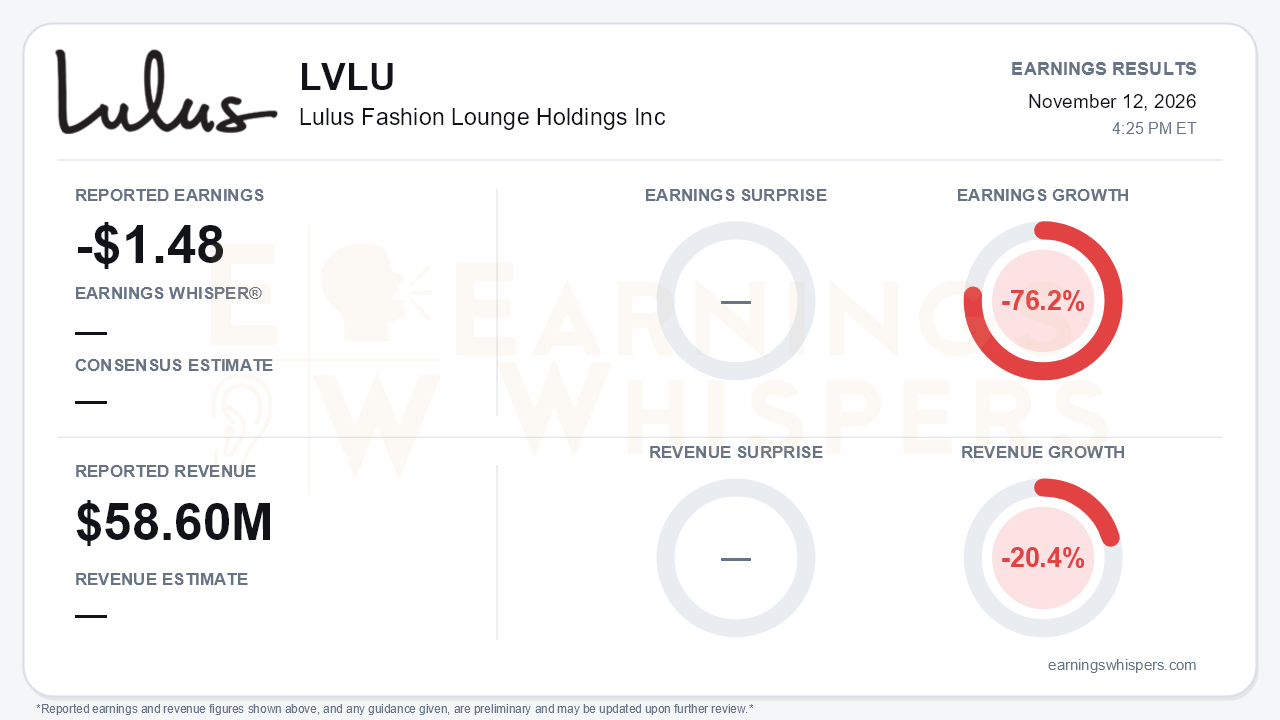
Lulus Fashion Lounge (NASDAQ: LVLU) reported a third-quarter loss of $1.48 per share on revenue of $58.6 million. Earnings fell 76.2% from a year ago, when the company lost $0.84 per share, and revenue fell 20.4%. No consensus estimate was available, so this is not a beat-or-miss story. It is a credibility story. Management had reiterated a fiscal 2026 framework of positive adjusted EBITDA and an improving revenue trend across three consecutive reports. That framework is now gone. Revenue declines have worsened every quarter, from -5% in Q4 FY2025 to -10%, -17% and now -20%. Adjusted EBITDA swung to a $1.8 million loss from a $0.4 million profit a year earlier. The fourth quarter is expected to look much like the third.
The quality of the quarter deserves scrutiny because the bright spots are mostly defensive. Gross margin rose 230 basis points to 44.9%, inventory fell 17% to $31.9 million, and year-to-date free cash flow was positive at $4.3 million. Those are real results of tighter merchandising. But the margin story is fading. Gross margin expansion has narrowed from 640 basis points in Q4 to 480, then 330, and now 230. Gross profit still fell 16% in dollars. Selling and marketing and G&A expenses were cut by a combined $3.1 million. Even so, the operating loss roughly doubled to $3.9 million because the revenue base is shrinking faster than costs. Total Orders Placed fell 20%, and Average Order Value held flat at $141. That means the damage is in volume and engagement, not pricing. Active Customers dropped 14% year over year to 2.04 million and 5% sequentially, so the stabilization management targeted for year-end is no longer in view. Higher return rates tied to sales mix added further pressure.
The call made the cause unusually explicit. Management attributed about $9.8 million of third-quarter revenue to lost color and fabrication adds from weak 2025 product cohorts, and it acknowledged underestimating those downstream effects. Lulus' model depends on reordering and extending winning styles. Weak cohorts therefore starve the reorder pipeline for quarters afterward, and management expects that drag to persist into 2027. The tone shifted noticeably. It moved from talk of second-half reacceleration in Q1 and increasing confidence in Q2 to an admission of misjudgment. The Q2 promise that casual and footwear would return to growth in the second half was not met, and new product introductions remain below plan.
There is a credible, if slower, recovery thread. Units per new casual and footwear launch rose 39% year over year. Full-price sales of new ready-to-wear products turned positive. Markdown sales fell 28%, and reorder eligibility among 2026 cohorts is running ahead of internal targets, with separates eligibility more than doubling. Wholesale grew at a high double-digit rate, and Lulus launched in Macy's and Bloomingdale's stores. However, same-account wholesale growth slowed from 61% to 35% on a trailing-twelve-month basis. An October workforce reduction should save about $5 million annually. Management's preliminary fiscal 2027 outlook calls for a moderating revenue decline, not a return to growth, alongside a "meaningful improvement in profitability." No numbers were attached.
The balance sheet is where bears have the most ammunition. Borrowings on the asset-based revolver rose to roughly $15.4 million from $10.1 million at the end of Q2. Net debt increased $2.9 million in the quarter to $8.8 million, although that remains below the $11.7 million at year-end 2025. Stockholders' equity flipped to a $5.0 million deficit from a positive $3.0 million in December. Management described liquidity as a constraint and said it is negotiating with existing and new lenders, with no definitive agreement in place. A strategic alternatives review is ongoing and added about $0.5 million of fees this quarter. Investor sentiment and current price data were not available for this report. For reference, shares opened at $16.40 after the August release, which is when the now-abandoned guidance was last reaffirmed.
The bottom line is that Lulus has moved from a turnaround in progress to a turnaround that must be refinanced and re-proven. Margin discipline, inventory cleanup and early signs from 2026 product are genuine. But they now serve as a bridge rather than a driver, while customer counts shrink, revenue declines deepen and the company seeks new financing under a strategic review. Until the reorder pipeline refills and lenders commit, management's 2027 profitability claim is a hope, not a forecast investors can underwrite.
This earnings review was originally published on Earnings Whispers.
This article is for informational purposes only and is not investment advice. Earnings Whispers and its staff may hold positions in the securities mentioned. It is AI-assisted, based on proprietary Earnings Whispers data and company reports, and edited by Earnings Whispers staff.
Mentioned In This Article
Latest News
| Nov-12 | |
| Nov-12 | |
| Oct-29 | |
| Sep-03 | |
| Aug-13 | |
| Aug-12 | |
| Jul-22 | |
| Jul-13 | |
| May-14 | |
| May-13 | |
| Apr-22 | |
| Apr-06 | |
| Mar-30 | |
| Mar-30 | |
| Mar-27 |
