Tenon Medical Repairs Its Balance Sheet, But Revenue Has Stalled Near $1.4 Million And Dilution Flatters The Per-Share Loss
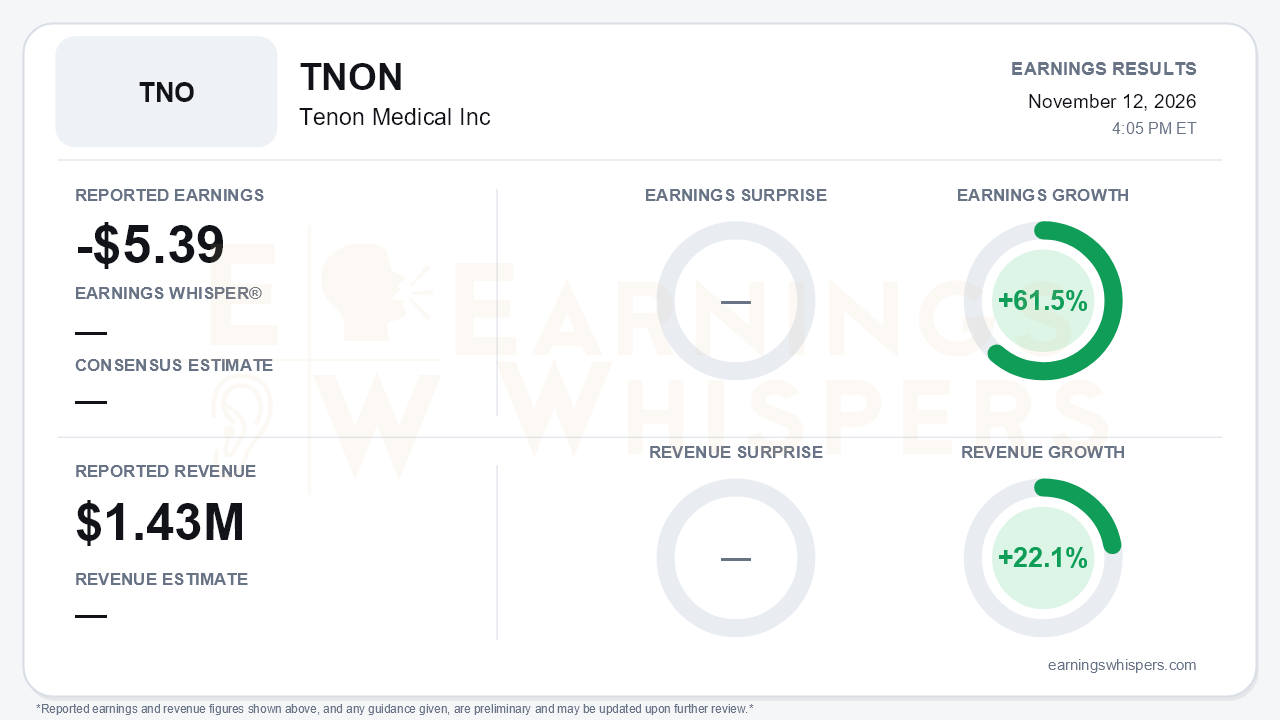
Tenon Medical's third quarter was about survival more than growth. The SI-joint fusion company reported a loss of $5.39 per share on revenue of $1.43 million. Earnings Whispers calculates earnings growth of 61.5% year over year, while revenue grew 22.1%. No consensus estimate was available to frame a surprise. Neither headline figure tells the full story. The per-share improvement comes almost entirely from a much larger share count, not a smaller loss. Weighted-average shares rose to about 1.23 million from 236,000 a year earlier, even after a 1-for-35 reverse split. In dollar terms, net loss roughly doubled to $6.6 million from $3.3 million. The central tension is that the quarter repaired the capital structure at real cost to shareholders, while the top line has plateaued.
The quality of the loss needs to be separated by line item. Operations actually improved. Loss from operations narrowed to $3.1 million from $3.4 million, and operating expenses fell to $4.0 million from $4.2 million. Below the operating line, the picture was much worse:
- A $3.1 million non-cash charge tied to warrants issued as inducement consideration.
- $0.7 million of non-cash interest from amortizing the convertible-note discount.
The mix within operating expenses also shifted in a constructive direction. General and administrative costs fell to $1.5 million from $2.2 million on lower professional fees. Research and development nearly doubled to $804,000, funding new products. Gross margin improved to 66.3% from 65.9% a year ago and from 64% in the second quarter. Management attributed the gain to better absorption of fixed costs and to the July 510(k) clearance that reclassified certain Catamaran instruments as reusable.
The call revealed growth problems the year-over-year headline obscures. The 22% growth rate is a sharp deceleration from roughly 90% in the first quarter and 127% in the second, as the August 2025 SiVantage acquisition laps. More telling, absolute quarterly revenue has been essentially flat for four straight quarters: $1.5 million, $1.4 million, $1.3 million and now $1.4 million. Management highlighted 12% sequential growth, more cases and physician users, and 36 training activities. However, it follows second-quarter commentary about a "record July" and a "strong start to Q3" that did not translate into a breakout. Gross margin also remains below the 69% posted in the fourth quarter of 2025 and the 68.5% in the first quarter. The 70%-plus margin aspiration for 2027 voiced earlier in the year was not repeated.
The catalyst list is real, but so is the slippage:
- **Launched:** The 3D-printed SImmetry+ lateral screw moved to full commercial launch after an alpha phase that generated about $1.2 million in revenue.
- **Hired:** Thomas Batton Jr. joined as Chief Revenue Officer to build out direct reps and distributors.
- **Planned:** A 510(k) submission for an SImmetry+ implant enhancement is slated for early December.
- **Patents:** The U.S. portfolio reached 38 issued patents, up from 29 cited earlier this year.
- **Delayed:** The Quickstep Decorticator, previously expected to be clinically active in the third quarter or October, is now targeted for full release in the first quarter of 2027.
- **Missing:** The posterior third-approach technology, slated earlier for a fourth-quarter alpha with details promised on this call, went unmentioned.
The call drew no analyst questions, which limits outside scrutiny of these timelines.
The balance sheet is genuinely better, but the runway is not long. The company raised roughly $15.6 million in gross proceeds during the quarter and repaid about $5.16 million of convertible notes ahead of maturity. It ended with zero debt, $8.3 million in cash, and restored Nasdaq compliance on both stockholders' equity and minimum bid price. Cash disclosure on the call was inconsistent: the CEO cited $3.8 million, which matches the year-end 2025 balance, while the CFO and the release cite $8.3 million. That buys time, not independence. Against a quarterly operating loss of about $3.1 million, the cash covers only a few quarters. The release still references substantial doubt about the company's ability to continue as a going concern. An at-the-market facility expanded to about $7.1 million signals that further equity issuance is likely. Shares outstanding have already risen to 2.68 million from 310,000 at year-end.
The market backdrop reflects that history. Shares opened at $5.70 after the August report, already split-adjusted and far below the current 200-day moving average of $15.91. Current price data were not provided, but the gap underscores how severely dilution and financing have weighed on the stock.
The bottom line is that Tenon removed its most immediate threats this quarter by eliminating debt and regaining listing compliance, and its operating discipline and margin recovery are real. The investment case now depends on whether a new commercial leader and a refreshed SImmetry+ toolkit can break revenue out of its $1.4 million-per-quarter range before the company needs to return to the equity markets. Until that happens, the improving per-share loss mostly reflects dilution rather than progress.
This earnings review was originally published on Earnings Whispers.
This article is for informational purposes only and is not investment advice. Earnings Whispers and its staff may hold positions in the securities mentioned. It is AI-assisted, based on proprietary Earnings Whispers data and company reports, and edited by Earnings Whispers staff.
Mentioned In This Article
Latest News
| Nov-12 | |
| Nov-12 | |
| Oct-29 | |
| Oct-28 | |
| Oct-15 | |
| Sep-30 | |
| Sep-14 | |
| Sep-14 | |
| Sep-11 | |
| Sep-11 | |
| Sep-09 | |
| Aug-31 | |
| Aug-31 | |
| Aug-28 | |
| Aug-28 |
