Prairie Operating Beats On A Sharp Production Ramp, But A Guidance Cut And Near-Exhausted Liquidity Define The Quarter
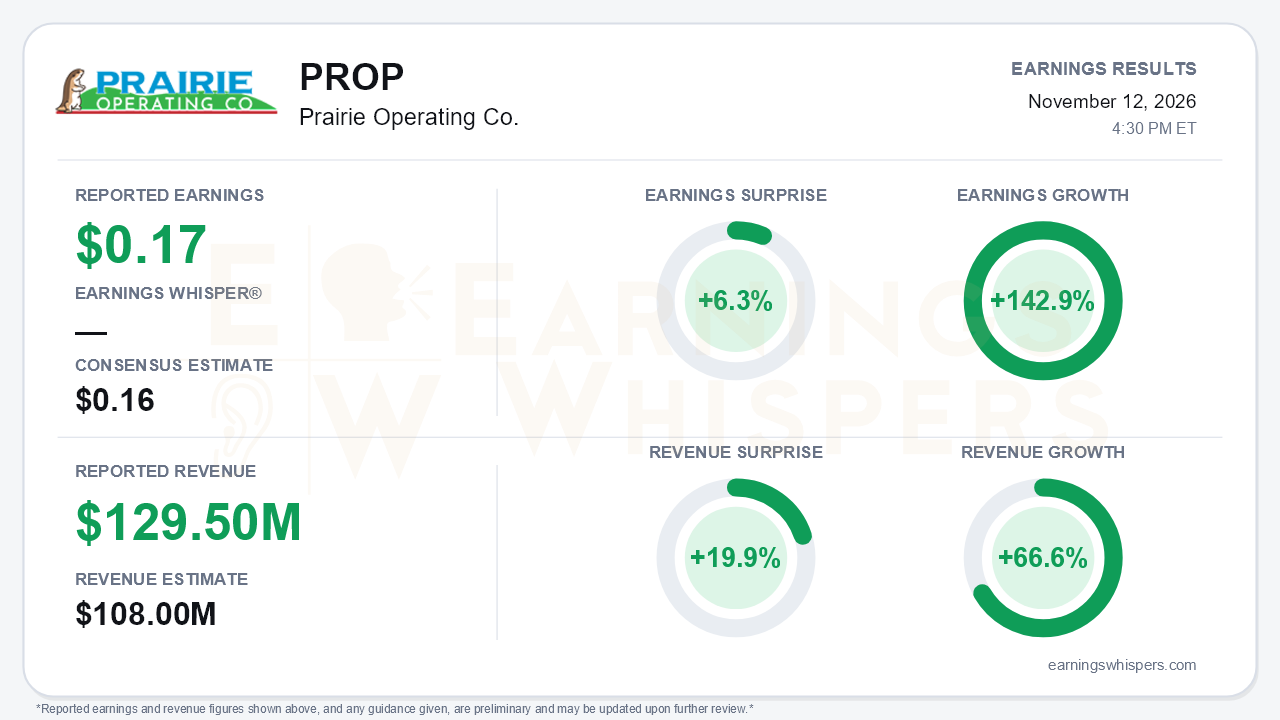
Prairie Operating Co. (NASDAQ: PROP) posted a clear operational inflection in the third quarter, reporting earnings of $0.17 per share against a $0.16 consensus, a 6.3% beat. Revenue of $129.5 million topped the $108.0 million estimate by 19.9%. Earnings grew 142.9% year over year and revenue rose 66.6%. The quarter's central tension is that operations finally scaled while the balance sheet and full-year outlook moved the other way. Production, unit costs and Adjusted EBITDA all improved sharply. At the same time, management lowered full-year production and capex guidance, liquidity fell to roughly $11 million, and the Series F overhang remains unresolved.
The quality of the beat deserves scrutiny. On a GAAP basis, Prairie reported a net loss to common stockholders of $34.0 million, or $0.26 per basic and $0.28 per diluted share. The loss was driven by a $134.2 million net derivative loss, $105.7 million of it unrealized, as oil prices ran well above the company's hedges. Without hedges, realized oil was $84.48 per barrel. Including hedges, it was only $62.24.
That gap explains why Adjusted EBITDA of $65.3 million rose 92% sequentially but only 16% from a year ago, even as revenue climbed 67%. Swaps cover roughly 1.37 million barrels in the fourth quarter at $63.23 and 4.66 million barrels in 2027 at $62.51. That limits how much of the commodity tailwind reaches cash flow.
The operating story itself is genuinely better. Sales volumes rose 21% sequentially to 26,117 Boe/d. The oil mix reached 56%, up from 48% in the first quarter. The company exited September at 30,229 Boe/d and reached about 32,287 Boe/d in early October. Unit costs also fell:
- Lease operating expense dropped to $5.71 per Boe, down from $6.85 in Q2 and $7.11 in Q1. That beats the roughly $6.25 target management discussed earlier in the year.
- G&A fell 24% sequentially to $4.56 per Boe.
The four-well Burnett pad, a step-out on the original acreage, averaged about 722 Boe/d of maximum initial production per well at 81% oil. Management said it beat the internal type curve. Its results supported converting 30 gross possible locations to proved undeveloped status within the Genesis OGDP I. Management also formed Stagecoach Logistics to bring field maintenance and logistics in-house as a further cost lever.
The forward picture is weaker than the beat implies:
- **Production guidance:** Management now supports 23,000–25,000 Boe/d for 2026, down from the 25,500–27,500 range set in April and reaffirmed in May.
- **Capex guidance:** Lowered to $180–195 million from $200–220 million.
- **EBITDA guidance:** The prior $240–260 million Adjusted EBITDA target was not repeated. Nine-month EBITDA of $136.4 million suggests a meaningful shortfall.
- **Activity and costs:** Production has already eased from the October peak, few new wells are coming online in Q4, and only four wells are being drilled, all for 2027. Well costs are running $300,000–$500,000 above the prior $5.3–5.5 million range.
- **No forward visibility:** Management declined to provide exit-rate or 2027 guidance.
Liquidity is the most pressing risk. Cash was $7.8 million with just $3.0 million available on a $475 million borrowing base that is $472 million drawn. Liquidity was about $113.5 million at the end of Q1. Management expects fourth-quarter free cash flow to improve liquidity "fairly dramatically" as capex falls, and a borrowing-base redetermination update is expected around December. However, the Series F anniversary warrant date was pushed again, to December 1, with no refinancing announced. Common shares outstanding have nearly doubled since year-end to 118.7 million, so bears have legitimate dilution ammunition.
Investor sentiment shifted dramatically, swinging from -0.30 before the prior report to +0.45, a move large enough to signal real re-engagement with the production ramp. The tape tells a harsher story. Shares sit at $0.37, down 56.3% from the $0.85 open after the August report and about 62% below the $0.98 200-day moving average. AVWAP and other trend readings remain more negative than positive. The market has been pricing balance-sheet and dilution risk far more heavily than operational progress, and one strong quarter has not yet changed that.
The bottom line is that Prairie proved its assets can produce: volumes, oil mix, unit costs and Burnett well results all improved meaningfully. But the guidance reset, hedges near $62–63 that blunt higher oil prices, and a nearly fully drawn credit line mean the investment case now hinges less on the wells than on the capital structure. The December borrowing-base update, the Series F resolution and whether Q4 free cash flow rebuilds liquidity as promised will matter more than this quarter's beat.
This earnings review was originally published on Earnings Whispers.
This article is for informational purposes only and is not investment advice. Earnings Whispers and its staff may hold positions in the securities mentioned. It is AI-assisted, based on proprietary Earnings Whispers data and company reports, and edited by Earnings Whispers staff.
Mentioned In This Article
Latest News
| Nov-13 | |
| Nov-13 | |
| Nov-13 | |
| Nov-12 | |
| Nov-11 | |
| Oct-28 | |
| Aug-17 | |
| Aug-17 | |
| Aug-17 | |
| Jul-31 | |
| Jul-23 | |
| Jul-22 | |
| Jul-08 | |
| Jun-25 | |
| Jun-11 |
