Lument Finance Trust Suspends Its Dividend As Legacy Credit Erodes Book Value And The Turnaround Timeline Slips
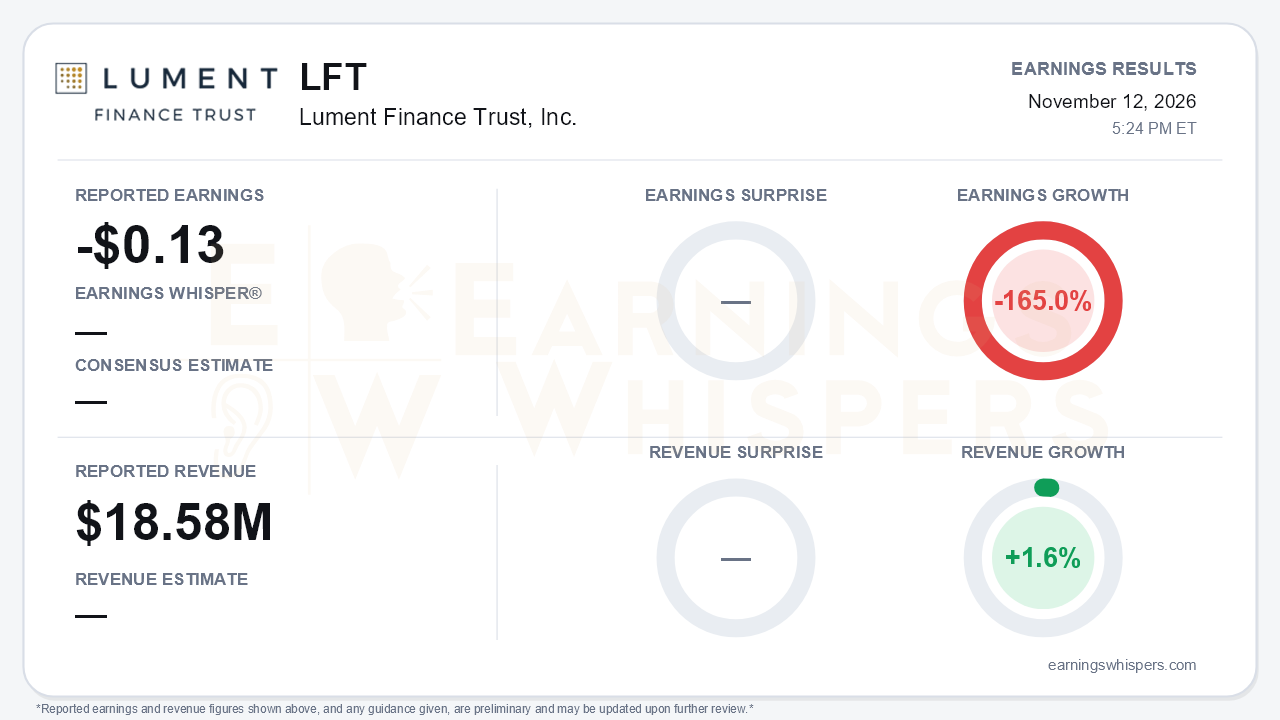
Lument Finance Trust (NYSE: LFT) reported a third-quarter distributable loss of $0.13 per share on revenue of $18.58 million. Earnings fell 165.0% from a year ago, while revenue rose just 1.6%. No consensus estimate was available, so the quarter cannot be judged as a beat or a miss. The more consequential news was elsewhere. The common dividend was suspended to preserve liquidity, GAAP losses widened, and book value fell again. Management also retreated from the deployment timeline it laid out last quarter. For an income-oriented mortgage REIT, losing the dividend changes the investment case more than any per-share figure.
The gap between GAAP and non-GAAP results deserves scrutiny. On a GAAP basis, LFT lost $13.5 million, or $2.57 per share. That compares with losses of $9.2 million in the second quarter and $1.0 million in the first quarter. Nearly all of the $12.8 million difference between GAAP and distributable results came from two items:
- $8.6 million of credit-loss provisions, the same heavy level as in Q2 and Q4;
- $3.9 million of impairments on real estate owned (REO).
Distributable loss did narrow sharply, from $5.3 million in Q2 to $0.7 million. That improvement mostly reflects the absence of the $5.1 million of realized losses booked in Q2, not stronger earnings power. Under LFT's definition, unrealized provisions are excluded from distributable results until losses are realized. The $20.5 million specific reserve and $6.6 million general CECL reserve therefore represent losses that could move into distributable earnings as loans are resolved.
The call showed credit deteriorating on several fronts:
- Loans rated 3 or better fell to 70% of the portfolio from 81% in Q2, and the weighted average risk rating rose to 3.2 from 3.1.
- A new $18 million maturity default moved into the risk-rated-5 bucket.
- Of 12 loans that matured after quarter-end, none were confirmed as paid off.
- REO grew to five properties carried at $77 million, up from four at $61.6 million, with occupancy of 67%.
Book value per share has fallen each quarter on a split-adjusted basis: $30.30 at Q4, $29.70 at Q1, $27.57 at Q2 and $24.97 now. Total equity is down to $191 million from $219 million at Q4.
There were modest offsets. Net interest income edged up to $4.6 million from $4.5 million as the weighted average coupon rose to 706 basis points and extension fees increased. Risk-rated-5 balances also slipped to $94 million from $98 million. Still, net interest income remains well below Q1's $5.7 million. The loan book continues to shrink, to roughly $980 million across 51 loans, versus about $1.1 billion at Q4. That is well short of the roughly $1.4 billion management considers an appropriate deployment level.
The forward story weakened most clearly in tone. Last quarter, management said it was committed to fully deploying capital in 2027 and described improving momentum. This quarter it said only that it hopes to be significantly through the legacy book in 2027, with no firm timeline. The rate backdrop has also turned against borrowers. Management cited the Fed's 25-basis-point hike in September and expects another 25 to 50 basis points in December or the first quarter of 2027, which would pressure refinancing and property values. Other cautionary signals:
- CLO spreads widened modestly.
- Borrower bankruptcies are delaying foreclosures.
- Continuation of the preferred dividend was framed only as a quarterly board decision.
The catalysts are real but narrow. Four REO assets carried at $49.8 million are now held for sale against actual offers, and management says industry-wide sales of non-performing loans and REO are picking up. Management also committed to fuller disclosure of loan maturities in future reports. It called share buybacks mathematically accretive given the discount to book but deferred them behind liquidity. Unrestricted cash dipped to $27 million from $29 million, so buybacks appear to rank below protecting the balance sheet. Some shareholders are now openly calling for a liquidation or sale.
Market context offers limited help this quarter. No current price, sentiment readings or inter-earnings range were supplied. The available reference points also conflict: the opening price after the prior report was $0.66, while the 200-day moving average is listed at $9.44. That mismatch likely reflects the reverse stock split and makes a reliable price comparison impossible from the data provided.
The bottom line is that LFT's narrower distributable loss is a function of timing, not a turn in fundamentals. Credit quality, book value and the deployment outlook all moved in the wrong direction, and suspending the dividend removes the main reason many investors owned the stock. Upcoming REO sales could crystallize value and test whether current carrying values hold. Until those sales close at prices near book and the maturity backlog clears, bears have legitimate ammunition, and pressure for a strategic resolution will likely intensify.
This earnings review was originally published on Earnings Whispers.
This article is for informational purposes only and is not investment advice. Earnings Whispers and its staff may hold positions in the securities mentioned. It is AI-assisted, based on proprietary Earnings Whispers data and company reports, and edited by Earnings Whispers staff.
Mentioned In This Article
Latest News
| Nov-13 | |
| Nov-12 | |
| Nov-12 | |
| Nov-09 | |
| Sep-18 | |
| Sep-09 | |
| Aug-14 | |
| Aug-13 | |
| Aug-13 | |
| Aug-10 | |
| Jul-30 | |
| Jun-10 | |
| May-15 | |
| May-15 | |
| May-12 |
