American Strategic Investment Co.: A New York State Lease Is The Bright Spot, But Cash Interest Still Exceeds Property Income
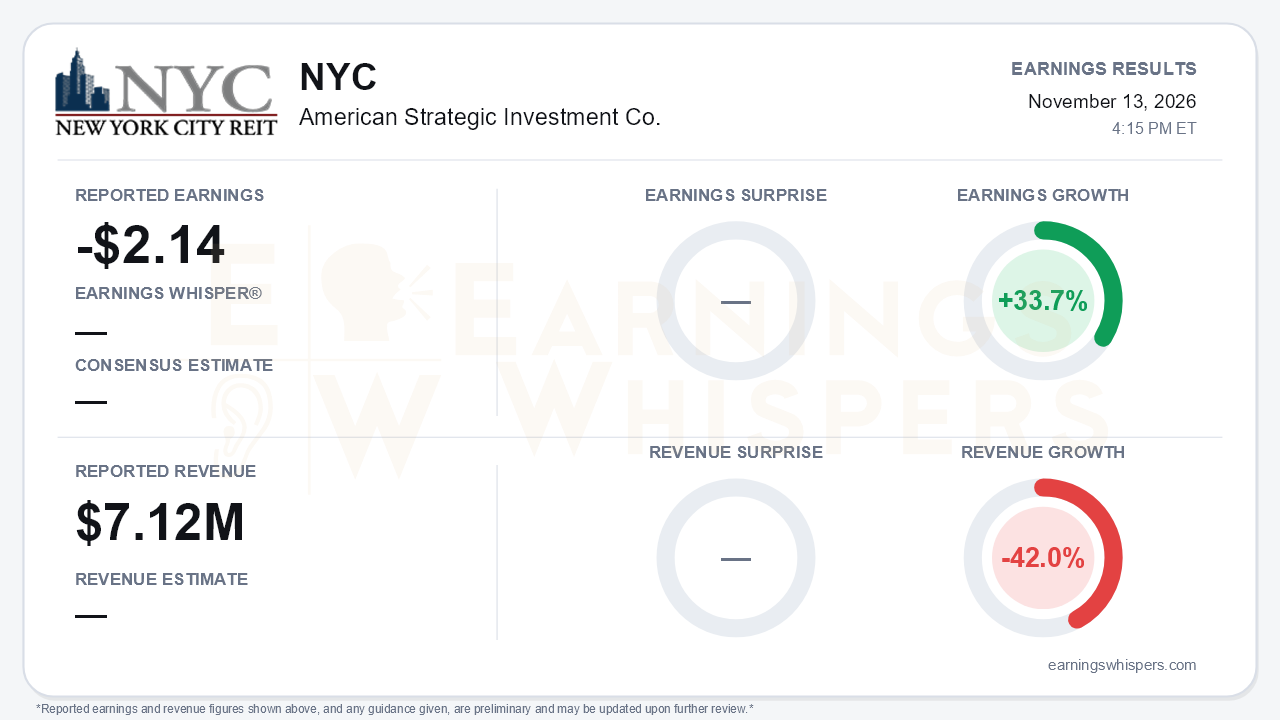
American Strategic Investment Co. (NYSE: NYC) reported a third-quarter loss of $2.14 per share on revenue of $7.12 million. There was no consensus estimate or Earnings Whisper, so the quarter has to be judged on its fundamentals rather than against expectations. Earnings Whispers' normalized comparison shows earnings improving 33.7% year over year, while revenue fell 42.0%. Those figures need context. On a GAAP basis, the company went from net income of $35.8 million, or $13.60 per share, a year ago to a $6.7 million loss. The prior-year profit was driven by a $44.3 million non-cash gain tied to the disposition of 1140 Avenue of the Americas. Investors should not read the normalized improvement as evidence of a recovering earnings stream. The central tension is that the remaining five-property, 0.7-million-square-foot portfolio is stabilizing at the property level, but the balance sheet is still under strain.
The quality of the quarter deserves scrutiny. Cash NOI was $3.5 million, down from $5.3 million a year ago because the portfolio is smaller. Total cash paid for interest was $4.3 million, so the properties are not generating enough cash to cover debt service. Adjusted EBITDA of $961,000 looks positive, roughly half of last year's $1.9 million. However, it includes an add-back of $1.03 million in asset and property management fees paid in stock rather than cash. Without that add-back, the figure is essentially breakeven to slightly negative. The company also recorded a $2.3 million disposition gain that exactly matched $2.3 million of interest expense on the property in receivership. Accrued interest on that receivership property rose to $16.5 million from $9.6 million at year-end.
The financing behavior tells the same story. The external advisor took stock in lieu of $1.12 million of fees in August, and another 244,480 shares were issued in October for $1.41 million of services. Shares outstanding rose from 2.69 million at December 31 to 3.32 million at quarter-end, and more issuance followed. Notes payable to related parties climbed to $3.9 million from $650,000. After quarter-end, the company borrowed another $0.3 million from the advisor for working capital, though it has since repaid that loan. Cash of $5.3 million sits just above the $5.0 million minimum-liquid-assets covenant, although that covenant also counts the $6.2 million of restricted cash. Total equity fell to $47.3 million from $64.8 million, and net debt to gross asset value stands at 58.6%. All debt is fixed at a manageable 4.56% weighted-average rate, but rate is not the problem; maturities and defaults are. The release points to foreclosure litigation over alleged defaults and acceleration on the loan secured by 400 E. 67th Street and 200 Riverside Blvd. It also references efforts to regain NYSE listing compliance.
The conference-call record adds little. The transcript labeled as the third-quarter call largely repeats the first-quarter call, including references to the first quarter and a June annual meeting. The operating figures cited on it therefore differ from this release:
- Adjusted EBITDA of -$1.1 million on the call versus $961,000 in the release
- Cash NOI of $2.8 million versus $3.5 million
The release should be treated as the authoritative third-quarter data. Read that way, Cash NOI improved sequentially from the $2.8 million reported in the first quarter, which is modestly encouraging. Earlier calls also flagged risks that this release did not resolve:
- A weighted-average remaining debt term of only 1.5 years at the end of 2025, with refinancing still being explored
- Planned sales of 123 William Street and 196 Orchard, where the language has softened from active marketing to "reviewing various approaches"
No guidance has been offered.
The genuine catalyst came after quarter-end. On November 3, the State of New York signed an 11-year extension and expansion at 123 William Street. The lease runs to 2037 and adds about 30,000 square feet, bringing the State's footprint to 70,629 square feet. Management says this lifts pro forma occupancy at the building to about 75% and portfolio occupancy to about 78%. That is meaningful, because leased occupancy was 74.0% at quarter-end, below the 80.3% cited at the end of 2025. A long-dated government lease also strengthens the case for either refinancing or selling 123 William. Lease quality remains a support: 69% of top-10 tenant rent comes from investment-grade or implied investment-grade tenants, with a 6.7-year weighted-average term.
There is no current sentiment, price, or technical data available for this report, so the market's reaction cannot be assessed. For reference, shares opened at $8.14 after the August report. Given the dilution from stock-paid fees, per-share value is under pressure regardless of how the stock trades.
The bottom line is that the normalized earnings improvement and the State lease are real positives, but they do not change the core problem. Property cash flow does not cover interest, liquidity depends on paying the advisor in stock, and foreclosure litigation plus near-term maturities remain unresolved. Until management closes an asset sale or refinancing, the investment case rests more on balance-sheet repair than on operating performance.
This earnings review was originally published on Earnings Whispers.
This article is for informational purposes only and is not investment advice. Earnings Whispers and its staff may hold positions in the securities mentioned. It is AI-assisted, based on proprietary Earnings Whispers data and company reports, and edited by Earnings Whispers staff.
Mentioned In This Article
Latest News
| Nov-13 | |
| Nov-13 | |
| Nov-03 | |
| Aug-22 | |
| Aug-12 | |
| Aug-04 | |
| May-15 | |
| May-15 | |
| May-08 | |
| Apr-16 | |
| Apr-15 | |
| Apr-10 | |
| Mar-25 | |
| Mar-09 | |
| Dec-01 |
