ProMIS Beats On A Shrinking Burn, But A $3 Stock Says The Oligomer Thesis Is Now On Trial
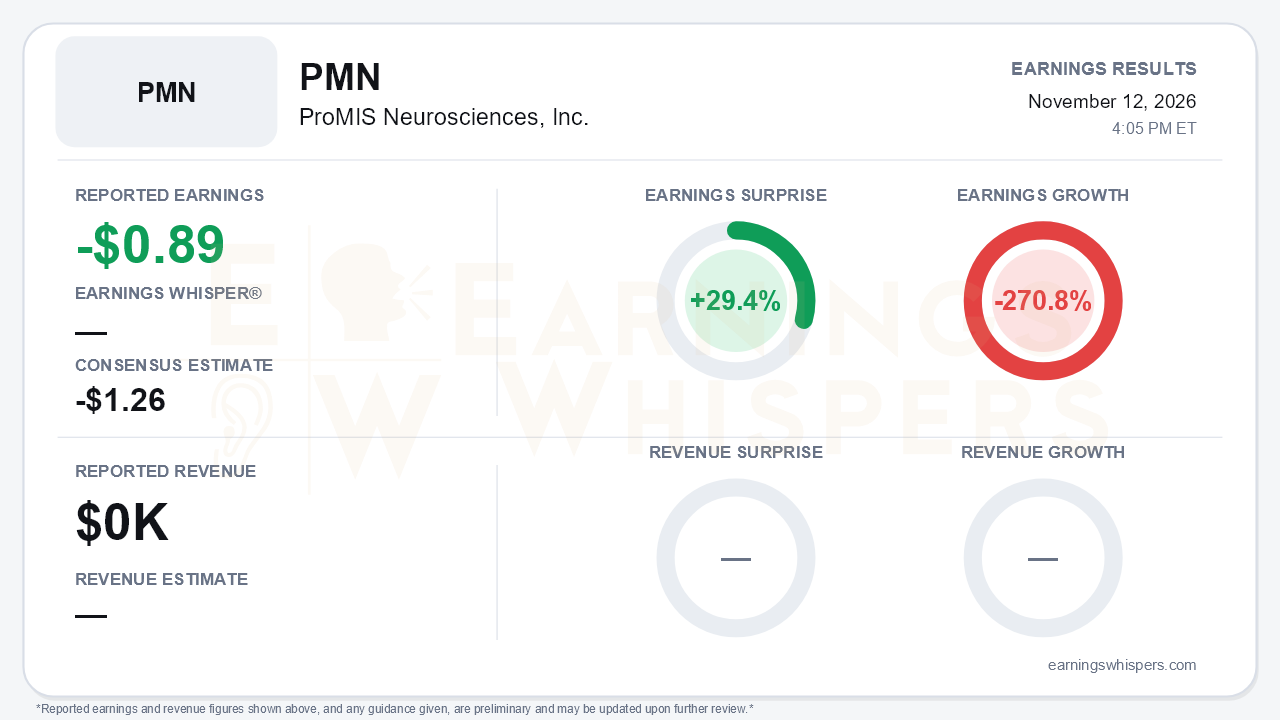
ProMIS Neurosciences reported a third-quarter loss of $0.89 per share, beating the -$1.26 consensus by 29.4%. As a pre-revenue biotech with $0.0 million in sales, the beat says less about the business than about spending. The figure Earnings Whispers tracks for year-over-year earnings growth is -270.8%. The release, by contrast, shows net loss narrowing to $8.2 million from $11.6 million. Per-share comparisons are heavily distorted because the weighted share count jumped to about 9.1 million from roughly 2.0 million after the January 2026 private placement. The central tension is that operating discipline improved while the market's verdict on the stock worsened dramatically. Shares now trade near $3.29, down 78.5% since the open following the August report. With no revenue to anchor the story, the investment case is now almost entirely a bet on the Q1 2027 PRECISE-AD readout.
The quality of the beat is straightforward and mostly mechanical. R&D fell to $6.7 million from $9.5 million in Q2 and $9.8 million a year ago. That 32% year-over-year decline came primarily from a $3.6 million drop in direct PMN310 costs as the Phase 1b trial approached the end of patient visits. G&A eased to $1.9 million from $2.7 million in Q2. Interest income on the larger cash balance rose to about $0.5 million from $0.2 million. None of this reflects a change in the asset's value. It is the natural wind-down of a trial, and it will likely reverse if a registrational study begins. Cash fell to $44.1 million from $53.4 million in Q2, roughly $9 million of burn in the quarter. Management still guides runway through 2027, comfortably past topline data but well short of completing any pivotal program.
The call marked a clear shift in posture. In Q2, management celebrated the July interim data and declined to give numeric efficacy expectations. This quarter it set an explicit bar: roughly 15-20% slowing on CDR-SB or iADRS at 12 months, with ARIA rates near placebo. The press release frames success more loosely, describing directional slowing similar to existing therapies. On the call, though, management put a number on it, which raises the stakes for a roughly 140-patient, 12-month Phase 1b. No new clinical data were disclosed. The interim figures are unchanged from July:
- no ARIA-E;
- ARIA-H of 4.4%, all mild and asymptomatic;
- about a 15% decline in plasma pTau217;
- a 13.3% decline in CSF MTBR-tau243.
Those results remain blinded and pooled, and the CTAD poster re-presents them rather than adding to them. Management's tone was notably more assertive, calling this the most important period in the company's history.
The most consequential external development was the failure of Acumen's oligomer-directed antibody, ACU193, on its primary and secondary endpoints at 18 months. Management argued that ACU193 was not a true test of the oligomer hypothesis, citing its plaque clearance and roughly 10% ARIA-E rate as evidence that it was not genuinely selective. That argument is plausible, but bears have legitimate ammunition. A failed peer readout in the same mechanistic category is exactly the kind of headline that compresses a single-asset story.
On the constructive side, late-stage planning became more concrete:
- Former Biogen and Roche executive Ivana Rubino joined as Chief Commercial Officer.
- An FDA meeting is planned after the full dataset is analyzed, leveraging Fast Track status.
- A registrational study could begin toward the end of 2027, with a subcutaneous arm embedded, subject to FDA feedback. Early subcutaneous work was described as encouraging.
Still, the cost and size of that pivotal trial remain unguided, and whether ProMIS will partner or self-fund is unresolved. The ALS and synucleinopathy programs received little attention compared with Q2.
Investor sentiment remains firmly negative but improved meaningfully, rising to -0.51 from -0.69. That suggests the report and call eased some anxiety without changing the overall skeptical stance. The price action tells a harsher story. Shares sit about 74% below the 200-day moving average of $12.60, and Earnings Whispers price and AVWAP trend readings are negative. The supplied range data reflect a volatile post-report session on November 13, with trading between $2.98 and $3.79; the stock closed near the middle of that band. That is consistent with a market still searching for a floor rather than one re-rating on the beat.
The bottom line is that ProMIS delivered what a clinical-stage company can control: lower spending, a narrower loss, reaffirmed milestones, and a sharper late-stage plan. None of that addresses the question that sent the stock down nearly 80% in a quarter, which is whether oligomer selectivity translates into clinical benefit. By publicly setting a 15-20% efficacy bar after a competitor's failure, management has made the Q1 2027 topline a clearer binary event. Runway through 2027 buys time to reach that readout. It does not resolve how a registrational program would be funded.
Read our earnings preview for ProMIS Neurosciences, Inc.: https://www.earningswhispers.com/article/PMN/22941
This earnings review was originally published on Earnings Whispers.
This article is for informational purposes only and is not investment advice. Earnings Whispers and its staff may hold positions in the securities mentioned. It is AI-assisted, based on proprietary Earnings Whispers data and company reports, and edited by Earnings Whispers staff.
Mentioned In This Article
Latest News
| 14 hours | |
| Nov-12 | |
| Nov-05 | |
| Nov-04 | |
| Nov-03 | |
| Oct-06 | |
| Sep-01 | |
| Aug-14 | |
| Aug-13 | |
| Aug-03 | |
| Jul-28 | |
| Jul-28 | |
| Jul-27 | |
| Jul-14 | |
| May-28 |
