22nd Century Group Delivers Its Long-Promised Inflection, But Credits, Cash Burn And A Quiet Retreat On Distribution Temper The Quarter
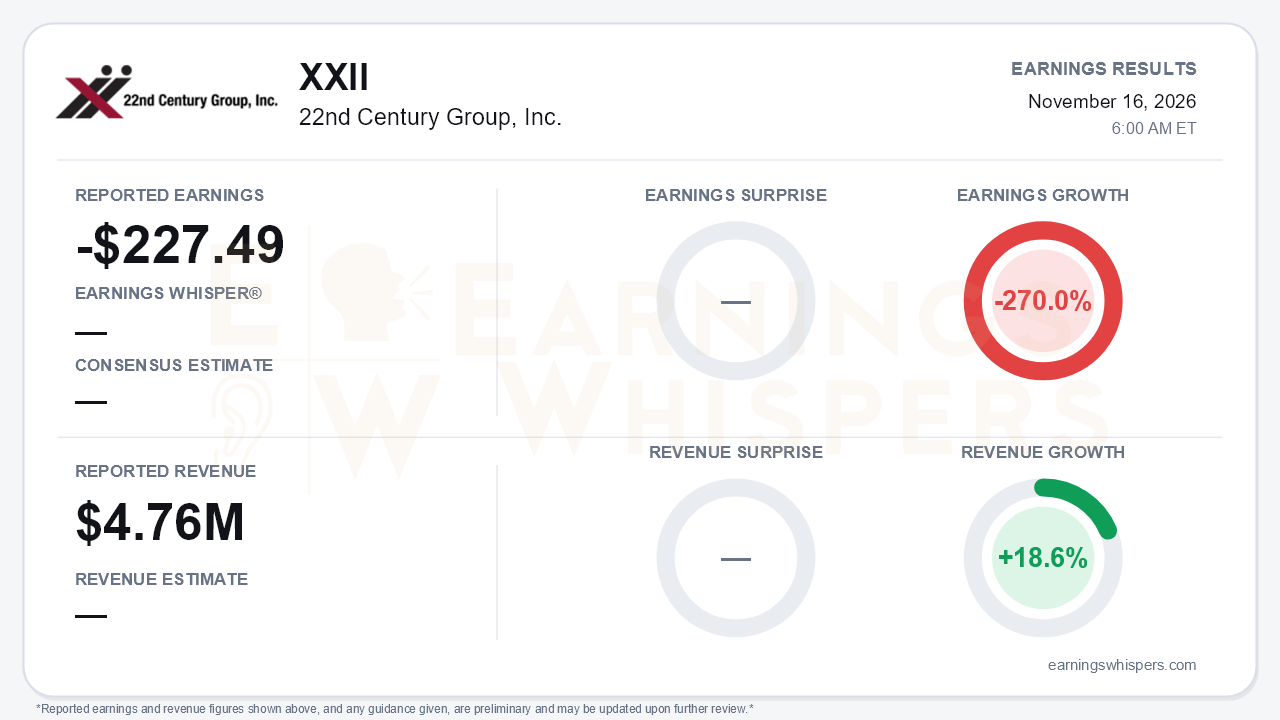
22nd Century Group (NASDAQ: XXII) finally delivered the second-half inflection management has been promising. Third-quarter revenue rose 66% sequentially to $4.76 million, up 18.6% year over year, and gross profit turned positive for the first time in the recent series. Earnings Whispers recorded a loss of $227.49 per share, with earnings down 270.0% year over year. No consensus estimate or Earnings Whisper number was available, so this was not a beat-or-miss quarter. The real question is whether the operating turn is durable. The release answers that only partially, and the call raised as many questions as it settled.
Per-share figures are close to meaningless here. Weighted average shares rose from 191 a year ago to 11,271, and the release's summary table shows continuing-operations loss per share as $(3.92) versus $(313.79), which conflicts with the $(227.49) on the income statement. Dollar results are more instructive. The net loss from continuing operations narrowed to $2.56 million from $3.76 million a year earlier and $3.3 million in the second quarter. The operating loss improved to $2.6 million from $3.3 million sequentially.
The quality of the gross-profit turn deserves scrutiny. The $446,000 gross profit included $550,000 of master settlement agreement credits booked against excise taxes, which management strips out of Adjusted EBITDA. Without those credits, gross profit would have been roughly break-even to slightly negative. That is still a clear improvement from gross losses of $0.3 million in Q2, $0.6 million in Q1 and $0.8 million in the fourth quarter of 2025, but it is not yet a clean margin story.
The revenue mix matters too. Cigarette revenue rose to $3.9 million from $2.3 million on more cartons and better pricing. Most of it came from contract manufacturing, as the company shifts away from low-priced export customers toward higher-margin natural-style products. Year over year, cigarette cartons fell to 131 from 345 while revenue climbed, a genuine pricing and mix improvement.
The strategic product, VLN, generated just $32,000, flat with Q2. Management attributed that to price promotions aimed at trial. It highlighted a 166% sequential jump in point-of-sale pack sales at its retail launch partner as evidence of consumer adoption, but that has not yet shown up in reported VLN revenue.
Management's tone shifted noticeably. Executives said the company is "firmly in growth mode," with restructuring "substantially behind us," a contrast with Q2's admission that improvement had been slower than planned. The positive developments were real:
- 150 more stores in metro New York and northern New Jersey
- approvals in 13 additional states
- six Pinnacle Pure SKUs
- a planned fourth-quarter launch on Gopuff's delivery platform
Yet the call also showed a quiet retreat:
- The year-end target of roughly 5,000 stores across about 35 states, reiterated on the first- and second-quarter calls, was not repeated.
- The retail footprint was described as 23 states via the #3 retailer, the same state count cited in the fourth quarter of 2025.
- The #2 retailer remains Illinois-only, and a Southeast retailer flagged in Q1 went unmentioned.
- The addressable-market framing slid from about $58 billion to about $35 billion, while the release cites a $50 billion U.S. cigarette market.
Bears have legitimate ammunition there.
The balance sheet is the other pressure point. Cash fell from $9.5 million in Q1 to $6.1 million in Q2 and $3.9 million at quarter-end. After the quarter, an at-the-market offering raised $5.8 million net, of which $1.2 million redeemed Series B preferred, leaving roughly $8 million pro forma. Management describes runway as "well into 2027." The company has also eliminated all warrants, lifted its baby-shelf limitation and freed up a $250 million shelf. That simplifies the cap table, but it also makes further equity funding easier. Common shares outstanding rose to 20,032 from 391 at year-end, and that dilution remains the price of the turnaround. Costs are also not yet disciplined on a year-over-year basis. Operating expenses were $3.0 million versus $2.2 million a year ago, and the nine-month Adjusted EBITDA loss of $8.3 million is worse than $7.8 million in the prior-year period. One sourcing conflict: the release compares Q3's $2.2 million Adjusted EBITDA loss with $2.9 million, which matches the prior-year quarter, while the call analysis puts Q2 at $3.5 million.
Market data offers limited context. No current sentiment reading or post-report price was supplied. Shares opened at $4.33 after the August report, against a 200-day moving average of $156.97. That gap reflects years of severe value destruction and capital restructuring.
The bottom line is that 22nd Century showed real sequential progress: revenue rebounded, losses narrowed and the capital structure is cleaner. However, the positive gross profit leaned on settlement credits, VLN revenue remains negligible, the distribution targets went silent, and the business still depends on equity issuance to fund its burn. The next test is whether Gopuff and the retail sell-through data translate into reported VLN revenue before the new cash runs down.
This earnings review was originally published on Earnings Whispers.
This article is for informational purposes only and is not investment advice. Earnings Whispers and its staff may hold positions in the securities mentioned. It is AI-assisted, based on proprietary Earnings Whispers data and company reports, and edited by Earnings Whispers staff.
Mentioned In This Article
Latest News
| Nov-16 | |
| Nov-16 | |
| Nov-16 | |
| Nov-16 | |
| Nov-03 | |
| Oct-29 | |
| Oct-28 | |
| Oct-26 | |
| Oct-22 | |
| Oct-15 | |
| Sep-28 | |
| Sep-24 | |
| Sep-01 | |
| Aug-18 | |
| Aug-13 |
