Jensen Leaves Void at Nvidia Ahead of Earnings, What's Next?
Stocks had already entered a period of rising volatility in recent weeks, led by sharp selling across the AI sector, only for the turmoil to intensify when Nvidia CEO Jensen Huang became embroiled in a scandal that led to his abrupt resignation.
Huang has not only been the visionary leader of Nvidia, transforming the company from a leading designer of gaming GPUs into the most important semiconductor company powering the AI boom, but also a key source of financing and strategic support for the broader AI ecosystem.
Despite the salacious details surrounding the scandal, including allegations involving at least two high-ranking Nvidia executives and a suspected Chinese spy, prominent Silicon Valley figures and supporters of Huang have been campaigning for his return. President Trump has also weighed in on the controversy, adding another layer of intrigue to an already extraordinary situation.
Further raising the stakes, Nvidia (NVDA) reports quarterly earnings Tuesday after the market close. Analysts expect another exceptionally strong quarter, with consensus estimates calling for a roughly 91% increase in revenue to $108.9 billion and a 90% increase in earnings per share to approximately $2.47.
But the real tension extends well beyond the quarterly numbers. Who, if anyone, can replace Jensen Huang? Could his absence threaten the broader AI boom? What are the implications for the world's leading AI chip designer? And how might investors respond if he were reinstated as CEO?
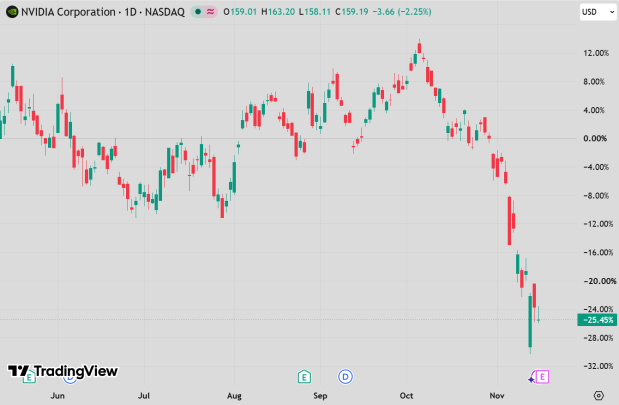
Image Source: TradingView
Nvidia and Huang’s Ascent to Rock Stardom (and Ensuing Demise)
Nvidia was founded in April 1993 by Jensen Huang, alongside Chris Malachowsky and Curtis Priem, and spent much of its early history operating in relative obscurity.
As a designer of graphics processors primarily used in video games, Nvidia was well known within the gaming industry and increasingly recognized on Wall Street. By 2020, Huang had built the company into a semiconductor giant worth more than $300 billion, an extraordinary accomplishment in its own right.
But even before the general public became aware of the enormous opportunities presented by artificial intelligence and large language models, Huang had been positioning Nvidia to capitalize on them.
Beyond developing the GPUs that would eventually become essential for training and running AI models, Nvidia had spent years building a formidable competitive advantage through its CUDA software platform.
First introduced in 2006, CUDA allowed developers to use Nvidia's GPUs for computational tasks far beyond graphics processing. Huang spent the following decade and a half championing accelerated computing, investing heavily in an ecosystem that would eventually become one of the company's greatest competitive advantages.
Then, in late 2022, that long-term vision collided with the breakthrough of OpenAI's ChatGPT.
Suddenly, the demand for computing power exploded, and Nvidia found itself at the center of what would become one of the largest technology investment cycles in history.
Huang transformed from a relatively unknown semiconductor executive into a rock-star CEO, instantly recognizable for his signature leather jackets and increasingly influential in Washington.
Between the beginning of 2023 and October 2026, Nvidia's market capitalization increased more than fifteenfold, briefly approaching $6 trillion and becoming the world's most valuable publicly traded company.
However, shares have since fallen roughly 35% from their record highs, reflecting both the broader correction in AI stocks and the uncertainty surrounding Huang's departure.
Looking back, one of the first major geopolitical challenges came in 2022, when the Biden administration imposed restrictions on exports of advanced semiconductors to China. Those restrictions would become an increasingly contentious issue for Nvidia, with Huang pushing to preserve access to the Chinese market while navigating national security concerns in Washington.
In hindsight, those tensions also help illustrate how Huang's role had expanded far beyond running a semiconductor company. He had become one of the most influential figures in the global AI industry, operating at the intersection of technology, finance and geopolitics.
And that brings us to the challenge facing Nvidia today.
Huang was truly a one-man wrecking machine, building and managing Nvidia in a way that few founders of companies this size ever have. Perhaps the closest comparison is Elon Musk, another founder-led executive whose personal vision and involvement are deeply embedded in nearly every aspect of the business.
Huang was famously involved in everything from product development and engineering to customer relationships and government policy. His unusually flat management structure, which at times included approximately 60 direct reports, allowed information to move quickly throughout the organization and gave him direct visibility into the company's operations.
That structure was particularly effective under a founder with Huang's technical expertise, institutional knowledge and ability to make decisions quickly.
But it also creates a serious succession challenge.
With Huang gone, Nvidia must determine whether that same organizational structure can function effectively without the individual around whom it was built. A new CEO may need to introduce additional layers of management, delegate more responsibility and fundamentally rethink how decisions are made.
And with Nvidia approaching one of its most closely watched earnings reports, investors have to consider not only the company's financial outlook, but also the unlikelihood that a new leader will maintain the execution and strategic direction that made Nvidia so successful.
Jensen Huang as a Key Source of Liquidity for the AI Boom
Beyond the uncertainty surrounding Nvidia's leadership, the broader AI ecosystem may also be approaching a critical juncture.
Along with building Nvidia into the semiconductor giant it is today, Huang played an important role in financing the broader AI boom. Under his leadership, Nvidia invested billions of dollars in emerging AI companies, helping fund the infrastructure expansion that has driven much of the industry's growth.
Some of these arrangements attracted criticism for resembling circular financing, where Nvidia would invest in companies that subsequently used that capital to purchase its GPUs.
This was particularly important for the emerging group of AI infrastructure providers known as neoclouds, including CoreWeave (CRWV) and Nebius (NBIS). These companies became major buyers of Nvidia's chips, building enormous computing clusters that could then be rented to AI developers and enterprises.
These investments helped accelerate the AI infrastructure buildout, but they also raised questions about how much demand was being supported by Nvidia's own financing.
Ultimately, markets come back to liquidity. In recent years, several powerful forces have supported equity prices, particularly fiscal deficit spending, accommodative financial conditions and the extraordinary capital expenditures of the major technology hyperscalers.
Together, these have provided a substantial tailwind for AI stocks and the broader market.
Now, with Huang stepping away, another important source of financing and confidence in the AI ecosystem faces uncertainty. Nvidia's investment commitments won't necessarily disappear, but its future appetite for funding customers and emerging AI companies could change considerably under new leadership.
Combined with what appears to be a renewed tightening cycle from the Federal Reserve, this raises the possibility that several of the liquidity drivers supporting the AI boom could weaken simultaneously.
Reports to Brings Back Jensen to Nvidia’s Helm
Despite the scandal, a growing movement of Silicon Valley executives, investors and Nvidia employees is pushing to bring Huang back as CEO.
A petition calling for his reinstatement has attracted more than 177,000 signatures, including prominent figures such as Elon Musk. Meanwhile, major technology investors have urged Nvidia's board to reconsider its decision, and Huang himself has reportedly discussed the possibility of returning.
Even President Trump weighed in this morning, saying he wouldn't mind seeing Huang reinstated and suggesting that the former CEO had learned a valuable lesson.
However, I think the prospects of a return are dwindling, as a risk-averse approach becomes the clearer path forward for Nvidia’s board. And even if Huang does return, it seems the damage to his reputation is permanent.
The iconic leather-jacket-wearing visionary, who commanded enormous influence across Silicon Valley and Washington, has lost much of his luster. I expect Huang will continue to play an important role in the AI industry, whether formally or behind the scenes, but I think it is unlikely he returns to lead Nvidia.
More importantly, even if he does, the old Jensen Huang is effectively gone. The extraordinary combination of credibility, influence and almost unquestioned confidence that defined his leadership cannot simply be restored. Whatever comes next, I don't think we will see that version of Huang again.
How Can Investors Invest in this New Market Environment
I have noted in several commentaries over the last week that the market appears to have entered a new regime.
We first saw the memory cycle, led by Micron Technology (MU) and Sandisk Corporation (SNDK), peak over the summer, followed by a broader rollover in technology stocks beginning in October. Then came the midterm election results, which, despite being largely anticipated, unsettled the markets, and finally the scandal surrounding Jensen Huang.
At the same time, the Federal Reserve has begun a new interest rate hiking cycle, as inflation not only persists but is showing signs of broadening beyond energy prices.
For investors who have remained heavily exposed to the increasingly wide universe of AI stocks, the last few years may have felt almost easy. Abundant liquidity, genuinely exciting technology and extraordinary revenue and earnings growth helped carry stocks higher. But some of those supporting forces now appear to be retreating.
What initially looked like a series of isolated risk events has developed into something resembling a broader macroeconomic shift. Of course, very little happens in isolation in financial markets, particularly given the interconnected nature of today's financial system and the enormous capital commitments supporting the AI boom.
Defensive areas of the market have clearly taken the lead, with healthcare, financials, consumer staples and value stocks demonstrating notable relative strength.
Energy stocks have also remained among the strongest performers, despite increased volatility, as geopolitical tensions in the Middle East raise the possibility of further disruptions to oil supplies.
For Nvidia and the broader market, the outlook is increasingly uncertain. I don't think this necessarily signals the beginning of a prolonged bear market, but it does suggest that the investment environment may look considerably different from what investors have become accustomed to.
For now, I favor a more selective approach, focusing on companies with durable business models, improving earnings estimates and strong relative price performance. There will still be opportunities in AI, but investors may need to look beyond the stocks and strategies that worked so well during the previous phase of the bull market.
Want the latest recommendations from Zacks Investment Research? Today, you can download 7 Best Stocks for the Next 30 Days. Click to get this free report
Micron Technology, Inc. (MU): Free Stock Analysis Report
NVIDIA Corporation (NVDA): Free Stock Analysis Report
Sandisk Corporation (SNDK): Free Stock Analysis Report
Nebius Group N.V. (NBIS): Free Stock Analysis Report
CoreWeave Inc. (CRWV): Free Stock Analysis Report
This article originally published on Zacks Investment Research (zacks.com).
Mentioned In This Article
Latest News
| 5 min | |
| 7 min | |
| 8 min | |
| 11 min | |
| 24 min | |
| 26 min | |
| 30 min | |
| 32 min |
TSMC Slumps Nearly 6% as Jensen Huangs Exit and AI Debt Fears Rattle Investors Ahead of Nvidia Earnings
NVDA
Benzinga Prediction Markets
|
| 34 min | |
| 38 min | |
| 43 min | |
| 45 min | |
| 46 min | |
| 1 hour | |
| 1 hour |
