Tyson Foods Misses On Earnings Despite Revenue Beat As FY27 Guide Resets Profits Lower And Chicken Rolls Over
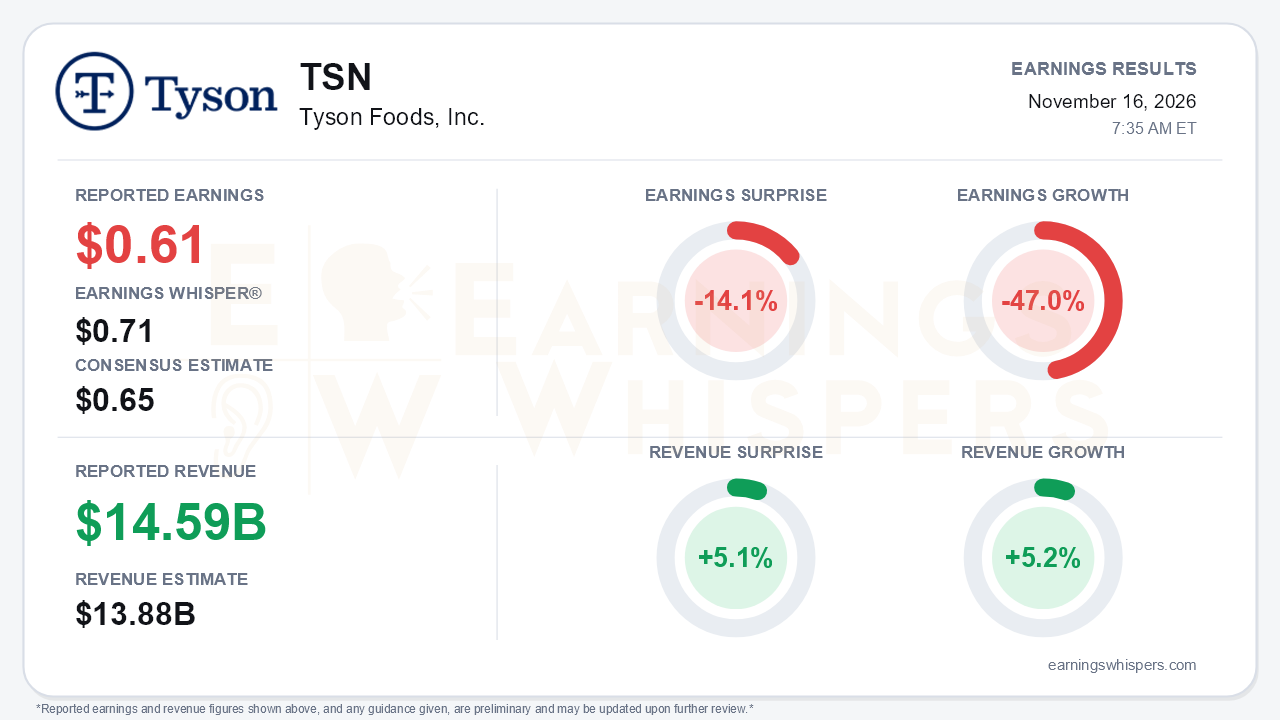
Tyson Foods delivered a fiscal fourth quarter where the top line and the bottom line pointed in opposite directions. Adjusted earnings of $0.61 per share fell short of the $0.65 consensus and well short of the $0.71 Earnings Whisper number, a 14.1% miss, and were down 47.0% from a year ago. Revenue of $14.585 billion beat the $13.88 billion consensus by 5.1% and grew 5.2% year over year. The revenue strength is not the story. The central takeaway is that Tyson's fiscal 2027 outlook resets earnings lower. The chicken and pork businesses that carried fiscal 2026 are now guided down, and the long-awaited beef recovery offsets only part of that decline.
The quality of the quarter deserves scrutiny. Sales growth paired with a near-halving of per-share earnings points to margin compression across the protein complex. Chicken segment operating income fell to $389 million, an 8.7% margin. That compares with $488 million (11.2%) in the third quarter and $523 million (12.2%) in the second, so the decline built steadily through the year. Pork earned just $16 million versus $47 million as belly prices fell faster than hog costs. Beef lost $171 million, including an $80 million live-cattle inventory write-down. Full-year adjusted operating income of $1.98 billion missed the $2.1 to $2.3 billion range given with third-quarter results and was well below the $2.2 to $2.4 billion targeted after the second quarter. Management said the result matched its September commentary, but the trajectory from raised guidance in the first half to a shortfall by year end is hard to ignore. Full-year adjusted EPS of $3.44 compared with $4.12 in fiscal 2025.
The bright spots were real. Prepared foods posted a record $1.33 billion in segment operating income for the year, and its fourth-quarter margin reached 12.6%, up 170 basis points. The segment gained volume share in 45 of 52 weeks and grew distribution points 4.4%. Free cash flow reached $1.7 billion, the top of the guided range and roughly $490 million better than the prior year. That funded $427 million of buybacks, including $300 million in the fourth quarter alone, plus another $93 million after year end. The quarterly dividend rose 2% to $0.52.
The guidance is where the setup changes. Management projects fiscal 2027 sales down 3.5% to 5.5% and adjusted operating income of $1.7 to $2.15 billion. The midpoint is flat to down from fiscal 2026, a contrast with third-quarter messaging that 2027 would look similar to 2026, with growth. The segment guides tell the story:
- **Chicken:** $1.3 to $1.6 billion, versus $1.86 billion in fiscal 2026, as industry cutout values fall about 25% and grain, freight and storage costs rise. The earlier argument that Tyson is "not a commodity company" has softened to one where volatility is cushioned but not eliminated.
- **Pork:** $75 to $175 million, versus $228 million.
- **Prepared foods:** roughly flat at $1.25 to $1.4 billion, despite earlier talk of profit growth.
- **Beef:** a loss of $300 million to a profit of $100 million, versus a $654 million loss.
Capital expenditures rise to $1.1 to $1.4 billion from $770 million, which cuts the free-cash-flow outlook to $0.8 to $1.3 billion.
Beef is the credible upside lever. Several developments support it: a long-term cattle supply partnership with Allied Beef, a full reopening of the Amarillo second shift by summer, a reopened Mexican border that could supply up to roughly 800,000 head, and early heifer retention of about 3%. A possible sale of the Pasco, Washington, beef plant fits the network-optimization theme. New CEO Jeff Schomburger laid out a strategy built on consumer-preferred products, joint planning with the top 25 customers and AI-driven cost reduction, with new share and household-penetration metrics tied to incentives. He also called the company's innovation success rate subpar and said fixing those capabilities will take one to two years to show up in results. That candor is useful, but it signals patience rather than a near-term catalyst. Food service softness and bacon category declines add to the near-term drag.
The market setup is more complicated than the miss implies. Investor sentiment improved meaningfully into the report, rising from 0.19 to 0.43. Shares rallied about 17.7% off a 52-week low of $49.96 set October 1 and touched $61.62 on November 10. At $58.82, the stock sits 5.2% above the open after the prior report but remains just below its $59.51 200-day moving average. The rally and the rise in sentiment left expectations elevated heading into a guide that steps earnings down.
The bottom line is that Tyson traded a strong fiscal 2026 in chicken and pork for a fiscal 2027 that depends on beef healing faster than those segments decline. Prepared foods and cash returns provide a floor, but bears have legitimate ammunition: an earnings miss, a lower profit outline, heavier capex, and a new CEO who says the rebuild will take time. That is a difficult combination for a stock that rallied hard and saw optimism climb into the print.
Read our earnings preview for Tyson Foods, Inc.: https://www.earningswhispers.com/article/TSN/23062
This earnings review was originally published on Earnings Whispers.
This article is for informational purposes only and is not investment advice. Earnings Whispers and its staff may hold positions in the securities mentioned. It is AI-assisted, based on proprietary Earnings Whispers data and company reports, and edited by Earnings Whispers staff.
Mentioned In This Article
Latest News
| Nov-16 | |
| Nov-16 | |
| Nov-16 | |
| Nov-16 |
Tyson, Starbucks Lead The S&P 500, Nasdaq 100 As Investors Play Defense
TSN +8.72%
Investor's Business Daily
|
| Nov-16 |
Investors Cheer Tyson Foods' Plan to Close Plants, Sell Less Beef
TSN +8.72%
The Wall Street Journal
|
| Nov-16 | |
| Nov-16 | |
| Nov-16 | |
| Nov-16 | |
| Nov-16 |
Tyson Foods Guides for Sales Decline as Beef Business Remains Under Pressure
TSN +8.72%
The Wall Street Journal
|
| Nov-16 | |
| Nov-16 | |
| Nov-16 | |
| Nov-16 | |
| Nov-10 |
